



















Greater levels of flexibility are needed to align supply and demand across the UK’s electricity grid as it transitions to low carbon energy. Faye Banks and Simon Rawlinson of Arcadis examine how new investment is being directed to deliver a whole-system solution
01 / Introduction
Network flexibility is a foundational capability of a reliable, low carbon electricity system. The UK’s decarbonisation trajectory relies on increased use of renewable power. This will create a three-way challenge for the network: provision for more variable demand, network stability, and managing a much more complex system of generators and users. If the government’s objective of maximising the use of low-cost, low carbon energy is to be met, then network flexibility will play a critical role.
The problem that flexibility solves is demand shift and supply shift – managing the growing mismatch between when electricity is generated and used. Solutions including storage, smart grids, standby generation and load reduction all play a role in enabling a more flexible grid. Alongside the need for flexibility, there is a growing requirement for network services, including balancing, frequency control, variability, and capacity to enable the robust and economic operation of the grid.
The UK has always had a flexibility market. Gas-fired power stations and pumped-hydro storage have long been used to boost supply in response to peaks of demand. The type of flexibility needed is now evolving, with a greater emphasis on long-duration storage to avoid curtailment of wind energy.
However, strategic planning for flexibility has been up-ended by the AI revolution. The latest generation of data centres have high-density 24/7 power demands that challenge a system built on intermittent energy sources. Furthermore, data-centre demand for connections risks crowding out the new generation and storage that the system needs. Critically, as demands on the network and its operation become less predictable, the opportunities for flexibility services will grow – correcting gaps between forecast supply and demand in real time.
Growing demand for energy shift has created a wide range of markets for grid and network services. Indeed, Centrica’s CEO, Chris O’Shea, recently claimed that system charges including network services will account for over 60% of total electricity costs by 2030. A diverse revenue stack has given investors plenty of opportunity, with 60GW of short-duration storage at present competing for 35GW of connection capacity.
As the whole energy system becomes more digitally enabled, commercial and domestic consumers can also participate in a market known as customer-led flexibility (CLF). New low-power market integrators are creating “virtual power plants” enabling photovoltaic (PV) systems, batteries, and even electric vehicles (EVs) to play a significant role in delivering the flexible grid.
This article examines the UK’s flexibility strategy and how this interacts with other network service requirements. We examine the technologies and how business models are evolving to attract new sources of investment into flexibility services.
02 / The UK flexibility strategy
The UK first launched a net-zero flexibility strategy in 2021, meaning that many of the building blocks are in place for a rapid expansion of capacity.
The national flexibility strategy helps to address four critical use cases:
- Time of use – this is the energy shift requirement, diverting consumption from peak periods to optimise network capacity, and storing unused energy to make best use of generating assets. Time-of-use agreements can be agreed years in advance or can be triggered by intra-day energy markets.
- Network constraint management, dealing with grid-scale bottlenecks. This can be addressed using technology and financial incentives in the short term but may ultimately require network reinforcement.
- Access products – connection delays are a major development constraint. Accelerated connection enables a network supply based on a curtailed service for an agreed period.
- Local constraint markets – these manage capacity problems without the need for new network investment, by enabling control of local generation, storage and energy management assets such as battery storage or smart devices.
As described in the introduction above, the drivers for flexibility are well understood, including the intermittent nature of new supply and the mismatch in the location of supply and demand, which creates network constraints. However, new sources of uncertainty have been added to the mix, including the explosive demand for new grid connections, on the one hand, and the slower-than-expected take-up of EVs and heat pumps on the other.
The current plan, the Clean Flexibility Roadmap, which was jointly published in 2025 by the Department for Energy Security and Net Zero (DESNZ), Ofgem and the National Energy System Operator (NESO), sets out an array of ambitious targets including an eightfold increase in clean flexibility capacity by 2050. This will involve a wide range of technologies, from grid-scale storage (23GW-27GW by 2030) to CLF, which is targeted to provide 75GW of capacity by 2050, mainly through the adoption of two-way “V2X” connections that enable EVs to be used as a back-up power resource.
The strategy is complex and dynamic, requiring a whole-system approach that unites the grid operators and generators at the top and individual consumers at the bottom, by selling back home-generated energy. Key players include:
- System operators (SOs) operate at the level of the national grid and regional distribution grids. SOs manage the grid in real time, forecasting consumption, balancing electricity flows, and managing energy markets. SOs control the markets and payments that incentivise other players to participate.
- Grid scale providers include power generators, network operators, storage suppliers and interconnectors connected at the transmission level. The electricity network is operated as a system but provides multiple markets for services ranging from the sale of energy, the guarantee of capacity or the provision of reserve as a service.
- Distributed energy resources (DER) are connected close to the load on the distribution network. Some of this storage is funded by energy users at a commercial or residential scale and is positioned “behind the meter” of the storage owner. Increasingly the scope of DER includes smart devices such as EV chargers that can be dialled up and down to add to network flexibility.
- Intermediaries consolidate the smart, connected energy market across the system. Elexon manages a platform and APIs (application programme interfaces) that enable the visibility of all registered flexibility assets, enabling the “virtual power plant”.
03 / Flexibility solutions
The UK’s electricity flexibility system has four main component parts, each comprising many different components and solutions. As flexibility requirements evolve, the system will continue to grow in complexity.
- Supply Flexibility in supply includes fast-acting storage such as batteries and pumped storage. Other aspects of the supply solution include stability services provided by the smart grid and long-duration balancing of supply and demand using low carbon technologies such as power with carbon capture use and storage (CCUS) or hydrogen.
- Demand Flexibility demand focuses on load shift. This includes incentives to switch loads to off-peak periods and load-capping agreements for industrial customers that enable connections to be accelerated on constrained networks.
- Transmission The grid needs flexibility to cope with large- and small-scale fluctuations in demand. Interconnections with the EU and Ireland bring much-needed additional capacity to the grid, while modern power-flow controls enable the network to actively respond to problems of congestion, instability and inefficiency.
- Digital systems The smart grid has a key role in enabling flexibility. The role of digital systems includes forecasting to match supply and demand, operational management, and payment for flexibility services including low-cost, off-peak tariffs. Given the connected nature of the flexible grid – potentially linking every connected asset and smart device, cyber‑security is also a major priority.
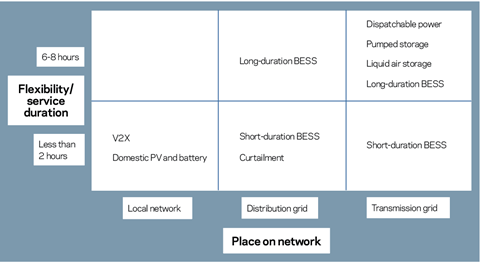
Requirements for flexibility across the grid are increasingly complex, with different technologies serving different requirements at each level of the network. The diagram highlights two main factors that determine technology suitability – position within the network and duration of response, both of which contribute to determining the scale of the installation.
Local energy networks
Local energy networks are at the bottom of the flexibility hierarchy but will play an increasing role as domestic use of EVs and heat pumps grows, increasing loads at the far edge of the grid. Local area networks will feature a combination of small- to medium-scale PV, battery and wind power installations combined with connected consumer devices including batteries, EVs and smart devices that can be combined to manage network load at a local level. Local energy networks are an emerging technology that will be boosted by the recent Low Power Plan, which is directing £1bn of funding towards the development of community-level local energy initiatives.
Short-duration storage
Short-duration storage comprises utility-scale installations that provide one to two hours of back-up power. The solution of choice is BESS – battery energy storage systems, typically using a lithium-ion technology. BESS provides back-up power and network stability services and can also be installed by industrial users to enable peak-shaving and load-shifting to mitigate network constraints. Short-duration storage has proven incredibly popular with investors; 7GW has been installed so far and 45GW is either consented or in construction. As a result, demand has exceeded available grid connections and developers are pivoting to the long-duration storage market. Short-duration BESS also has a ready market as a behind-the-meter solution for energy consumers.
Long-duration storage
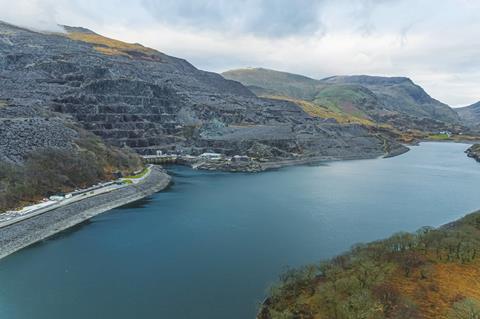
Pumped storage currently fulfils the UK’s need for long-duration storage, which is a requirement for sustained output over eight hours. The UK has 2.8GW of operational capacity, dating back from the 1980s. A total of 5GW to 10GW is needed by 2035, and a newly developed support mechanism was introduced in 2026, based on a cap and floor price guarantee model. This has attracted a lot of interest from BESS developers, which have submitted 48 proposals totalling 20GW. Other technologies under consideration include a range of compressor-based technologies, such as liquid air storage, which are not exposed to risks associated with long-term deterioration of the capacity of batteries. The key challenge is the financial viability of these solutions and their attractiveness to investors.
Long-duration dispatchable power
Dispatchable power is designed to be ramped up and down in response to NESO demand. This capability is currently provided by gas-fired power stations, with around 8GW of capacity secured for periods of low renewables generation including the “dunkelflaute” phenomenon of prolonged low wind. Long-duration power will always be needed; over 50GW of capacity is targeted by 2050, and a new generation of zero carbon solutions is being brought forward including gas-fired power with CCUS. Unlike long-duration storage, the business model is yet to be finalised, but the technology represents one of the biggest long-term opportunities for the infrastructure sector.
>> Click here for more infrastructure market reports
Opportunities for domestic consumers
One surprising aspect of the UK’s flexibility strategy is the planned scale of participation by domestic consumers. Domestic consumers provided 1.6GW of flexibility in 2024, and this is expected to grow to 10.6GW by 2030. By 2050, consumers could be providing 75GW of flexibility, mainly through their EVs providing V2X services.
Currently domestic CLF is mostly provided by load-shifting using PV, batteries and smart devices. Some 2.6 million UK consumers are on flexible tariffs, which reportedly enable consumers to shift around 50% of peak demand to off-peak consumption, saving on bills as well as on network capacity. Although the industry is working hard to develop “no-effort flexibility”, based on automated energy transfers, another 2 million users have participated in demand flexibility services by manually turning down power on request.
The further evolution of CLF is dependent on continuing investment and market reforms. PV uptake is rising as solar arrays become standard on new-build homes, but only 200,000 UK homes have battery storage. Further developments in system security and system interoperability are probably needed before consumers can play a full role in the UK’s flexibility market.
04 / How grid flexibility is financed and funded
The UK’s energy system is almost completely privately owned and funded. Given the long-term nature of investments into the grid, payment models designed by government play a critical role in attracting investment into the sector. Most energy used on the grid is purchased on long-term four-year and one-year agreements providing investor certainty, but when consumption deviates from forecast levels, additional pricing signals are used to bring more power on line, or to reduce consumption.
As the flexibility system has evolved system-wide, the range of services that owners can provide has broadened and the number of opportunities to access revenue streams has increased. The so-called “revenue stack” enables investors to diversify their income but creates an additional challenge for NESO in that a service provider can vary the flexibility services that their asset provides. Payment is made based on consumption or on availability – reserve capacity paid to be immediately available in case of a stress event.
A critical distinction in the flexibility market describes services that are funded solely by market revenues, and those that benefit from price support. Renewable generation including wind and solar have benefited from contract-for-difference (CfD) arrangements that provide a price guarantee to attract investment, and similar arrangements will be needed to make long-duration storage and clean dispatchable power bankable.
Cap and floor arrangements are common for the generating elements, although the regulated asset base (RAB) model is being used to fund the transport and storage infrastructure for CCUS.
By contrast, short-term storage like BESS is provided on a merchant basis, relying solely on trading revenues. The energy market has been designed to provide enough opportunities to enable profitable operation. One of the essential elements is arbitrage, where battery operators charge batteries at low off-peak rates and sell at peak rates. As the grid becomes more fragmented and power generation more intermittent, the opportunities for arbitrage are likely to grow, further strengthening the investment case for BESS.
Other paid-for services provided by short-term storage are typically focused on intra-day markets where requirements are traded in 30-minute price blocks. NESO typically issues 3,100 instructions daily focused on reserve, constraint management and frequency response.
Operators can potentially use the same BESS capacity to meet the needs of multiple markets, such as availability and frequency control – further strengthening the investment case for BESS. Given the complexities of the market, intermediaries like NESO, the DSOs and Elexon all have a critical role in co-ordinating transactions that extend down to the consumer.
One final piece of the revenue equation involves incentives for CLF, where energy users choose to reduce their consumption at peak times. CLF is also enabled by arbitrage, and demand is expected to grow as the price difference between peak and off-peak power increases and as payback periods decrease.
05 / Conclusions
Flexibility and network services are set to play a key role in the operation of the UK’s cost-effective, resilient grid. By minimising requirements for grid reinforcement, reducing curtailment of low-cost renewable energy and by cutting use of expensive peak power, the cumulative avoided costs by 2050 could total £70bn.
However, requirements for flexibility are evolving rapidly as patterns of generation and use change and as the system becomes more fragmented. In practice, a grid based on renewables will create more opportunities for profitable arbitrage as energy production becomes harder to forecast.
The need for greater certainty is driving a growing focus on longer-duration services and on long-duration dispatchable power that can provide a clean alternative to gas-fired power stations, which still underpin the bulk of the capacity market.
However, rapidly evolving patterns of energy demand, particularly from data centres, could potentially disrupt the market, either by changing patterns of consumption or by introducing additional sources of flexibility associated with on-site generation.
The UK remains at an early stage in its transition towards a fully flexible electricity system. Installed flexibility capacity remains below 20GW, and ensuring a flow of investment is therefore paramount. The successful implementation of secure, transparent and well-functioning flexibility markets will be essential to provide the long-term confidence required by investors, while ensuring that all participants, from grid-scale storage to domestic V2X, are fairly rewarded for the services that they provide and are incentivised to invest in.
Acknowledgments
The authors would like to thank Mark Docherty, Carlos De Freitas, Sherif Gebaly and Lucy Williams for their contributions to this article.







No comments yet