














The factory-built home ready right down to the lightbulbs
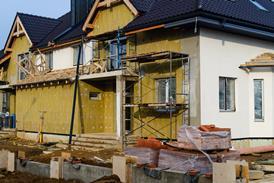
Building houses in factories holds no fears for Neil Reed – it's traditional sitework that bothers him. "The quality of work is always a problem," he sighs. Reed, a project manager with consultancy Weeks, is designing and building a dozen three-bedroom modular houses on two sites in Rochester for social landlord MHS Homes under a partnership contract.
As well as better workmanship and super-fast construction (prefabricating in the factory cut time on site from 28 weeks to 18), Reed saw a modular-based project as a hands-on opportunity to learn lessons about how to make offsite work.
Cost counting
While it gave Reed the quality and speed of programme he wanted at Rochester, it also cost more – a premium of 5% to 10%. Reed, however, is unfazed. He says a definitive costing exercise, taking into account, for example, the extra £40,000 in rent MHS will get from letting out the houses 10 weeks earlier, would show that modular costs only a little more than traditional. He also thinks the expanding market will allow construction companies to cut the cost.
The lowest possible cost, however, isn't always a driver. Social housing is a competitive marketplace where quality gives the client the edge. "We want people to want our houses," says Frank Barber, technical services manager at MHS.
Once the planners gave the go-ahead, manufacturer Elliott Group set to building the modules at its Congresbury factory in the West Country, delivering them to site four weeks later complete with radiators, windows, doors, light bulbs, fitted kitchen and bathroom. Each module is a steel-framed box with a composite timber floor and timber-stud walls clad with brick slips. Four of them make up each two-storey house. On the outside, the houses are indistinguishable from traditional brick houses and form a terrace on one site and semis on the other.
To complete each house, a trussed roof made on site was craned on. "On the first day we put in two houses," says Elliott MD Graham Cox. "We were finished by three o'clock with the rafters. By mid-morning next day, the tiles were on."
Reed says that one of the biggest lessons he's learned is to pay more attention to managing the utility works. Modular requires two site visits from gas, water and electricity providers – before the modules arrive and after they are bolted together. So managers need to ensure the utility companies get the sequencing right – next day rather than a fortnight later.
And while steel frame demands less extensive groundworks, the rigidity of the modules means the foundations have to be perfectly flat. "Skilled brickies can take out any irregularities in foundations," says Barber, "but any twist in modular build and all the tiles in your bathroom will fall off."
But the biggest setback had nothing to do with modules at all. Delays at the planning department stretched the wait out to 20 weeks, scuppering the handover deadline.
Enquiry number 200
Grant’s quick fix for bargain basements

Seamus Grant couldn’t help gulping when he decided to build 35 houses with basements. Traditional, in situ construction of basements adds months to the programme, so the MD of Martin Grant Homes, like most other UK developers, simply hadn’t built any. Any innovation – and Grant proposed to make the basements from precast waterproof concrete panels – feels more like a gamble when you don’t have experience of traditional techniques. Six months on and it’s a different story on Grant’s riverside development near the centre of Cambridge. Precast has lived up to its promise, halving the time needed to get out of the ground compared with in situ techniques. “We were three months ahead by the time we reached ground level,” says Grant with satisfaction. But Grant didn’t build the basements just because he could do it quick and get his investment back faster. He’s done it to get more living area out of the same site footprint. And by putting in what supplier ThermoneX calls the Rolls-Royce of basements, he expects buyers to stump up accordingly for the extra space in the houses, whose four floors include a room in the roof as well as the basement. Whereas many basements never rise above such peripheral functions as wine cellars, playrooms and recording studios, those in Cambridge play a more central role. Most host the kitchen and are well lit, thanks to a sunken patio that acts as a lightwell. That X FACTOR
The ThermoneX units aren’t just bright, they are also warm. Made of a polystyrene core sandwiched between a lightweight, water-resistant concrete, called X-Concrete, the external walls are waterproof and well insulated – the typical U-value is 0.3. The dividing walls between the cellars are made of ordinary dense concrete, as are the sunken patio floors and walls, because that’s better than X-Concrete at blocking out sound. ThermoneX manages the installation as well as the manufacturing process. It sends the X-Concrete mix to pre-casters who make and store the panels, casting in conduits and electric boxes. When the concrete foundation raft is down, the company trucks the panels to site, craning them into position and fixing them together by running a bar through steel loops that project from the sides of each panel and grouting it all in. The walls are then ready for decoration. After fixing the walls together, ThermoneX hoists concrete planks on top to act as the ceiling. At Cambridge, the basements for each block of eight houses took two to three days to install. Culture change?
X-Concrete is the lightest structural concrete available. It has a strength of 12.5N compared with the 30-35N of ordinary concrete, so you can stack up to five storeys on top of an X-Concrete basement. Swedish company Delcon, which developed the concrete a generation ago, has been building basements in Scandinavia for 25 years. In the UK, ThermoneX has been installing basements for the last three years, often for self-builders. Not surprisingly, it would like the major housebuilders to consider putting basements into all their houses – something that hasn’t happened over here on any sort of scale for well over 100 years. The company says precast basements give luxury developments something special – one Surrey man used his to house a trainset he could operate from anywhere in the world – or let builders pack more houses onto the same site by redistributing floorspace over an extra, subterranean storey. But cost remains a drawback. Each Cambridge basement cost nearly £22,000, up to half of which represents dig-out costs. For that sort of money a housebuilder has to be sure its customers will pay for the privilege. With the Cambridge development nearing completion Grant is confident about recouping the extra spend. “The basements are proper accommodation, standard rooms not cellars,” he says. “We’re pleased and expect to do well with them.” Enquiry number 201
Budget hotel guru to cut the cost

Traditional housebuilding leaves John Blyde cold. “The quality’s crap and everything’s late,” says the MD of keyworker accommodation developer LiveIn Quarters. He’s not much more complimentary about modular construction: “Most don’t deliver an economic solution.” Blyde reckons he can do a great deal better. He’s setting up a modular factory (a 1,000-unit production facility in either Barking or Dagenham next year) simply to show the rest of the industry how to do it properly. Some years back Blyde quit as CEO of the Potton Group after 35 years at the company, which is the UK’s largest builder of budget hotels. During that time he built 170 Travelodges quickly and cheaply out of modules made in a factory and trucked to site where all that remained was to bolt them together. He aims to use his Travelodge experience to cut the cost of modular construction, adding lower price to modular’s plus points of better quality and guaranteed delivery times. By pushing down the cost of labour and materials, he says he can turn modular’s premium into a price cut. “We’ll take people without vocations off the street and train them,” he declares. “That will bring costs down.” Savings on materials will come from cutting three-year supply deals with clients, so LiveIn can source globally and more cheaply. “When we did our first Travelodge, we never thought there’d be any more,” he says. “It had 40 beds and didn’t need even one van of tiles. By the time we were doing 26 hotels a year, we had people going to Spain to source tiles at much better prices.” Dreammaker?
Until its own factory is up and running, LiveIn will source modules for keyworker units from other manufacturers. That doesn’t bother Blyde, who sees LiveIn less as a modular builder than a partner with organisations that build keyworker housing. LiveIn will deliver the modular design and a funding model that will let firemen, teachers and nurses pay £85 a week for a share in a £200,000 flat in, say, Hackney. “I spend a lot of time making people’s dreams happen,” says Blyde. It isn’t all altruism, though. The demand for keyworker housing in London is unlikely to be satisfied any time soon, leaving companies like LiveIn with a long-lived business. Enquiry number 202
Structherm lets teachers take centre stage

Sitting under a palm tree on a beach in Thailand did the trick for Peter Grimshaw. The civil engineer had a problem waiting for him back at home: how to build a new teaching block for Winchcombe School in the Cotswolds to accommodate the headteacher’s wish for classrooms that were wider at the back than at the front, and the local planners’ insistence on something better than a rectangular box in an area of outstanding natural beauty. It’s not as cranky as it sounds. Plenty of auditoriums adopt the principle, because a megaphone shape allows the speaker – in Winchcombe’s case, the teacher – to project their voices to the back of the room more easily. And with desks arranged in lines diverging from the front rather than in parallel, a teacher can see every student in the classroom simultaneously. Although the head had suggested a circular block divided up like a pie, that wasn’t on. A circular building would have been too intrusive for the planners, requiring a diameter of at least 30m, not to mention a massively complicated roof. Grimshaw, who is a governor at the school, took the problem on holiday where he had his eureka moment: to build segmental rooms in the shape of a fan, covering 160 degrees of a circle. Grimshaw built the curving structure with Structherm structural insulated panels – rigid insulated cores sandwiched by a wire frame and encased in dense, waterproof concrete with openings for the windows and doors. The only other system flexible enough to curve was traditional brick and block, but that would have cost around 40% more than Structherm. Typically, Structherm prefabricates each wall as one panel in its factory to the exact shape and size required, but for Winchcombe, the company made each panel 2m wide. Set alongside each other in a series of chords, the panels make the walls look curved. Building the block was easier than conceiving it, and a dry shell was ready for fit-out within seven weeks. “The panels save on prelims and you’re in and out a lot faster,” says Jonathan Gould of installer TecniBuild. “The whole scheme only took eight months.” It also took place in the winter, unaffected by wet weather. The block contains five classrooms and other areas at the outer edge of the fan separated from a music room on the inner edge by a 4m-wide corridor that bends so far round that you can’t see one end from the other. Enquiry number 203
Source
Construction Manager
Postscript
for more information on a product, go to www.construction-manager.co.uk/enquiries

No comments yet