













Costing Steelwork is a series from BCSA, Steel for Life and Aecom that provides guidance on costing structural steelwork. This quarter provides a look at cost and carbon in office frame typologies, by Aecom’s Patrick McNamara, Ioana Price, Jack Brunton and Mae Ann Ta, BCSA’s Michael Sansom and Jonathan Davis of William Hare
Click here to read the full costing report
In sustainable construction, the relationship between carbon and cost is rarely straightforward. Decisions made at the earliest stages of a project, often before the full scope is defined, can lock in both environmental impact and financial trajectory. From site selection and massing to internal layout, each choice influences embodied carbon, operational efficiency, and long-term value. Yet sustainability and cost are still too often treated as opposing forces rather than interconnected levers.
Together, the structural frame and foundations typically represent most of the upfront carbon emissions for new office buildings. Commissioned by the British Constructional Steelwork Association, this article examines how different structural solutions perform across carbon and cost metrics, and why strategic alignment during early design stages is critical.
To support this study, Aecom’s Eco.Zero™ Concept carbon and cost optioneering tool enabled analysis beyond generic benchmarks to generate outputs grounded in structural design data. This tool facilitates deeper analysis of how column grids, material choices and layout strategies affect both embodied carbon and capital cost. As with any early-stage quantification tool, it relies on certain assumptions and simplifications, such as regular column grids, uniform loading and consistent ground conditions. Still, the insights it provides help inform smarter, lower-carbon decisions at the project outset when flexibility is highest and impact is greatest.
Sustainable design begins with the recognition that reusing and refurbishing existing structures should always be the first consideration. Where new construction is required, structural options must be evaluated through a lens that extends beyond carbon alone to include cost, material intensity and circularity. To that end, this analysis focuses on the structural frame as a key component of the broader sustainability picture.
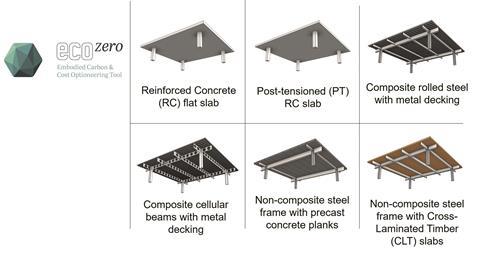
Six structural typologies (figure 1) were evaluated across column grids ranging from 6×6m to 12×12m. Analysis of the 12m results indicated that steel typologies are more efficient at greater spans. This aligns with industry guidance; the Concrete Centre’s Economic Concrete Frame Elements identifies 12m as the threshold where concrete solutions become uneconomical.
Figure 1: Structural typologies analysed for this study
The study adopted London ground conditions with cohesive soils and a notional seven-storey office building with a gross internal area (GIA) of approximately 10,000m². The building is free from transfer decks, cantilevers and basements. The boundary encompassed the primary frame, roof, ground floor slab and continuous flight auger piled foundations only. Stairs, facades and finishes were excluded.
All embodied carbon assessments followed the Institution of Structural Engineers’ (IStructE) current guidance on calculating embodied carbon, including appropriate uncertainty factors in accordance with RICS Whole Life Carbon Assessment for the Built Environment (second edition). The application of consistent material specifications across all options ensured a valid comparison. A parallel cost review outlined the relative ranking of solutions; the cost model derives from an elemental structural breakdown and does not represent full construction cost. All cost data reflected Q1 FY26 market rates.
Upfront carbon
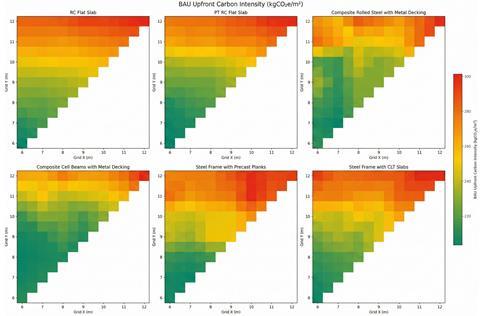
The heatmaps (figure 2) display upfront embodied carbon intensity (A1-A5, kgCO₂e/m²) for six structural systems across grid arrangements from 6×6m to 12×12m, showing steel’s clear advantage at spans exceeding 8m. While concrete performs marginally better at compact 6×6m grids (reinforced concrete flat slab: 195kgCO₂e/m²), steel systems outperform as grids extend.
Figure 2: Upfront carbon intensity by structural system and grid for seven-storey configuration
Sequestration benefits were excluded from this assessment. Sequestration can create a misleading impression that timber has inherent environmental benefits, when realising those benefits depends on responsible sourcing, replanting, and end-of-life management. Sequestration should only be reported alongside Modules C (end of life) and D (benefits beyond the system boundary) to demonstrate how stored carbon will be retained or recovered.
Business-as-usual materials
For the business-as-usual (BAU) scenario, the study followed the recommended default A1-A3 carbon factors and calculation methodology outlined in IStructE’s How to Calculate Embodied Carbon (third edition).
The British Council for Offices’ (BCO) 2023 Guide to Specification added 6m and 7.5m spans to its recommended range to reduce embodied carbon, acknowledging that column-free offices can be carbon intensive. While concrete solutions are more efficient at 6m square grids, composite cell beams outperform both concrete options at 7.5m and 9m grids, which are common for open plan offices. One advantage of cellular beams at longer spans is service integration within the structural zone, which can reduce floor depth and storey height, allowing shorter columns and reduced cladding area.
At 9×12m grids, steel excels. Composite rolled steel reaches 263kgCO₂e/m² (19% increase from 6×6m), while reinforced concrete flat slab climbs to 365kgCO₂e/m² (87% increase). With BCO guidelines specifying 10m² per person and prioritising collaborative settings for hybrid working, steel delivers both lower upfront carbon and the column-free flexibility these workplace patterns demand.
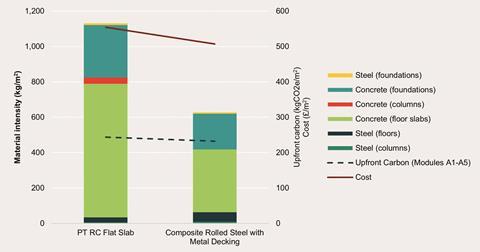
Figure 3: Material versus carbon versus cost intensity review for 9x9m column grid
Not just carbon – responsible material use
Sustainable development requires more than cutting carbon emissions. Even low-carbon materials can harm biodiversity through extraction, production, and deployment, so minimising material use is essential. Projects should avoid focusing solely on carbon performance and instead present material intensity alongside these metrics.
An in-depth assessment for a 9×9m representative column grid explored this multi-component relationship through a wider lens. In this example, upfront carbon and cost metrics are comparable, trending lower for steel. Notably, the steel solution requires 45% less total material mass than its concrete alternative. This is primarily due to lower concrete intensity within the upper floorplates, which in turn enables an efficient foundation design from the lighter steel structures. This example reinforces the argument that carbon and cost cannot be evaluated in isolation. While the industry currently lacks metrics to measure the ecological impact of new materials directly, reducing the demand for materials is essential. Which structural system or geometrical arrangement performs best must be assessed carefully, balancing cost, carbon and material intensity.
Low-carbon alternatives discussion
Having optimised structural layout for material efficiency, the study explored how the comparative performance of different structural solutions shifts when low-carbon materials are specified. However, engineers must understand the unintended consequences of specifying low-carbon materials purely to meet project-level carbon targets.
Specifying electric arc furnace (EAF) steel or elevated levels of ground granulated blast furnace slag (GGBS) in concrete solely to meet project targets can be misleading. Global ferrous scrap is constrained and already highly utilised; increasing its use in one location often displaces scrap elsewhere without reducing global emissions from steel production. Similarly, global GGBS stock is fully utilised, so over-specifying GGBS will not reduce global emissions. However, Tata Steel UK is transitioning to EAF production at Port Talbot for hollow sections, and a decision regarding British Steel’s transition to EAF for open sections is still awaited. New cement replacement methodologies are also gaining traction.
In contrast to the BAU scenario, the low-carbon scenario adopted the typical lower bound carbon factors from the same IStructE guide and additional sources, such as the Low-Carbon Concrete Group’s (LCCG) benchmarks and an average of environmental product declarations for structural steelwork using EAF and renewable energy production.
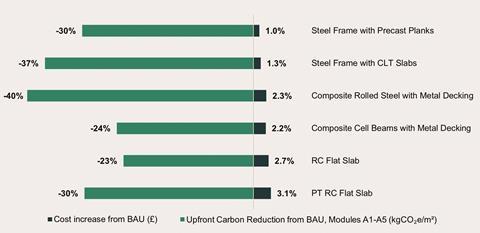
Figure 4 examines the use of EAF steel and low-carbon concrete aligned with LCCG benchmark data and best practice. When analysing embodied carbon savings per additional pound spent relative to BAU, all steel-framed typologies outperform their concrete counterparts. For a 2.3% elemental cost increase, the composite steel solution achieves 40% reduction in upfront carbon, while concrete alternatives return smaller reductions (up to 30%) at higher cost premiums (2.7% to 3.1%).
Figure 4: Percentage change in potential embodied carbon savings and associated cost uplift relative to BAU materials for various frame typologies, 9×9m column grid
Steel solutions remain more cost-effective because concrete typologies require significantly higher material volumes to achieve comparable performance and spans. EAF steel is commercially mature and does not typically incur a price premium while delivering significant carbon reductions. However, lowest-carbon, scrap-based EAF products manufactured using renewable energy may carry an additional cost. High demand and constrained scrap supply can also limit availability, and costs remain sensitive to electricity prices.
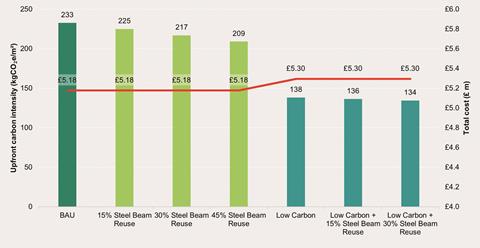
The analysis also examined the benefits of reused steel sections. Although reusing steel offers clear benefits for circularity, social value and biodiversity protection, the reduction in embodied carbon across Modules A1-A5 is less pronounced than that achieved through low-carbon concrete and EAF steel. This is largely because concrete within the floor decks still makes up a large proportion of embodied carbon within the upper floors.
Currently, only 13% of recovered structural steel sections are reused. While demand for steel reuse is high, contractors can realistically source only a small proportion, which limits potential carbon savings. However, as industry bodies release newly developed protocols and guidance, steel reuse remains a promising strategy. Expanding the available stock will unlock much greater carbon-reduction potential.
Costs for reusing reclaimed structural steel can be volatile and may increase due to the requirement for careful deconstruction and handling, and any rectification required (eg cutting, hole repair, cleaning, testing). Recent studies (such as DISRUPT) still indicate a current and future cost benefit, and to simplify the study, costs associated with steel reuse have been assumed to be broadly comparable to new steel.
Figure 5: Deep dive typology: composite rolled steel with metal decking for a 9×9m column grid
Circular economy
For too long the construction industry has operated on a linear economy, stuck in a cycle of “take, make, waste”. Construction generates 62% of UK waste. A circular economy offers an alternative by redefining waste as a resource, keeping materials in use and retaining their value.
Structural carbon assessments often focus solely on upfront emissions (Module A), yet end-of-life impacts reveal substantial circular benefits for steel. The study interrogated these emissions, including the impacts of implementing a design for disassembly (DfD) strategy which enables open section beams and columns to be dismantled at end of life for recovery and reuse.
The analysis demonstrated that steel solutions with DfD deliver lower upfront carbon emissions than concrete alternatives while achieving substantially greater end-of-life recovery benefits. A switch to DfD can increase the carbon recovery potential by almost two-thirds compared with typical demolition, with the modest increase in deconstruction emissions far outweighed by enhanced reclamation benefits.
The DfD assessment followed Greater London Authority and HTCEC v3 guidance. Module D1 benefits vary by production route: BF-BOF steel shows substantial recovery (~1.6tCO₂e/t), whereas EAF steel shows lower calculated values due to already low production emissions, though the physical environmental benefit of reuse remains equivalent. More accurate Module D1 accounting for EAF steel would incentivise steel reuse and address current supply constraints.
Cost discussion
While sustainability is the central theme for this study, cost remains a critical driver in structural decision-making. Among the various frame typologies, the structural grid emerges as the key metric influencing both material selection and cost outcome.
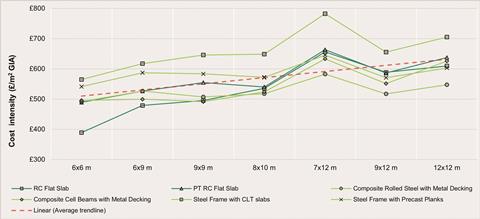
Smaller spans of 6m to 9m tend to suit concrete solutions, whereas long-span solutions lean heavily towards steel framing. At 6m square grids, costs are broadly comparable between PT RC flat slab and a composite cell beam solution. Similarly at 9m square grids, RC flat slab and composite rolled steel give similar cost ranges. As spans increase to 9×12m, steel becomes more cost effective: composite steel is approximately 13% cheaper than RC flat slab, and composite cell beams are around 6% cheaper than PT flat slab.
Figure 6: Cost comparison
The figures presented reflect elemental costs only, focusing on carbon-intensive components to support early-stage decision-making rather than providing comprehensive estimates for full frame construction. The cost model includes allowances for trade contractor preliminaries, design development, and sundries, but excludes main contractor on-costs and items such as specialist design, edge protection, temporary propping and screeds. Other benefits of adopting structural steel versus concrete, not captured in the cost analysis, include shorter overall programme, 16% fewer deliveries to site (based on a 9x12m grid example) and reduced operatives on site due to the benefits of offsite manufacturing.
The benefits of steel frame solutions increase for taller office buildings, where reduced weight and faster floor construction deliver cumulative programme and cost efficiencies. While this article addresses sustainability metrics in separate sections, many of the listed cost advantages also lower environmental impact by reducing transport, material use and site activity. Typically for an eight- to 10-storey office building, the benefits of adopting a steel frame versus concrete would equate to 1%-1.5% of overall construction costs, in the order of £45-50/m².
Conclusion
The climate emergency demands that sustainability become a core decision driver alongside cost. While embodied carbon is a crucial metric, it cannot be considered in isolation. Biodiversity loss and resource depletion must sit alongside carbon and cost when shaping design choices. Broader impacts, including responsible sourcing and supply chain ethics, also warrant consideration but fall beyond this study’s scope.
This study demonstrated that for a typical mid-rise office building, steel-framed solutions generally achieve lower embodied carbon than concrete alternatives, using around 45% less material by mass. Even when low-carbon materials are specified, steel frames can deliver reductions in upfront emissions by up to 40%. Circularity further strengthens the case: a DfD steel frame can increase end-of-life carbon recovery by almost two thirds compared with conventional demolition approaches.
Yet the numbers only tell part of the story. Reducing the demand for new materials remains the most powerful lever available. This requires lean design, thoughtful span selection, reuse of existing structures and reclaimed components, and strategies enabling future disassembly. To unlock its full potential, steel reuse should be considered by engineers and clients from the earliest project stages, supported by better retrieval pathways and improved Module D1 methodology that adequately reflects the circular economy benefits of reuse.
These interconnected decisions are fundamental to driving meaningful progress in climate resilience and sustainable construction.
Steel For Life sponsors
BrsQ8T3
Costing Steelwork is available at www.steelconstruction.info. The pricing data and rates contained in this article should be used for comparative purposes only and should not be used or relied upon for any other purpose without further discussion with Aecom. Aecom does not owe a duty of care to the reader or accept responsibility for any reliance on the contents of the article.







No comments yet