

















Phil Sutton welcomes a change in the rules that will allow the easier specification of more sustainable kerbing

For more than two decades, the sustainable materials industry has made the same argument: recycled products can perform as well as their traditional counterparts while using less carbon and making use of waste that would otherwise go to landfill. Since I founded Duraproducts in 2003, I have watched the same pattern play out in meeting after meeting – architects and procurement teams nod, express interest, and then someone asks the question that ends the conversation: “But is it in the specification?”
It seldom was. Now, for the first time, it is.
What has changed
The British Board of Agreement’s Highway Authorities Product Approval Scheme, known as BBA HAPAS, was established in 1998 by the County Surveyors’ Society and the BBA to give councils, contractors and government agencies a single, independent standard for assessing new highway materials, removing the need for each authority to run its own separate testing programme. It has become one of the most demanding certification routes in UK construction, combining laboratory testing, field trials and site inspections, followed by audits every three years to confirm a product continues to meet the standard.
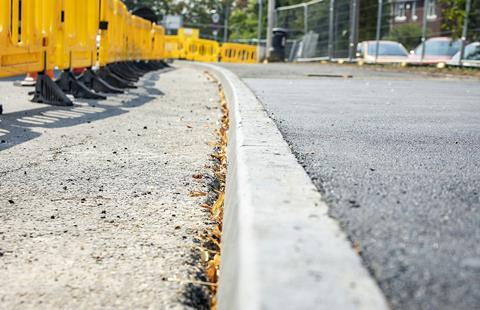
The latest update covers a specific clause in National Highways’ rulebook for how roads get built: CC/207, the section of the Manual of Contract Documents for Highway Works that sets the material and performance standards for kerbs, footways and paved areas. Until now, CC/207 recognised only precast concrete and natural stone as compliant kerb materials. It now recognises polymer kerb units too, provided they clear the same demanding bar: sustained temperatures of 60°C without losing structural integrity, and impacts from vehicles of up to 44 tonnes travelling at 80km/h without being displaced.
Recycled polymer kerbing has met that bar, and is now named directly within the clause itself rather than treated as an exception to it. This is not a minor technical update: it is the removal of a barrier that has shaped procurement decisions for a generation.
Why the industry has favoured the familiar
UK highways procurement is conservative by design. It has to be. Roads are public assets that need to last decades, and the engineers and contractors responsible for them operate within tightly defined standards. Deviating from those standards – even for a product backed by excellent independent test data – introduces risk: legal, procurement, reputational. In a sector where margins are tight and accountability is high, risk-aversion is entirely rational.
The result has historically been a bias toward the familiar. Concrete kerbing has sat in the specification for generations. It may be carbon-intensive and made from virgin materials, but it is approved, and it is operationally risk-free.
Recycled alternatives – however well tested – have had to clear additional hoops every time: bespoke testing, custom sign-off, one-off justification documents. The administrative burden has sat almost entirely with whoever was trying to specify something more sustainable.
A gap closed, not a favour granted
That imbalance has now shifted. The update to the Manual of Contract Documents for Highway Works formally listing polymer kerbs within national specifications, deserves credit as a deliberate piece of standard-setting by National Highways. It replaces years of case-by-case justification with a single, documented route to approval, and in doing so signals that recycled materials are no longer viewed as a compromise, but as an equivalent, specified choice.
In practice, it means a local authority or Tier 1 contractor can now specify a certified recycled polymer kerb without commissioning bespoke testing or seeking a one-off exemption. The product is already independently validated, nationally and officially, which turns what was once a weeks- or months-long approval process into a routine procurement decision.
The scale of the opportunity
The scale of what a change like this can unlock is worth considering. The UK’s highway network runs to hundreds of thousands of kilometres, and kerbing appears in almost every new road scheme, resurfacing project and junction upgrade undertaken on it. Construction, demolition and excavation already account for around 60% of UK material use and waste generation. Most of that waste is recovered rather than landfilled, but recovery and genuine circularity are not the same thing; a lot of it is downcycled into low-grade aggregate rather than returned to equivalent use. Diverting even a modest share of new kerbing specifications toward recycled polymer rather than virgin concrete represents a meaningful dent in both landfill volumes and embodied carbon, at a point when the industry badly needs both.
That need is not abstract. National Highways has committed to net zero emissions from its own operations by 2030, net zero maintenance and construction emissions by 2040, and net zero emissions from road users by 2050. On its own published figures, the 2040 construction and maintenance target is meant to be met almost entirely through decarbonising the materials, plant and transport involved, principally concrete, steel and asphalt, with only a small residual share reliant on carbon offsetting. It has published a dedicated roadmap for taking carbon out of those three materials specifically. Lower-carbon alternatives for supporting infrastructure, kerbing included, sit squarely within that agenda, even if they rarely attract the attention that asphalt and concrete innovations do.
Beyond kerbing
The precedent this sets is important too. Kerbing is unlikely to be the last product category where this pattern plays out. Bollards, signage posts, drainage channels and temporary barriers all have recycled-material equivalents already on the market, most of which are still navigating the same specification gap that kerbing has just closed. If this update becomes a template that other product categories can follow, rather than an isolated case, the effect will compound well beyond one line item in a highways contract.
None of this happens overnight, and the shift from concrete to recycled polymer kerbing as a default choice won’t either. Change at this scale is built from incremental wins, project by project, tender by tender. But the barrier that has consistently stalled that change – the absence of a named route through the specification – has been lifted.
Written into the document
Credit for that belongs, in large part, to the standards bodies and highway authorities willing to do the unglamorous work of updating the documents that councils, contractors and engineers rely on every day. This is how meaningful change tends to happen in infrastructure: not through pledges or announcements, but through specifications. The document has now been updated – what happens next is a matter of uptake, project by project. But the case no longer needs to be made from outside the specification.
It’s in the document now.
Postscript
Phil Sutton is founder of Duraproducts







No comments yet