












With budgets under pressure and expectations changing, university estates need to work harder. Lisa Pike explores how campuses can become more flexible, inclusive and human
Universities have transformed almost every aspect of higher education over the past two decades. Teaching is more flexible, research is increasingly interdisciplinary, and partnerships with industry have become central to how institutions create and share knowledge.

Many campuses, however, still reflect an earlier model of higher education - beholden to siloed and outdated ways of working with often staggering low estate utilisation, while student appetite to collaborate and forge community is higher than ever.
Universities can’t solve today’s financial, teaching, and research challenges with yesterday’s estate strategies. At a time of rising maintenance costs, constrained budgets, and changing expectations from students and staff, estates need to do more than accommodate activity. They need to enable it.
Workplace design has spent years adapting to similar shifts in how people work and collaborate. The workplace is no longer a static container; it is a cultural organism, a system of relationships, rituals and resources.
The point is not to copy the commercial workplace, rather, to learn from the principles behind these adaptations. This means designing environments around how people actually use them, making better use of existing space, and creating campuses that are flexible enough to support future needs.
Estates are defined by their people
The people who occupy these campuses have already adapted. Research is increasingly interdisciplinary, and teaching moves seamlessly between physical and digital environments. Academic staff collaborate not only across faculties but also through industry and institutional partnerships, often moving across multiple locations.
Students no longer distinguish between formal and social learning spaces in the way they once did. They expect choice, in the places they can occupy from quiet focus zones to immersive and socially alive spaces. Environments where people can gather, focus, share, and grow. Because great learning spaces do more than teach, they transform.
Equally, estates must meet their sustainability targets, not only environmental ones, but financial ones too. Every square metre of investment needs to deliver value for a university’s people, place, and planet.
What if campuses enabled us to be more curious, more open – more human?
The commercial workplace has grappled with many of the questions that universities are now asking. What if campuses worked the way people using them, already do?
The challenge is not about allocating desks; it’s about understanding what people actually do and designing places that help them do it well. Rather than focusing on desk count or square feet alone, the goal is to create inclusive environments that reflect how organisations work today, while remaining flexible enough to support the practices of tomorrow.
This means implementing adaptable use strategies that are connected to culture and are equally empowering as they are efficient in their curation. The focus shifts from the amount of space provided to how effectively it supports focused work, enables collaboration, and strengthens the sense of belonging across the many communities that make up a campus.
Data isn’t the barrier
The biggest barriers to change within university estates are rarely technical. Estates teams are well versed in their utilisation data, operational performance and sustainability roadmaps. They know which buildings are underutilised and which are disproportionately expensive to operate. They also understand where existing spaces no longer support today’s teaching and research patterns, let alone flex to future demands.
The challenge is using this data to navigate difficult conversations and build consensus around opportunity-led solutions across a complex network of stakeholders.
This is because space can carry meaning in universities that extends far beyond bricks and mortar. Conversations quickly shift from utilisation to academic identity, institutional reputation and values. A private office isn’t simply a place of work - it can represent years of academic achievement. Traditional departmental space can embody institutional values and identity. As a result, conversations about how space is used can sometimes feel less like operational discussions and more like challenges to an institution’s identity.
Conversations about how space is used can sometimes feel less like operational discussions and more like challenges to an institution’s identity
This doesn’t make change impossible. Rather, it highlights the saliency of engagement rooted in an institution’s identity and collective values. Data identifies the opportunity; engagement is what makes change possible.
What if the future of knowledge starts with how we gather now?
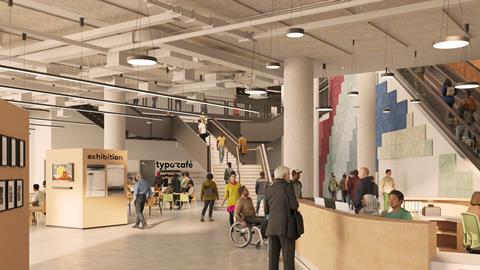
Some universities are already showing what that can look like. At University of the Arts London’s new London College of Communication in the heart of Elephant & Castle, the ambition wasn’t simply to create better teaching spaces but to reflect how an institution can support student learning and engagement, foster creativity and equip them for creative careers in a challenging world.
The 37,000 sqm fit-out designed by Perkins&Will is designed around the principle that modern learning and creativity emerge from the intersection of both formal and spontaneous learning activities.
The design reimagines the college’s learning and teaching environments as a series of interconnected neighbourhoods - living spaces that invite collaboration and adaptation and are anchored in wellbeing. Workspaces support individual and collaborative working. Focus rooms enable adaptability between digital and physical workflows, recognising that online teaching and virtual collaboration are now part of everyday academic life.
The street level is an open invitation to local communities to explore and engage through public exhibition and cafe spaces, embodying the University’s civic role beyond the campus itself. What makes this project so exciting isn’t simply its scale, it’s the scale of impact it seeks to make and the intention behind every decision, with spaces designed to genuinely open doors for the students and communities who need them most.
The architecture matters, but the principle matters more. The most valuable spaces on campus are those where bright minds can pause and collide after sessions, where researchers from different disciplines build ideas and pipelines from spontaneous encounter, and where universities forge genuine communities rather than collections of buildings. This lesson extends far beyond specialist creative education.
Keeping pace with higher education
Universities have long been homes for innovation. As they continue to rethink teaching, research, and the value they bring to the student experience, their estates should also be viewed as strategic enablers of that change.
That means moving from viewing campuses as fixed assets to creating agile estates that can contract, adapt, or expand—informed by good data and aligned to how universities really want to work and how our future students expect to be able to learn.
None of this means abandoning academic tradition or institutional values. If anything, those values should guide how universities shape their estates for the future. But their campuses also need to keep pace.
Old buildings aren’t the challenge. The challenge is organising them around a model of higher education that no longer reflects how universities teach, research, and collaborate today. Creating campuses that better connect students, educators, and researchers starts with asking the right questions today.
Lisa Pike is higher education practice leader at Perkins&Will







No comments yet