














Sticking to the norm is not an option given construction’s contribution to waste. We must move to an approach prioritising re-use and the capital is perfectly placed to spearhead the effort, writes David Wellwood.
It’s no secret that the construction industry is one of the biggest contributors to both waste and emissions in the UK. Construction, demolition and excavation account for 60% of material use and waste generation, with 25% of UK emissions directly attributed to the built environment (UKGBC). As such, there is growing awareness of the fact that we must move to a more circular approach prioritising reuse when it comes to both buildings and materials.

Why London should lead the charge
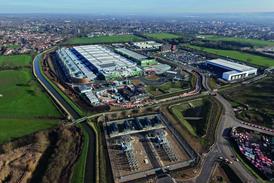
Earlier this year, the UK’s first Circular Construction Hub, Tipping Point East, opened in London’s Royal Docks. It aims to supply reused and recycled construction materials for new homes in the area but it’s not just residential that can benefit.
Demand for sustainable, efficient office space in London continues to rise and clients are increasingly seeking contractors who build with sustainable practices in mind. As efficiency standards are raised and occupiers consider their office part of their ESG strategy, much of London’s existing office stock requires refurbishment, retrofitting or rebuilding. Here lies an opportunity to not just procure new materials but to reuse and recycle those from buildings that are not viable to remain.
A circular construction approach must be agreed upon at the very beginning of a project to ensure a full audit of the building’s materials can be completed and everything that can be removed and reused doesn’t end up in a pile of rubble
Given the prevalence and proximity of office buildings in the capital, it’s ideally positioned for materials to be extracted and transported with greater ease than other parts of the country. Coupled with the construction expertise and ESG investors in the city, London is the place to trial a new way of thinking when it comes to reducing waste and embodied carbon.
The London Plan is one of the first pieces of legislation in England which requires consideration of a circular construction approach, stating that buildings are more easily adapted and dismantled and a Circular Economy Statement is submitted at both planning and completion stages documenting performance. Not only is London geographically positioned, but it also has the legislation and the appetite for sustainability.
We’re increasingly seeing circularity requirements in tenders and forward-thinking clients want to see contractors prioritise this in their responses. However, there is a long way to go and several barriers preventing widespread adoption of this approach.
The barriers to a circular construction approach
As contractors, we often find the strip-out has already taken place once we arrive on site, meaning the opportunity to extract materials has been missed. Because of this, a circular construction approach must be agreed upon at the very beginning of a project to ensure a full audit of the building’s materials can be completed and everything that can be removed and reused doesn’t end up in a pile of rubble.
Another issue we have as an industry is that the linear construction model has been the norm for a long time and a shift to a circular approach won’t just happen overnight. It requires a new way of thinking, and at present, it can be more expensive and time-consuming to source second-life materials than to simply procure new ones.
However, if we are serious about adopting new approaches and reducing emissions in line with 2050 targets, then we must think first and foremost about using what is already there. Increasingly, clients are open to the idea of increasing spend or extending project timelines to ensure that sustainable practices can be implemented. Although some might hold the view that recycled materials impact the finish of a new build, this needn’t be the case.
The majority of today’s buildings were not designed to be deconstructed, meaning identification and extraction of components can be difficult
The materials themselves also pose challenges. The majority of today’s buildings were not designed to be deconstructed, meaning identification and extraction of components can be difficult. Additionally, most manufacturers are not designing products to be reused and there is a role for them to play in how materials are removed and adapted to give them a second life.
Logistically, a lack of storage on site can be a barrier and sourcing recycled components is not yet easy. However, the introduction of circular construction hubs, organisations championing circularity and innovative approaches is helping to tackle these issues. Widespread adoption of material passports would also enable greater understanding and documentation of building components.
Looking to the future
Whilst it’s clear that there are challenges to overcome, the opportunity London provides to trial a circular construction approach cannot be ignored. As we look to the future, we must design with adaptability and deconstruction in mind and shift our thinking to utilising existing components before procuring new ones to break the cycle of waste.
As with many things, it will require collaboration and some form of standard to create tangible change. While our industry has been known to be less forthcoming in adopting new ways of thinking, sticking to the norm is simply not an option.
David Wellwood is regional construction director (London) at McLaughlin & Harvey







No comments yet