






Manchester University NHS Foundation Trust has developed a digital twin to manage its 10 hospital sites more efficiently, bringing together disparate data on space, assets and building condition onto a single platform that will eventually integrate facilities from the New Hospital Programme. Thomas Lane reports
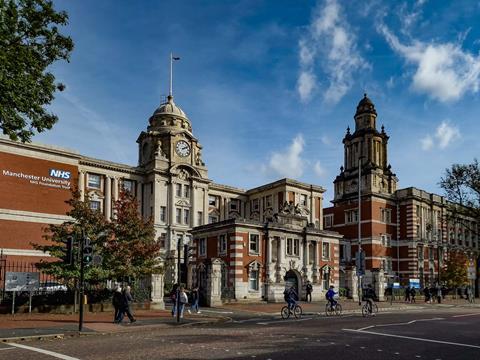
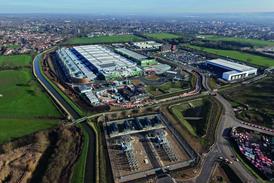
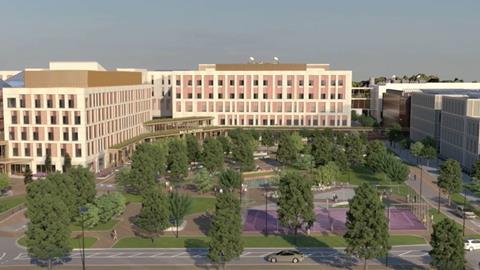
As the largest NHS trust in the country, efficiently managing and maintaining the buildings on Manchester University NHS Foundation Trust’s 10 hospital sites is a huge challenge. One of those sites, the North Manchester General Hospital, is part of the first phase of the New Hospital Programme (NHP) which will see 70% of the site rebuilt or refurbished. The project comprises 70,000m² of new build and 27,000m² refurbishment with the goal that this will be an intelligent, digitally enabled hospital with technology ranging from sophisticated building management systems to electronic patient records.
The NHP also requires trusts to build digital twins to operate their new buildings more effectively. Given this, and the fact that the new hospital will only make up 20% of Manchester University NHS Foundation Trust’s (MFT) total estate, a couple of years ago the trust decided to develop a digital twin to help it manage the existing estate more efficiently and integrate the new hospital into this twin once this is operational.
Building a digital twin from disparate data sources
The project has been led by the head of digital estates, David Bailey who had to create a digital representation of the estate. The project focussed on six hospitals, the other four will be integrated later. He says the digital twin started out based around how space is recorded and managed. “Space is the hook for many different forms of estates and facilities data,” he explains. “Assets all have a location so if there is asbestos it will have a location and you do a project in a specific location.” He adds that MFT was formed out of three different trusts who had different ways of recording space, the digital twin project introduces one common standard.
Workshops held in the planning stage to establish what the biggest staff challenges were revealed that better spatial information was a top priority. Problems included not being able to find drawings or being to identify the most up to date versions and inaccurate spatial information.
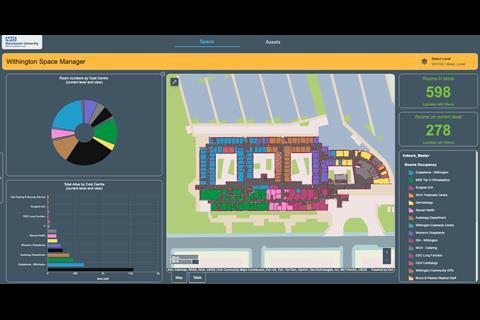
The digital twin brings together a host of disparate information including drawings, information from the computer aided facilities management system (CAFM), condition data, project data and so on onto one platform, visible as a single source of truth. Different disciplines are given access to data specific to their needs. The aspiration is patients will get access to the system to help them find their way around the huge, sprawling estate.
We couldbring in demographic data, weather data, transport data, and hopefully at some point we’ll link in electronic patient record data, so we will be able to look at where our patients are going
David Bailey
“It’s fully customizable and controllable to what whatever you need it to be. You can spin it so it is public facing,” he explains. “Using geographic information we could link and bring in demographic data, weather data, transport data, and hopefully at some point we’ll link in our EPR [electronic patient record] data as well, so we will be able to look at where our patients are going, where they are and potentially way find them using this system.”
He adds that this could help reduce the number of missed appointments, a huge problem for the NHS with 8.1m missed appointments in 2024-25 across England. MFT is looking at ways of reducing its share of this figure which will include better wayfinding for patients.
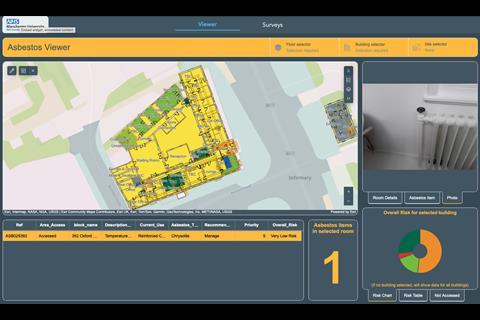
From RAAC management to patient wayfinding: practical applications
The digital twin is hosted on a platform called ArcGIS, from geographic information software specialist ESRI. This converts CAD and BIM data, Revit models which is used by design teams, and information from the CAFM system from the maintenance teams into interactive 2D or 3D visualisations. The information is sufficiently detailed to show individual rooms yet can provide an estate wide view including connections between buildings.
A surveying company can go into the model, click on that RAAC plank and then record the condition of those individual planks
David Bailey
Information can be stored on layers assigned to specific information such as the location and condition of RAAC planks. “We’ve built a tool for management of RAAC so you can model the individual RAAC planks. A surveying company can go into the model, click on that RAAC plank and then record the condition of those individual planks,” Bailey says.
Although there is a dedicated team of digital specialists who perform tasks such as downloading CAFM data each day and uploading this to the digital twin, engaging and upskilling other staff to be able to benefit from the digital twin was essential. For Bailey the digital twin is a tool that will constantly evolve and become more capable as information is added to it.
“We need everyone’s input into it, so they will need to be upskilled and to recognise what the system is doing for them,” he says. “This will bring that change for us. I don’t think you can do that in one sort of big fell swoop; it’s an iterative thing that will slowly pervade through all the teams.”
This could include bringing in energy use management into the system. Bailey says that M&E kit is slowly being added to the twin and once submetering is put in place the digital twin will help identify areas of excessive energy use. This could be linked to building condition data, for example how much insulation is in a roof which could help inform retrofit programmes. It could also include cost information.
Measurable benefits have included reductions in time taken for reporting, and the streamlining of processes that have saved our security and asbestos teams an equivalent of two full time employees in total
David Bailey
Bailey says it is early days in terms of the benefits from the tool it only went live in October last year. But he is optimistic. “We expect to see significant benefit from the digital twin over time, and we are actively monitoring our projects to establish the benefits,” he explains. “Measurable benefits have included reductions in time taken for reporting, and the streamlining of processes that have saved our security and asbestos teams an equivalent of two full time employees in total. We predict this will rise to five full time employees with the future potential work that is envisaged. This enables the time saved to be utilised for other tasks, providing consequential service improvements.”
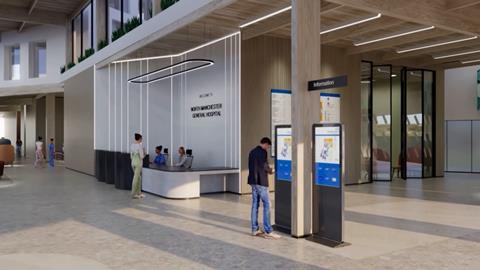
Integration with the New Hospital Programme’s intelligent hospital vision
The work done on the digital twin will feed into the New Hospital Programme, which has ambitions to utilize AI and data to develop the ‘intelligent hospital’. All the trusts involved in the programme are going through smart buildings gap analysis to find out where the digital capabilities, and lack of, are. This will identify where further work needs to be done to prove that concepts will work. Different trusts have their own projects, such as proving how AI could be beneficially used, with the goal that best practice is shared.
“We may benefit from one of the other NHP trusts doing an AI strategy piece around digital twins, or smart buildings, that then passes through to all the other trusts and then percolates down to wave two and wave three trusts as well,” Bailey says.
In time, this will hopefully make the enormous task of managing the NHS estate easier and more efficient which should help lead to the ultimate healthcare goal; better patient outcomes.






No comments yet