













President Nick Maclean and CEO Justin Young say the professional body has moved beyond its troubled past. Their mission now? Rebuild confidence, modernise qualifications and reconnect with members

It’s a grey February morning at the Royal Institution of Chartered Surveyors headquarters in Westminster’s George Street, where Nick Maclean and Justin Young have arranged to be interviewed. Young, the CEO since 2023, is caught up in a meeting and running five minutes late so Maclean, the new and at the same time not so new president, exchanges small talk while we wait.
He chats easily about the Middle East – referring to the 21 years he worked in, and then ran, CBRE’s business there. He talks about population split in the UAE, where about 88% of the population are foreigners, describing it as a ”fascinating social experiment” from which the West might learn.
He was speaking before the world knew that the US and Israel were about to launch a military campaign against Iran, leading to retaliatory strikes, airspace closures and renewed geopolitical instability. Last week, on a follow-up call, he was able to go into some depth about the impact on friends and former colleagues as well as his views on the longer-term implications for the region (see Middle East market and the Iran conflict panel below).
Maclean, 62, left CBRE at the end of 2024 and returned to the UK last year. He didn’t know it at the time, but this meant he could be parachuted in as acting RICS president in March 2025. His predecessor, Justin Sullivan, had stepped aside just two months into his presidency to allow an investigation into his role as an expert witness in a court battle over a moth-infested mansion.
The Sullivan episode, while awkward for the institution, was far less serious than the governance crisis that hit the headlines in 2021 after a RICS leadership row. A damning report into the affair by Alison Levitt found that four non-executive directors had been unfairly dismissed after they raised concerns over why a critical financial report into the RICS’ treasury management function had been suppressed. The findings led to a full review by Michael Bichard into the institution’s purpose, governance and strategy in 2022.
The RICS is light years away from where we were four years ago
Nick Maclean
Being a member of the RICS governing council at the time, Maclean, worked with Levitt on her report and subsequently with Bichard.
Meanwhile Young, 59, is the first permanent CEO to be brought in after Richard Collins, the interim appointed in October 2021 following Levitt’s recommendations. Both Maclean and Young believe the RICS has undergone a genuine transformation and, in Maclean’s words, the institution is “light years away from where we were four years ago”.
Dealing with the past
In Building’s first interview with the RICS leadership since all the controversies, the two men say they are keen to talk openly about the progress that has been made and the challenges that remain. People who know them both describe them as a “strong team” and, as they talk about the issues for the year ahead, they appear in sync, pausing to allow each other to chip in and build on one another’s points.
Many of the recent reforms have focused on ensuring the institution – which has retained its royal charter despite the reputational knocks – now has a robust governance structure. That structure has stabilised the 158-year-old body, albeit there was a significant wobble three years ago when all the members of the standards and regulations board stood down (see timeline, below).
Maclean and Young say they are grappling with a different dilemma: how does the organisation maintain stringent processes and procedures while also demonstrating to its members that it can be agile and adaptable to meet their changing needs?
Most RICS members think good governance should be a given; they expect more. They want to know what the RICS can do for them, their careers and their businesses.
Maclean and Young know this. They talk about governance in passing and the focus is on how the RICS is becoming a member-led organisation, on efforts to enhance “member experience”, on work to modernise qualification pathways and life-long learning, and on global engagement.
But first, the elephant in the room: Sullivan’s sudden decision to step aside and refer himself to the RICS’ standards and regulation board for an independent review into his conduct as an expert witness. When will we know the outcome of that review?
Apparently this is “the number one question” Maclean is asked everywhere he goes, acknowledging there is criticism that the process is taking a long time. So he has got his answer prepared: “It sounds a bit lame, but I say, ‘I actually don’t know’. I can’t know because that interferes with the privacy of Justin and the regulatory framework.”
Nevertheless, he says the review process is expected to come to a conclusion this year, and the findings will be made public.
Moving forwards
In the meantime Maclean and Young have been cracking on with their shared vision. “Nick coming into place early has meant the bigger things that are on both of our agendas – like the whole education piece – we’ve been able to make some great strides on that,” says Young. “We’ve got that two-year runway to actually get stuff done.”
All of the issues that happened four or five years ago none of that happens anymore. We’re very transparent and open about everything that we are trying to do
Justin Young
Key to getting stuff done is making clear that the RICS has moved on, which Young says is helped by working with a “totally new management team [and] executive team”. He says: “All of the issues that happened four or five years ago […] none of that happens anymore.
“We’re very transparent and open about everything that we are trying to do and it’s [with] people who’ve got a totally different concept and want a different culture.”
Maclean points out that the only person remaining from that “tricky” time during the Levitt review is in fact himself, and he is very clear about why he stayed on to be part of the presidential team. He says his goals for his presidential year are to move the institution on in three key areas: education, confidence and influence.
“I think there were times that were difficult for the institution but, like all organisations, it’s the way we recover from them which is the most important.
“And working with Alison Levitt for nine months, as I did […] it really sets the agenda for the future. [Alison] said, we’ve got the opportunity to be the gold standard for member organisations. And I took that on board. And the reason I came back after I’d stepped down from governing council […] is because I had unfinished business.”
Where is the value for RICS members?
Early feedback on how the Maclean/Young team are doing is due at the end of March, when a planned independent review into how the Bichard reforms have been embedded is due to land on their desks. They sound confident the institution will be given a full bill of health, and Maclean says the challenge now is flexing some of those new structures that are “becoming a bit of an inhibitor on the transformation […] so we want to have a streamlined governance process”.
The pressure is on to combine agile, quick decision-making with transparency and scrutiny, in order to demonstrate value to each of the 20 or so sector specialisms within its membership that ranges from quantity surveying and project management to geospatial and land surveying.
One challenge that often comes from experienced people working for cost consultancy firms is that, when they started out as quantity surveyors, achieving RICS chartered status was seen as an honour. Now they see people early in their careers questioning why they would want to join the RICS.
In short, the RICS brand has taken a battering and not everyone is convinced it is working fast enough to persuade new generations of professionals of its merits.
[RICS members] want to show they can stand next to the lawyers and the accountants and whoever else, saying, ‘I am a qualified professional
Justin Young
On this point, Young and Maclean push back, highlighting the revamped RICS Matrix network and awards for people in their first 10 years of the profession. “We’re on [a] journey, absolutely. No, we haven’t fully recovered,” says Young.
“I think what we are seeing, though, is people knowing they want to be qualified into a profession. They want to show they can stand next to the lawyers and the accountants and whoever else, saying, ‘I am a qualified professional’.
Making it easier to become qualified is their big priority, and specifically they say the RICS is determined to create modular education pathways over the next decade that will introduce flexibility into the APC accreditation process.
Young explains: “If you’re working for a smaller organisation and you’re out dealing with clients all day, every day, then going through that APC process is harder. So we’re trying to make that more attainable.”
At the same time Maclean says they also want to make it easier for people mid-career to change direction: “We need to make that pathway much easier for people to change tack because it’s going to be increasingly unusual for people to do the same thing for the whole of their career like I did.
“And we also want to make the profession accessible to people who’ve got life experience. So a 41-year-old person who’s worked in oil and gas in north-east Scotland but has got plenty of life experiences, how do we make them contributors to the built environment?”

In response to demand for standards in new areas the RICS has also developed new sector pathways for retrofit surveying, sustainability advisory, and data analytics and intelligence. The aim is to create an educational platform for lifelong learning, and AI is one area where they know some members need accessible resources about new technologies that will make them more employable (see Responsible use of artificial intelligence in surveying practice panel, below).
Ultimately it really is about ‘does [RICS] help me make more money?’ And the answer has to be yes.
Justin Young
Maclean and Young believe the standard of its training courses and research means members can be confident of offering their clients a better service, because, Young says, “ultimately it really is about ‘does [RICS] help me make more money?’ And the answer has to be ‘yes’.”
Maclean adds: “I think we’ve been too shy in saying there’s a commercial advantage to our members. So we’ve got to be less meek in saying, if a client wants someone who’s an expert, whether they be a quantity surveyor or general practice surveyor, they need to pay more for a chartered surveyor.”
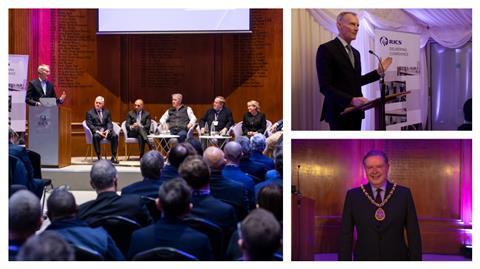
Success, they argue, can be seen in their membership numbers which have increased from just over 92,000 in 2021 to more than 100,000 in the UK at the start of this year, which rises to over 140,000 including global members.
The global brand is increasingly important, with Gulf states being its fastest-growing region. Maclean, with his knowledge of the Middle East, says one reason for this is that clients of big building projects or infrastructure developments see the value of RICS members.
Internationally, he says, the RICS’s standards are a major “export” and driver of its global influence. Foreign governments, he says, are increasingly adopting RICS valuation principles and other standards to build market credibility and attract inbound capital. He also sees opportunities for the institution’s standards in Europe post-Brexit and in the US, especially in the fast-growing data centre sector.
Middle East market and the Iran conflict

Maclean says his contacts across the Gulf remain calm and focused on the long term, with alert systems across the governments of the GCC functioning well and no widespread desire among professionals to leave. While the conflict is “tragic”, he believes the region’s record of rebounding from past shocks will hold again.
“There is a general consensus of, ‘This is a tricky situation, but we’re here for the long term’,” he says.
He acknowledges the dramatic turn of events will have an impact: “I’m not foolish enough to say that this is not going to have an impact short term on the economy. Of course it will, particularly from a tourism perspective.
“But [the Gulf states] coped with the 2008 situation, the 2013 situation and covid. And I would say [they] seem to have come out stronger through all those circumstances. I think that’s going to be the same.”
At the moment, we’re scaling up the opportunity to get more people qualified within the region. I don’t see any change in that plan
He adds: “There’s an uncanny knack for the countries of the region to rebound more strongly. I don’t know how they do it, and I think other governments around the world could probably learn lessons from them.”
He is similarly optimistic about the RICS’ own membership plans in the region, saying: “At the moment, we’re scaling up the opportunity to get more people qualified within the region. I don’t see any change in that plan.
“If this development boom is going to continue – which I think it will into the medium term – then we need to put more resources on the ground and help more people become qualified. Because what we are hearing from the governments, the regulators in the region, is that they want us to be more involved particularly in Saudi Arabia and the UAE. So we’re not reshaping our plans as a result of the actions this week.”
He concedes that, even before the recent crisis, some consultants had seen development work drop off, particularly in Saudi, but says the scale of some of Saudi’s ambitions means it was “almost inevitable” that the delivery was going to take longer than people forecast.
He describes this as an “elongation of delivery, as opposed to outright cancellation” and says the workload experienced by consultants in the past five years “was not sustainable indefinitely”.
He adds: “I think the other component is we’ve not got to the construction stage of many of these projects. And that, in itself, is going to be a catalyst for further growth.”
As for Iran, he speculates that if the current crisis did ultimately lead to a change in direction for the country it could open up the region even further. It is hard to see beyond the current high-stakes stand-off between Iran and the US, and the fear among many commentators is that regime instability could lead to internal violence, mass movement of refugees and wider economic uncertainty as the chaos impacts the oil and gas markets.
But, if sense does somehow prevail, Maclean says there is an alternative scenario for Iran: “You’ve got 100 million people [in Iran] who are not actually taking part much in the economy of the Arabian peninsula at the moment, but the economic potential for mobilising is huge.”
Beyond George Street: new ways of engaging with the membership
How about the criticism from some quarters that the RICS leadership needs to “get out of George Street” – as one member put it – and visit the firms around the country that employ their members? The distance between the institution’s carefully worded strategies drafted in London and the commercial hard realities faced by many companies around the UK is a familiar gripe that has not gone away. But is it fair?
Maclean and Young argue that it is not, and say a key plank of improving member engagement is its policy of decentralisation. This has involved shifting budgets and personnel from the London headquarters to the regions, where the RICS aims to empower local boards and ensure it is responsive to local market needs.
Another initiative that is being considered is a representative body within the organisation specifically for SMEs, which make up 70% of the membership.
Three years ago we had 700 member volunteers. Today, we’re 1,800
Nick Maclean
Engagement with the large global firms is also being strengthened through dedicated forums, such as a construction forum for QS leaders and a property advisors forum for CEOs of major consultancies, which have their own specific business needs.
A statistic that Maclean and Young track is the number of member volunteers, who are on various RICS committees. Maclean says: “Three years ago, we had 700 member volunteers. Today, we’re 1,800. So we have more than 1,000 people who have stood up to say, ‘actually, I want to be a part of this organisation’. We don’t pay these people.”
Professional standard: Responsible use of artificial intelligence in surveying practice

The RICS’s new standard takes effect this month (March). It states:
Members and RICS-regulated firms which use AI systems with a material impact on the delivery of surveying services must make clear to clients, in writing and in advance of using those AI systems, when and for what purpose AI is to be used.
The terms of engagement, contractual documents, service agreements and other relevant documentation used by members and RICS-regulated firms to govern their client relationships must detail in writing:
• When AI will be involved in the delivery of a surveying service
• The parts of the process for delivery of a surveying service in which AI will be involved
• If available, the extent of professional indemnity cover for use of AI systems by the firm
• The internal processes to contest the use of an AI system
• The processes to seek redress if a client feels they have been negatively affected by the use of an AI system, and
• How a client can opt out of the use of AI systems in the delivery of a surveying service, if at all
Policy influence
Looking outwards, Maclean and Young say the organisation has ramped up its engagement with the UK government, providing expert advice on major reforms related to building safety, leasehold and planning. They see the RICS has playing a key role in advising politicians and civil servants, who are just across the road from them, on the unintended consequences of new legislation, such as post-Grenfell gateway systems.
They also think they have got better at working with other professional bodies representing engineers, architects and planners to present a unified “voice from the built environment” to policymakers.
Changes to post Grenfell are very honorable and valid but we need to have a practical approach to making sure […] we have enough professionals to be able to make the gateway system work
Nick Maclean
On building safety Maclean says: “Changes post Grenfell are very honorable and valid, but we need to have a practical approach to making sure […] we have enough professionals to be able to make the gateway system work for developers.”
Rebuilding the RICS’ reputation from the crisis it found itself in 2021 has been a slow process. Maclean and Young are hoping members are now starting to feel the benefits of their work coming through, and that 2026 will be the year they can pick up the pace and stop looking backwards at the internal mistakes of the past.
Members will want the institution’s focus to move rapidly beyond the confines of George Street and towards their own fast-changing companies and careers. Asked what a successful presidential year would look like Maclean says: “Rekindling the confidence that our clients have in us and our members have in the institution is important. And if I make any contribution to this organisation, that’s what I would be most proud of.”
RICS timeline: Changes at the top

Sept 2021 Alison Levitt publishes independent report into a row that started back in 2018 and resulted in the unfair dismissal of four members of the governing council in 2019. Nick Maclean works closely with Levitt in his role on the governing council taskforce.
Sept 2021 Chief executive Sean Tompkins, president Kathleen Fontana, governing council chair Chris Brookes and management board chair Paul Marcuse all stepped down
Oct 2021 RICS appoints interim chief executive Richard Collins, who the following month writes an open letter in Building saying “We will make you proud to be RICS members again”
June 2022 Civil servant Michael Bichard publishes his independent review into the purpose and strategy, recommending a shake-up of senior roles and the governance structure, as well as committees to improve services for members and future reviews every five years
Aug 2022 Bichard appointed interim RICS senior independent governor
Dec 2022 Martin Samworth appointed RICS chair
June 2023 Appointment of new CEO Justin Young, formerly COO at Knight Frank
June 2023 All 10 members of Standards and Regulations Board, chaired by Dame Janet Paraskeva, resign in protest over plans to by the governing council to break up the board and transfer responsibilities for technical standards to the newly established knowledge and practice committee
July 2023 RICS names replacement members of Standards and Regulations Board
July 2023 Newly elected members join the re-constituted governing council, with terms lasting one and a half or two and a half years
Jan 2024 Liz Peace replaces Bichard as RICS senior independent governor
Jan 2024 Maclean becomes senior vice president
Jan 2025 Justin Sullivan becomes RICS president, Maclean is president elect
Mar 2025 Sullivan steps aside as RICS president and refers himself to the Standards and Regulation Board over his involvement in legal battle over a £32m moth-infested mansion. Mclean takes over as acting president
Jan 2026 Maclean becomes RICS president, Maureen Ehrenberg as president elect and Susan Eickermann-Riepe senior vice president







No comments yet