
















A few years ago, it was supposed to be on its last legs as tenants downsized and moved out. Now it’s going to be home to the biggest office building in London. ’It was all rubbish,’ Tom Venner tells Dave Rogers

“London is competing against every European city for business and international cities too. We are part of the London offering and I believe you get the best quality real estate in Canary Wharf.”
A few years ago, the obituary of Canary Wharf was being written by some. In the wake of covid and office working patterns changing, what was the point of a place like Canary Wharf with all its, well, offices? The narrative was fuelled by several long-term tenants – notably HSBC – deciding to leave the Wharf, as lots call it, for smaller space elsewhere.
But Tom Venner, Canary Wharf’s chief development officer, is having none of it. “It was never dying,” he says. He sounds genuinely baffled that people ever thought it was. “It’s transformed fundamentally in the past five or six years.”
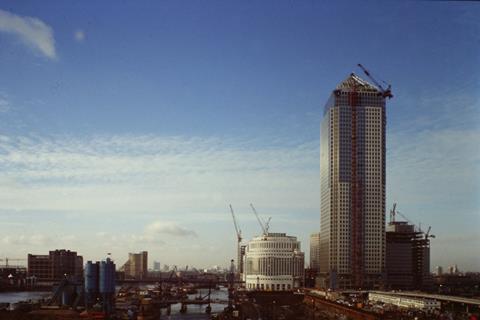
It was purpose built for offices with towers like One Canada Square and the Fosters-designed HSBC block becoming London landmarks.
“That’s been incredibly successful for us the past 30 years. We briefed the best architects in the world and we built great things,” he says. “Since then, we’ve been on a massive evolution into residential, life sciences, all sorts of different occupiers. We’re not just financial services anymore.”
By 2028, he says, just 55% of the Wharf will be what people have known it for: finance. When it started back in the 1990s, it was over 90%.
Over 3,500 people live at Canary Wharf which is set to double in the next few years, there are more than 300 retailers on site, along with hotels and leisure. “Come here at the weekend and it’s really busy,” Venner adds.

JP Morgan’s HQ: a defining moment
All in all, Canary Wharf is feeling pretty chipper right now not only because of the record footfall the estate pulled in last year – 72.6 million – but also because of the news, announced last November, that US bank JP Morgan Chase will build a new headquarters at the site.
JP Morgan coming is enormously significant for Canary Wharf, massively significant for London
Venner adds: “JP Morgan coming is enormously significant for Canary Wharf, massively significant for London.”
It was such big news that a quote from chancellor Rachel Reeves was pasted into the press release announcing it all.
The building at a site called Riverside South is being drawn up by Foster & Partners, the practice which worked on JP Morgan’s recently opened global headquarters in New York, but the scheme is at an early feasibility stage with details of its height and what it will look like still under wraps.
What is known is that it will run across three million sq ft and be home to 12,000 employees while flight path regulations in the area mean it cannot be more than 265m high. Some think it could end up being two buildings, given the amount of space being planned.
No one is really allowed to talk about it at all because it’s all very hush-hush. But Venner does say: “Height is not the most important factor here. It’s statement architecture. It’s about their people and client experience. [JP Morgan] want people to come in and go ‘oh my good God’.”
Canary Wharf is working as a co-developer on the project and Venner adds: “Our job is to help them deliver a scheme that works for them and get it delivered. Whether that’s us or someone else [who builds it], to be confirmed.”
In the meantime, Gardiner & Theobald has been appointed to a preliminary cost consultancy role on the job with the firm helping out with early feasibility work. And that’s about it as far as what is publicly known about the scheme.
Who will build it, as Venner says, remains up in the air. He won’t be drawn further, other than to say he hopes it will be Canary Wharf Contractors, which has been responsible for much of the estate’s development over the years.
But, equally, it could be a tower builder like Multiplex or Mace – both of whom are interested. “It’s to be decided [who builds it],” he says. “It’s entirely a call for JP Morgan but it’s not yet something we or they are thinking about.”
What he will say is this: “It’s important that the world’s most valuable bank has said that Canary Wharf is the place where they want to house their European headquarters.”

There is no doubt the estate is cock-a-hoop about the news. Its chief executive Shobi Khan admitted at the time: “It marks a defining moment for Canary Wharf.”
When work will get going is not really known although Venner thinks that with a fair wind, it could be as early as next year. It has the advantage of the basement having been completed by Expanded when a proposal by RSHP for a twin-tower scheme at the site was stalled in 2010 because of the financial crash. JP Morgan was the client then, having chosen the plot as the location of its European HQ.
But there’s a heap of other schemes going on that Venner wants to talk about as well.
Last year, Canary Wharf saw its highest level of office leasing in over a decade with UCL School of Management and Visa among those taking space – both at the One Canada Square tower.
Also announcing that it was taking up space was HSBC which in 2023 said it was leaving the 42-storey tower, its headquarters since 2002, for a new site at St Paul’s. For many, that news began the whole ‘Canary Wharf is dying’ narrative.
A lot of organisations took decisions at a really unusual time in the market – covid, basically. Some acted very quickly on those feelings
Diplomatically, Venner says: “A lot of organisations took decisions at a really unusual time in the market – covid, basically. Some acted very quickly on those feelings.”
There’s no hard feelings for those that decided to leave or those that decided to leave and then come back. “HSBC has been very proactive with us.”
But, again, news that the bank was taking 11 floors of extra space in Canary Wharf, because of a squeeze on space at its new headquarters, must have been the equivalent of Canary Wharf sticking two fingers up to all the naysayers.

HSBC has signed a 15 year lease on 40 Bank Street which amounts to 210,000sq ft and HSBC chief operating officer Suzy White said at the time, possibly a little sheepishly: “We are delighted to be retaining a presence in Canary Wharf [and] continuing to operate from multiple sites in London, as we always have.”
HSBC tower reimagined
Canary Wharf appointed KPF nearly two years ago to come up with a plan to reimagine the HSBC tower, whose official address is 8 Canada Square, which the bank will move out of next year. Its proposal will see chunks carved out of it and a 180-room hotel put into its top floors. Venner says of the plan. “There won’t be any residential. It will have a bedrock of office but it will definitely have a leisure element.”
Planning documents submitted last month outline plans to turn the top seven floors of the 45-storey tower into a 180-bed hotel and leisure space, which could include a bar and a restaurant. The group also wants to turn the bottom two floors into retail space and construct a new promenade linking the building to the nearby Elizabeth Line station
We have invested in loads of different interventions in the public realm. It feels a nicer, softer, warmer place
In some ways, its plans for the HSBC tower are a microcosm of its wider reinvention. Venner says: “We have invested in loads of different interventions in the public realm. It feels a nicer, softer, warmer place.
“We’ve invested heavily in the amenities of the place. That has encouraged people to come here seven days a week. It’s busy here every day.”
He’s speaking a few weeks after the Wharf had its record ever footfall in one day of 325,000 during Winter Lights, a free light art festival it stages every January.
Venner says this success hasn’t happened by chance. “We deliver the right product at the right time into a supply constrained market whether it’s residential or diversifying the existing office estate.”
As well as 8 Canada Square, the firm is looking at revamping 10 Cabot Square which has seen architect Howells submit plans to part-demolish and add three floors to the 10-storey office building completed in 1991 by architect SOM.
Overbury is continuing to overhaul 25 Canda Square for US bank Citi – the cost of which has topped £1bn making it Overbury’s biggest ever job – while Canary Wharf has plans to overhaul its next-door neighbour, 33 Canada Square, another Fosters building which was completed in 1999.
At 105m high, it is smaller than the 200m-high 25 Canada Square which was completed in 2001 under a design drawn up by César Pelli. Venner says that with 33, which received planning last month, Canary Wharf wants to deliver a “a more sustainable, market-leading office building” with a design drawn up by TP Bennett. Another long-term tenant, Morgan Stanley, wants to overhaul its building at 20 Bank Street too.
Look at the City and count the cranes, there’s hardly any. Canary Wharf is buzzing
For Venner it’s the thing about the right product at the right time again. “We have an opportunity to create some amazing product. Look at the City and count the cranes, there’s hardly any. Canary Wharf is buzzing [Canary Wharf says around 2,000 construction workers are on site]. We’re positive about the market. If I was another landlord in the City, West End, South Bank I might be feeling slightly different.”
Its schemes at 8 Canada Square, 33 Canada Square and 10 Cabot Square are, Venner says, its big three office jobs with expected capital costs of £2bn.
He says work on these three offices set for a finish by 2030. “8 Canada Square will be like something London has never seen,” he adds. “A building of scale and height that is publicly accessible. It’s an opportunity to create something quite special.”
Life sciences and diversification
But there’s a planned life sciences building Kadans is developing at One North Quay, due to finish in 2028, while a swathe of residential has gone up with more due. Its centred on Wood Wharf with 2,500 units already built and a further 1,300 planned.
A couple of years ago it set up several frameworks for consultants, including cost consultants, project managers, M&E, planning and structures. “We are more efficient as a result,” Venner says of these moves. “We have a community of consultants working together who learn from each other and get better.”
We have a community of consultants working together who learn from each other and get better
It doesn’t have a framework of architects but as well as Fosters, KPF and Howells the firm is also working with practices such as Grid, Darling Associates, TP Bennett, Pilbrow & Partners – mainly on its residential schemes.
He has a tip for architects looking to get work at Canary Wharf. The estate holds architecture competitions for all its jobs and he says: “What sets some apart from others are those who have done their own research and thinking and come up with their own ideas before they walk through the door.
“They’ll understand the technical issues in the retrofit space. Those are the ones who set themselves apart.”
Modular construction challenges
While Venner remains overwhelmingly upbeat, there has been one fly in the Canary Wharf ointment – a serviced apartments scheme at One Charter Street on Wood Wharf.
It was being built by Caledonian but the modular firm collapsed into administration in March 2022 and Venner admits the 279-key development has “proved very difficult” ever since.
As a result, the 20-storey building is late – he’s reluctant to say how late – but Venner reckons it will be finished in May.
He thinks MMC is great for the industry but his experience at One Charter Street has left him needing to be convinced more about modular. “You’re trusting that whatever is happening in a factory is actually happening.”
Caledonian isn’t the only modular firm to sink and Venner is at a loss to know why it keeps happening. “Why they keep going bust, I don’t know. There’s very few out there with the strength to deliver a job like this [One Charter Street]. From a developer’s perspective, that’s a big ask.”
He adds: “The quality of the output is yet to be of a standard where people like us can trust it.”
As a result, the job has gone back to traditional on site building methods. “If you have multiple trades [on site] they can all see each other working and hold each other to account.”

It will be four years this summer since Venner arrived at Canary Wharf after a decade at Landsec and. later, five years as commercial development director at HS2. “I’m very lucky,” he says, “a lot of people have been here 30 years and others for five minutes. Everyone is totally invested. The construction team are really proud of their work.”
He is too and speaks like a Wharf veteran. Canary Wharf is not dead, never was, he says. “I challenge anyone who says that to come here, walk around and see for themselves.”







No comments yet