















The ascent of Andy Burnham has pushed the issue of regeneration up the political agenda with many in the industry sensing new opportunities. Regen Connect has continued to track billions in funding, major project approvals and the way regeneration is shifting across the UK. Here is a summary of the campaign’s activity in the second quarter
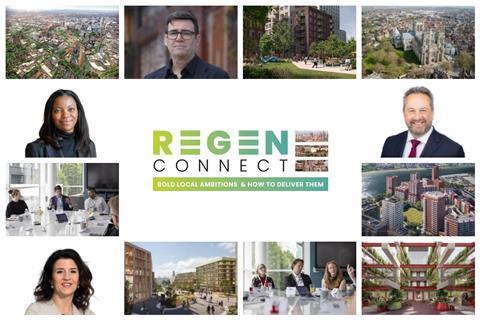
If the first three months of Regen Connect charted an industry testing new funding and delivery models amid a new era for regeneration, the second quarter has been defined by a single, dominant story. It’s a story that has put devolution at the centre of the debate: the rapid ascent of Andy Burnham to Number 10.
Following Keir Starmer’s resignation in the wake of Burnham’s Makerfield by-election win, the former Greater Manchester mayor used a series of set-piece moments - culminating in a state-of-the-nation speech in Manchester in early July - to lay out what he called “Manchesterism”: a plan to rebalance power away from Whitehall, anchored by a new prime ministerial outpost, “Number 10 North,” based in the city.
Burnham’s pledges are sweeping in ambition if light on mechanics: the biggest council housebuilding programme since the post-war period, devolution of housing, employment support and utility oversight to combined authorities, and a promise of “good growth in every postcode.”
For an industry wrestling the funding and viability pressures, the prospect of a prime minister drawn directly from the devolution movement - and prepared to use development corporations, good growth funds and regional housing banks as delivery vehicles - is potentially the biggest shift in regeneration policy we have seen in years.
Industry reaction has been positive but wary. Developers and housing bodies have broadly welcomed the renewed focus on housing and devolved powers, while economists and cost consultants have pressed the same question repeatedly: who pays, and how. With capital spending constrained by defence costs and no clarity yet on funding for a national housebuilding drive, the sector’s optimism is tempered by a familiar demand for detail.
Beyond Westminster and Manchester, the deals, planning approvals and completions kept moving. This quarter saw further action on mayoral development corporations or zones in Liverpool, York and North Yorkshire, and East Birmingham, alongside a steady run of stories about major schemes from Salford and Bradford to the Old Trafford stadium masterplan - suggesting that, Burnham or no Burnham, the machinery of regeneration is already shifting towards a more devolved, corporation-led model.
Our Regen Connect campaign has continued to publish deep-dives on different part of the UK, including covering the UK Design Capital of the Year Award for 2026, which recognises cities leading the way in architecture, placemaking and regeneration as part of the Architect of the Year Awards.
What will a Burnham premiership mean for regeneration?

Those wondering what Andy Burnham in Number 10 will mean for regeneration and the built environment were immediately given a few clues in June following his victory in the Makerfield by-election.
Burnham pledged the ‘biggest rebalancing of power our country has seen”, with a new “Number 10 North” office working to extend devolution as part of his “Manchesterism” agenda.
Number 10 North will be given three “clear tasks,” Burnham said: reforming essential utilities; reindustrialisation and regeneration of places, to be delivered through a series of new 10-year plans which regional authorities will be required to write.
But what will this actually mean? Building in July looked at the potential significance of all of this.
The expansion of Number 10 North would seemingly cover the aforementioned three tasks the Treasury would normally have a definitive say over. Therefore the Treasury – which the soft left of Labour has long been suspicious of and often perceived as too cautious- could lose some of its power.
Burnham’s speech also hinted he would focus on regenerating left behind towns through public development corporations and regional banks, as opposed to green belt development.
Burnham also pledged to push for equivalent living conditions in all part of the UK and talked about consolidating public and private at a place-based level. Greater public control of services, such as utilities was also hinted at, along with more public-private partnerships and more powers for London over housing. Whether Burnham’s push for more “council house” building will mean less influence for housing associations remains to be seen.
It is clear Burnham is interested in regeneration and in new models for devolving power and funding to local areas while attracting private investment. This is already generating optimism in the industry.
Renew campaign
Those making the case for more devolved funding for regeneration therefore may be feeling that they will be shortly pushing at an open door.
One organisation that is certainly aiming to influence the regeneration debate is social housing provider group the Northern Housing Consortium through its Renew inquiry,
The inquiry, chaired by Lord Richard Best and backed by Muse and Homes for the North, in its interim report found housing-led regeneration could unlock more than 500,000 homes in the North of England - with the right support.
It calls for a new, £500m-a-year place-based regeneration fund, devolved to mayoral strategic authorities. It also calls for a dedicated regeneration finance facility delivered via Homes England’s National Housing Bank which includes a specific appraisal framework that ‘captures the full social and economic case for regeneration’.
The report, launched at a parliamentary reception attended by Regen Connect, also makes the case for a dedicated minister for regeneration and for a new National Centre for Regeneration based in the north.
As it works up its final report the inquiry is in a strong position to influence Burnham’s ministers.
Projects and pipeline: where activity is happening
New development corporations and other new models
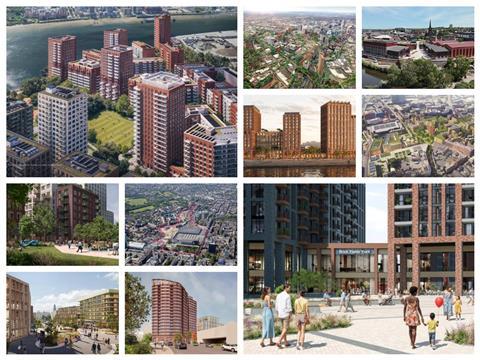
If Burnham’s intention is to use public corporations as delivery vehicles to boost regeneration, he will perhaps have been encouraged by activity around the country to set up the bodies.
The mayor of the West Midlands in May launched a new development corporation to lead on the regeneration of East Birmingham.
The Birmingham East Mayoral Development Corporation (BEMDC) will be responsible for an £11bn regeneration project spanning 422ha, or the size of more than 600 football pitches.
In Liverpool meanwhile, The Liverpool City Region Combined Authority and Liverpool city council is consulting on proposals to establish a mayoral development corporation for Liverpool’s North Docks. If approved, the Liverpool North Docks MDC would deliver an extension of the city centre, including up to 17,000 new homes, five million sq ft of new commercial space and new green space on 174ha of brownfield land.
Sadiq Khan’s existing Old Oak and Park Royal Development Corporation is stepping up its activity and is searching for a development partner for a £12bn urban district across roughly 31 ha of brownfield land in west London.
Khan also in June announced a £100m equity investment in a 7,000-home major regeneration scheme at Silvertown. The deal means City Hall has become an active developer for the first time.
And in York and North Yorkshire, the combined authority is proposing to establish three mayoral development zones (MDZs) to develop Scarborough, the Selby Growth Zone and York Central. MDZs allow a mayor to lead on bringing together developers, landowners and the local authority to attract private sector investment and align public sector funding.
Mapping regeneration activity
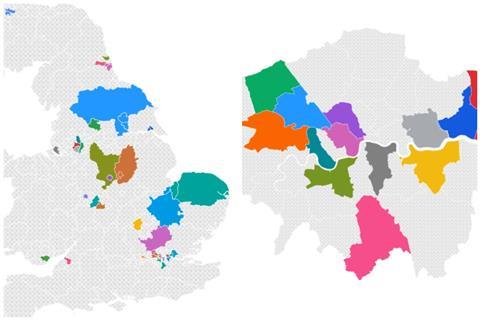
Regen Connect’s interactive map provides a view of regeneration activity across the UK, tracking planning approvals, funding announcements and project pipelines.
Users can zoom in to find details or developments by local authority area, offering a picture of where investment is being directed and how activity is evolving geographically.
The map is updated regularly, and you can explore it by clicking the link below. And if you know of a project that should be on the map, get in touch via the links at the end of this article. We have also produced a separate map for London
Top 10 projects
Here are 10 individual projects that have made the headlines over the past few three months:
- Ballymore’s 1,700-home Silvertown scheme gets go ahead Towers scheme is Ballymore’s second major consent in the Newham regeneration district this year
- Work set to begin on next 900-home phase of £1bn Salford regeneration Canalside Middlewood Locks scheme has delivered 1,300 homes to date
- Plans to double size of Bradford city centre unveiled New rail station and tram line could support 5,000 new homes at Southern Gateway project
- Homes England looking for developer to turn 1970s Nottingham shopping mall into new homes Stalled scheme will replace Broadmarsh centre with 1,000 homes and new offices
- Wolverhampton Council seeks feedback on 6,700-home city centre regeneration plans Wolverhampton Council has launched a public consultation on a new regeneration framework for the city centre.
- Plans in for first 500 homes at major quayside regeneration scheme in Glasgow Peel Waters proposes £100m co-living towers on city waterfront site
- Consultation on Euston masterplan begins Plans to redevelop area around station due to be sent in next year
- Rotherham Council brings forward plan for more than 200 homes Final proposals set to be brought forward next with Capital&Centric taking leading role
- Sunderland council and Muse sign agreement for 1,000-home regeneration plan Masterplan will be drawn up for site in middle of city
- More than 1,000 homes in Derby get council thumbs-up Scheme being developed by shopping centre owner Derbion
- Muse and Homes England submit plans for 1,500-home Slough regeneration Pair proposing to redevelop former university site in town centre
Design Capital of the Year and Voices of Regeneration
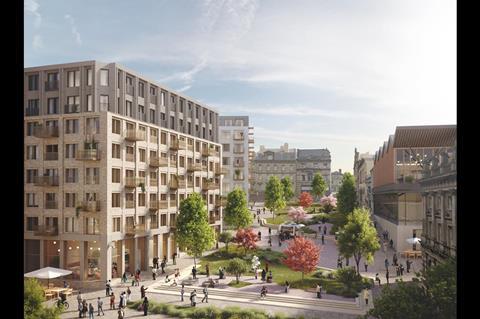
The quarter saw the announcement of the UK Design Capital of the Year Award shortlist, which is part of the Architect of the Year Awards.
Regen Connect is profiling each of the four shortlisted cities, starting on 6 July with a focus on how regeneration is driving the revival of Bradford.
This was followed by a deep-dive into York which has completed a collection of visionary projects which has started to forge a new identity for the city.
We will also be profiling Cardiff and Plymouth in the coming weeks.
Regen Connect continued its series of interviews with key figures in regeneration in different parts of the UK.
In April we interviewed Matt Forrest, the chair of the new Tees Valley Housing Partnership, on the regeneration challenges and opportunities in the north east region. A big takeaway was the importance of social regeneration, as opposed to physical regeneration of buildings and estates.
Much of the focus in the national regeneration debate has been on major city regions but Regen Connect this quarter has also sought to highlight how borough or district councils with smaller budgets can make the most of regeneration opportunities. One borough we highlighted was Newcastle-under-Lyme Borough Council, which has reshaped its town centre through three imaginative inter-linked projects. Its deputy chief executive Simon McEneny told Regen Connect more about the projects.
People and comment
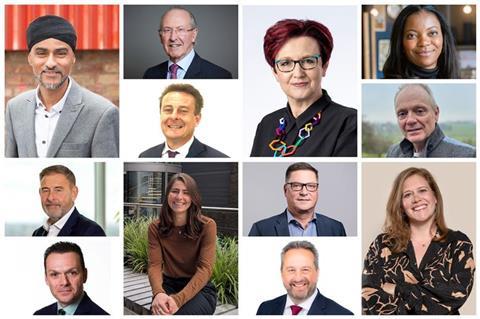
To support the campaign, Regen Connect has convened a panel of senior industry figures spanning development, investment, construction and advisory roles.
The panel is helping to shape editorial priorities, identify key issues and contribute to the campaign’s final report - which will be published at our Building the Future Conference in October - ensuring that coverage reflects the most pressing challenges and opportunities facing the sector.
The 12-strong panel includes leaders at tier one contractors as well as those with investment, legal and advisory expertise in the world of regeneration from across the built environment, they are:
- Dav Bansal, partner at Howells
- Lord Richard Best, crossbench peer
- Jasmine Ceccarelli-Drewry, director, place strategy & social impact, Avison Young
- Ben Denton, head of strategic growth at L&G
- David Lunts, board member, Clarion Group and vice chair, Joseph Rowntree Foundation
- Simon Marks, city executive for the midlands, Arcadis
- Alex Notay, chief executive, Housing Forum
- Olaide Oboh, managing director, Populate
- Mary Parsons, national regeneration and partnerships director, Lovell Partnerships
- Leigh Thomas, managing director, Kier Property
- John Wilkinson, chief operating officer, BAM
- Paul Woodhams, managing director for regeneration, McLaren Construction
Opinion columns
This quarter has seen Regen Connect gather exclusive insight and opinion from major figures across the built environment. Here is a selection of the best.
To ensure the industry is making the most of the regeneration opportunity it is important to ensure developments create lasting value for communities rather than simply provide buildings.

Olaide Oboh, managing director of Populate and Regen Connect panel member in June wrote a piece arguing social value needs to be embedded in procurement from the start, not treated as a compliance exercise.

The return of public private partnerships was a hot topic at UKREiiF and in the industry more broadly and appears to be something Burnham is interested in.
Leigh Thomas, managing director of Kier Property, argued in a piece in June that they must retain the strengths of private sector efficiency and innovation, while embracing greater flexibility and transparency.

Our pieces this quarter also looked at more practical questions about how to make regeneration work.
One issue tackled by Richard Bonner, managing director buildings and places at AtkinsRéalis, argued that the UK’s pipeline of schemes will only move forward if early-stage business cases give investors confidence on value, risk and deliver.
Bonner gave his thoughts in an op-ed setting out how putting the right funding, capability and expertise in place to develop robust business cases is key to building a pipeline that can attract capital at scale and sustain long-term delivery.

While the industry could do more to develop better business cases, government could also do more to make it easier for regeneration projects to access affordable homes funding.
Mel Barrett, chief executive of £450m-turnover housing association Metropolitan Thames Valley Housing argued current funding rules are too restrictive. Under the £39bn Social and Affordable Homes Programme, Homes England currently restricts funding for regeneration – as opposed to new build - to 10% of allocations. Barrett acknowledges this is to ensure supply is increased but argues the rule risks constraining schemes which create additionality alongside improvements to older, less suitable homes.
Regen Connect leading the debate at UKREiiF
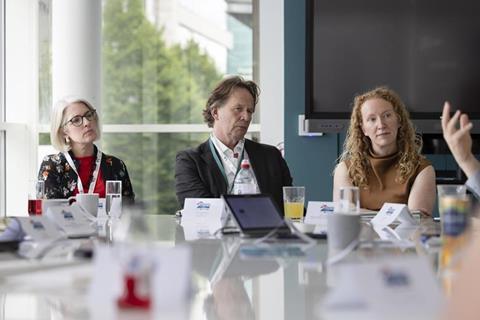
A total of 17,000 people, including investors, local authorities, developers, construction firms and politicians, descended on Leeds in May for the annual UKREiiF conference.
Our team of journalists dipped in and out of the dozens of place-based pavilions, reporting on the latest regeneration debates.
Whether it be devolution opportunities and challenges, funding issues, the prospects of a comeback for PFI or the use of stadiums as regeneration landmarks, there an impressive range of talking points and Regen Connect pulled all the key takeaways into a single guide.
But Regen Connect was not content to merely report on the conversation, we also sought to lead it by convening roundtable discussions with senior figures from across the indutstry. One discussion focused on the government’s devolution initiatives are reshaping regeneration, and what still needs to happen for the sector to deliver at scale.
A second roundtable looked at the roadblocks to regeneration, including fragmented funding and strategies to competing priorities, and how these can be overcome
Regen Connect
Next few months
The next phase of Regen Connect will focus on turning insight into action and identifying what needs to change to unlock regeneration at scale.
In the coming months, the campaign will continue to:
- Publish regional deep dives and project analysis
- Explore funding, policy and delivery challenges
- Feature perspectives from across the industry
Click here for more from the campaign
These insights will culminate in a major report to be launched at Building the Future in October.






No comments yet