













In the latest in our Voices of Regeneration series, Simon McEneny explains how a small Staffordshire town is drastically revamping its town centre in a bid to revive the High Street
When one thinks of regeneration projects it is tempting to look solely at the biggest cities, combined mayoral authorities and metro mayors. After all, there are schemes involving tens of thousands of homes, swathes of land and seriously huge levels of investment and collaboration shaping the future of our regions.
If however the United Kingdom is to seize the regeneration opportunity, it is vital that imaginative regeneration happens at a smaller scale also.
Regeneration can also be used by smaller borough or district councils to revitalise town centres and reshape places, creating economic and social value.
One town that is showing just what regeneration can do is Newcastle-under-Lyme in Staffordshire, which has embarked on an £85m strategy to revitalise its town centre with Capital & Centric, the Manchester-based developer known for taking disused buildings and regenerating them.
The plans involve the re-use of three inter-linked town centre sites: redevelopment of a shopping centre, a multi-storey car park being turned into housing and an old civic centre being demolished for a new car park and homes.
As part of our Regen Connect series, Building spoke to Simon McEneny, deputy chief executive of Newcastle-under-Lyme Borough Council, while at UKREiiF to find out more about the plans.
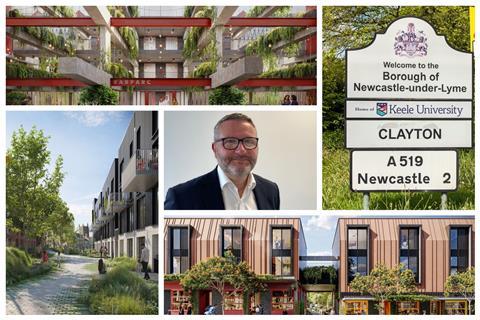
Builidng finds McEneny on the local authority’s UKREiiF stand, surrounded by pictures and diagrams of projects and pipeline opportunities in his borough. There is an ambitious message for such a small local authority with small urban centre – the population of Newcastle-under-Lyme itself would almost fit into Manchester United’s Old Trafford stadium.
McEneny starts by reflecting on multiple grant funding awards made to the authority in a short space of time back in 2020 and 2021, which he saw as an unprecedented opportunity for the borough. The council received £11.4m in from the Future High Streets Fund in 2020 and then followed this up by securing £43m from the Town Deals Fund (since consolidated into the Local Regeneration Fund) along with £4m of revenue funding through the Shared Prosperity Fund. Last year it secured a further £18.9m for land remediation through Homes England.
An unprecedented funding opportunity
“Newcastle-under-Lyme has never had any real government grant funding in its history, since 1974 [when it was founded],” says McEneny.
“We realised we needed to do something to change the nature and feel of the high street because it is just dead, we’ve got very few national brands. We’ve got a few little artisan shops but it was sort of dying.
“How do we create something which is really quite exciting with the money we’ve got? Because we’ve only got this one chance, we’re probably not going to get this money again.”
The approach taken by the council and McEneny shows how multiple sites can be used together as part of a cohesive regeneration plan for a town centre, with each site’s usage impacting others.
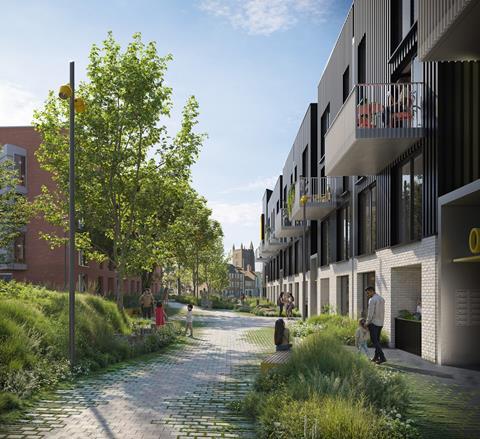
The Ryecroft site: hotel, car parking and new homes
McEneny says he realised the town needed a hotel as it was missing out on attracting visitors. “We don’t have a decent three-star offer in the area, even though we’re about an hour away from Alton Towers, which is one of Staffordshire’s biggest tourist attractions.”
But McEneny says he could not get a hotel brand interested unless there was sufficient car parking space. Therefore the council purchased the vacant Ryecroft site and demolished some 1960s municipal offices. It is now working with Capital & Centric to build a new 455-space multi-storey car park and the hotel, along with 130 flats in three blocks, with later living units built by McCarthy & Stone and affordable housing managed by housing association Aspire Housing.
McEneny says that the provision of a brand new car park left the council with a disused Brutalist Midway multi-storey car park built in the 1960s.
McEneny says: “The frame is still strong, it’s concrete and I didn’t want to knock it down because it will cost a fortune and will only have to rebuild the site with something else.”
Instead McEneny spoke to Tim Heatley, boss of Capital & Centric who he says found the concept of converting the car park into housing “interesting.”
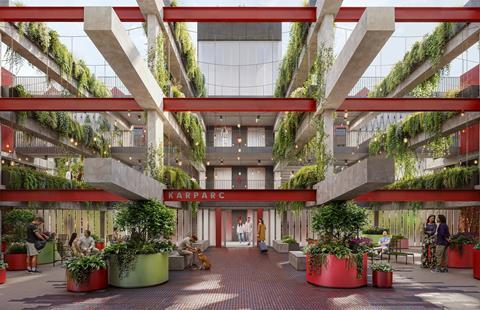
The five-storey car park is now being transformed into 110 flats designed by architect Shedkm. The project, believed to be the first of its kind in the UK, will also see rooftop extensions, communal gardens, and a three-floor atrium with a social hub, gym, and mini-cinema.
Reimagining the town’s shopping centre
The third of the three linked projects at the heart of Newcastle-under-Lyme’s regeneration plans is the old York Place shopping centre. The 1960s building is currently being revamped, again by Capital & Centric.
The centre will retain the existing structure. It is being refurbished to include shops, bars and cafes, a new public square, 42 homes and a new music venue. McEneny says the centre will be renamed “Astley Place” after Philip Astley (the father of the modern circus) who grew up in the town.
McEneny says the former circus owner, who pioneered the circus ring, is of “cultural importance” to the town, so the three projects include circular public spaces or “rings” as a homage.
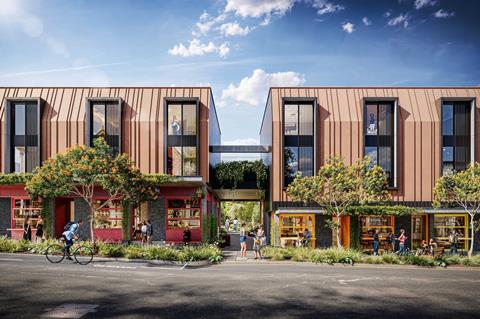
“Tim [Heatley of Capital & Centric] and his crew have taken our idea of the circles and created these three developments that are interlinked, but there are urban parks or places of interest where people can populate and own the space across the town and just make it make people’s interactions with the town a lot different to just walking through,” he says. The shopping centre is due to complete by Christmas, the Midway car park by next May and the Ryecroft scheme by the end of 2027.
McEneny sounds confident about these timelines. He also sounds confident about the council’s risk level in the schemes.
De-risking the deal
Under the deal, Capital & Centric will buy the scheme back off the council upon completion for whatever the council has spent or the value of the development, which ever is higher.
The three schemes
The three inter-linked projects will deliver 328 homes, 8 new bars, restaurants and cafes and a community use music venue in addition to landscaping.
Developer: Capital & Centric
Contractor: AC1 Construction, Clegg Construction and HBC Construction
Architect: ShedKM
Start on site date: December 2025
Expected completion date: The shopping centre is due to complete by Christmas, the Midway car park by next May and the Ryecroft scheme by the end of 2027.
This, plus the £18.9m funding from Homes England means the council has “de-risked the investment.”
He says: “The council didn’t want the financial responsibility of it. So, we have been de-risking that, because Capital & Centric have got a tried and tested model and they own it after [completion].”
We move on to talk about other regeneration strategies. McEneny has a vision of turning Merrial Street, which runs through the middle of the three schemes, into an “independent artisan street”.
“We’re not going to get big brands back on our high street […] we’ve tried, but they’ve left and they’re not coming back,” he says. Instead the council is looking at incentives, such as time-limited reductions in rent or paying for new window fronts to incentivise shopkeepers.
Local government reorganisation
Newcastle-under-Lyme council’s new Reform leadershipn is an obvious topic of interest. Reform UK locally campaigned on stopping greenbelt development.
McEneny says there is a shortage of brownfield sites to develop on, which is problematic for an administration opposed to green belt development but which nevertheless is expected to deliver homes to its local plan.
All of this, however, may well be a moot point as far as Newcastle-under-Lyme Borough Council is concerned.
After a long period of uncertainty and what McEneny described as “limbo”, the government last week finally confirmed Newcastle-under–Lyme will be merged with Stoke-on-Trent and Staffordshire Moorlands to create a new unitary council covering North Staffordshire expected to be established in 2028.
Quite what this means for the town of Newcastle-under-Lyme remains to be seen. But it would seem that, as far as the borough council’s concerned, McEneny’s decision to jump at the opportunity to regenerate the town presented by the funding in 2020 and 2021 was astute.
Regen Connect

Through ongoing analysis and expert commentary, Regen Connect highlights the policies, funding streams and local priorities that matter most to the construction and development sector.
This coverage will culminate in a special report to be published at our Building the Future Live Conference in London on 7 October.
How you can get involved:
Throughout the year, our team will be gathering insight from across the sector to inform editorial features, debates and events. We welcome contributions from practitioners who want to share experience or shine a light on emerging trends.
Click here for more on the campaign
Be part of the conversation – contact us to contribute or get involved by emailing our deputy editor at dave.rogers@building.co.uk and to find the campaign on social media follow #regenconnec






No comments yet