














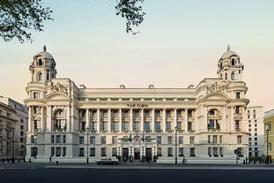
The State Tax University’s main campus building was destroyed in the early months of the Russian invasion. Last week, they sought inspiration for its replacement in a tour of several UK universities.
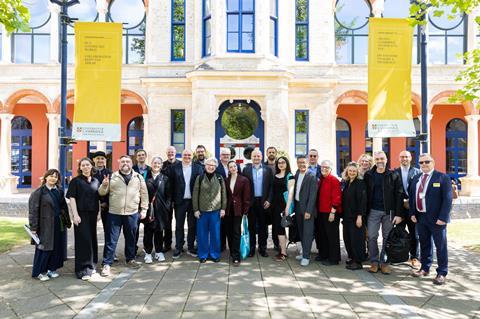
A delegation from a war-damaged Ukrainian university toured Oxford, Cambridge and London last week, seeking inspiration ahead of a Stantec-led rebuild project back home.
The research trip, organised by non-profit Build Forward Ukraine, saw students, faculty and administrators from the State Tax University (STU) in Irpin shown round major recent schemes at the London School of Economics, University College London and the universities of Oxford and Cambridge.
Irpin was at the centre of fighting in the first months of Russia’s invasion a little over four years ago and more than half of the STU’s buildings, including much of its main campus, were damaged or destroyed by shelling and fires.
The university, which has existed for more than 100 years, is under the jurisdiction of the Ministry of Finance and trains law enforcement professionals to combat corruption within state institutions.
A document handed out by its representatives, entitled ’wounded, but unbroken’, gave one kind of accounting of the costs of the conflict - €130,860 to repair dormitory water drainage and heating systems, another €207,000 to repair the roof of the admissions building. But such figures do not come close to describing the disruption and trauma inflicted on its academic community.

The main campus building was closed due to the damage but education continued, with all campus activities, and roughly 5,000 students, relocated to other parts of the university, causing overcrowding. Some of the delegates on the trip are still involved in the civil defence formation for the City of Kyiv.
With the Soviet-era campus badly damaged from the war, the university launched an international competition in November 2024 to design its replacement. Nearly 500 applicants from 86 countries made submissions, with 49 proposals selected for the final round.
Stantec’s “learning beneath the trees”, which draws inspiration from Irpin’s many verdant parks and reimagines the university’s main entrance as a “Garden Gateway”, was chosen as the winner last May. Between design and construction costs, the project could cost more than €60m.
The purpose of last week’s trip, which ran from Monday to Thursday, was to explore trends in university design and pedagogy, with a view to developing Stantec’s plans for the STU.
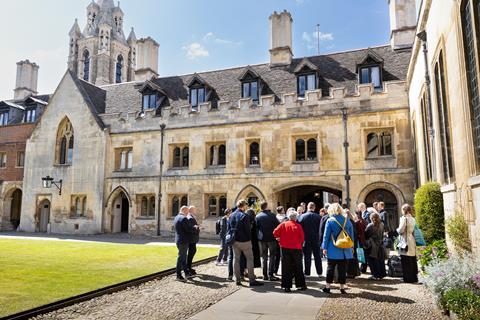
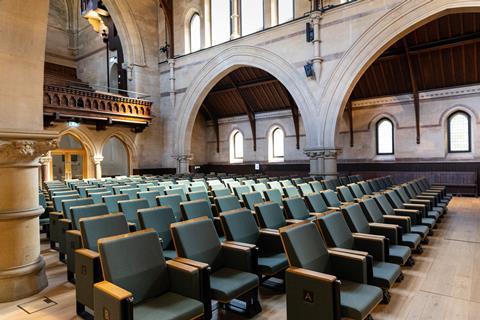
The group spent Tuesday in Cambridge, touring buildings including the Student Services Centre, Simon Sainsbury Centre at the Judge Business School, Pembroke College, and the West Hub. The following day they were shown around Oxford’s Blavatnik school of Government, as well as the brand new Schwarzman Centre for the Humanities and the University’s Mathematical institute.
After a winter in which temperatures dropped as low as minus 20 degrees in Ukraine, delegates were treated to the best of British spring time, culminating in a Thursday spent looking at exemplar schemes in London. Building caught up with the tour in the morning as they headed around the LSE campus in Holborn.
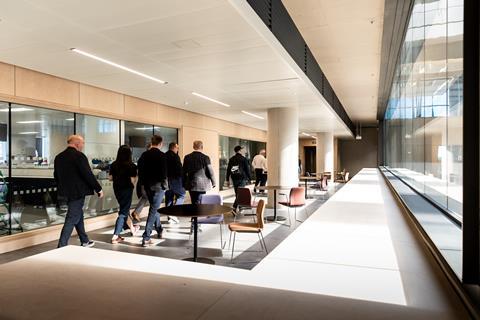
The first stop was the LSE Library, an old WHSmith warehouse converted by Norman Foster in 2000. While the LSE’s director of estate, Julian Robinson, told the tour it was students’ “favourite place to study”, he also offered a “lesson learnt” to the group. “If its all open plan, it can be a sort of management nightmare […] Because all of the book stacks are open, the noise does sort of go up”.
It was a learning that seemed to have been taken onboard by Irish architect Grafton in its designs for the nearby Marshall Building, an ambitious, sculptural construction which impressively blends social and study spaces in its lower levels, as well as teaching spaces and research accommodation.
As the visitors were shown around the building, Dathe Wong, principal design director at Stantec, intervened to explain how it had been “one of the key buildings” they had looked at for the design competition.
“We looked carefully both at the integration with the city but also at the variety of student spaces that are dotted through the building,” he said.
As well as the various academic spaces, the Marshall Building includes terraces on the higher floors and a flexible events space at ground level. Below ground, is a complex of sports and cultural facilities of a size you would never imagine from street level.
In London, using subterranean space is a matter of maximising a limited supply of land but in the Ukraine it has a different valence. One of Stantec’s challenges is to design functional spaces for the university that can double as shelters for 500 people.
“One of the main tasks for Stantec is to make this new campus safe, because you know what’s going on in Ukraine,” said the STU’s acting rector, Dmytro Serebrianskyi.
What function these underground spaces could play was among the focuses of the research trip. “In Oxford, the basement was a theatre, and here the basement is a sports gym,” Serebrianskyi told Building over a sandwich lunch.
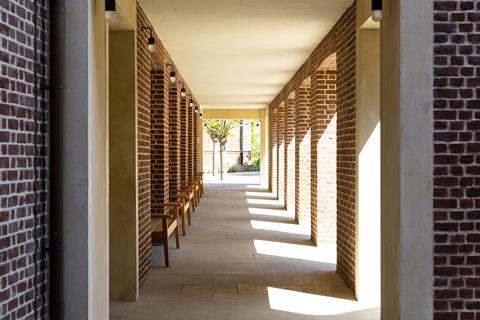




More generally, trauma-informed design is a major part of the brief for a project in which almost every single end user, at least initially, will have lived through war. Energy efficiency is another big topic, but again with a slightly different emphasis than in net-zero conscious UK schemes.
“This winter because of the war, we were almost all the time without electricity,” said Serebrianskyi. “You have to understand that it could happen again. So we need to be more energy independent.”
Asked what lessons they would take back home for the Stantec project, Serebrianskyi said he was impressed by the “big, open zones for students with libraries, with halls, with sitting places, with cafes”.
He said they wanted to “use these best European practices that are presented in the UK in order to bring as much as we can to our project”.
Stantec’s Wong told Building that the STU project “immediately stuck out to us both in terms of its overall mission and in being aligned with the design that we were thinking about, both in learning spaces and public realm”.
He said they were attracted by the brief for a scheme that aimed both to “educate the next generation of Ukrainians and be a beacon of hope”.
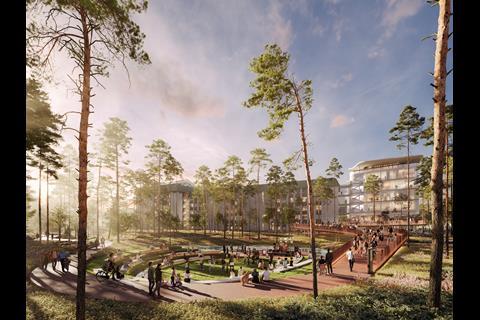
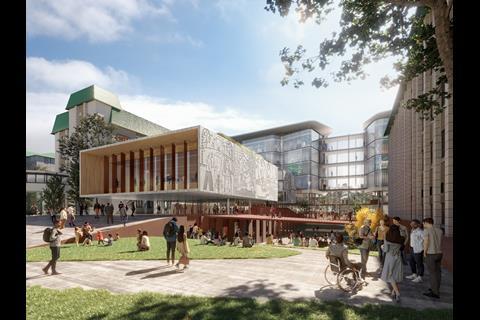
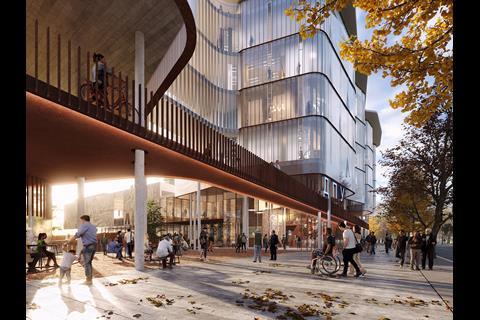
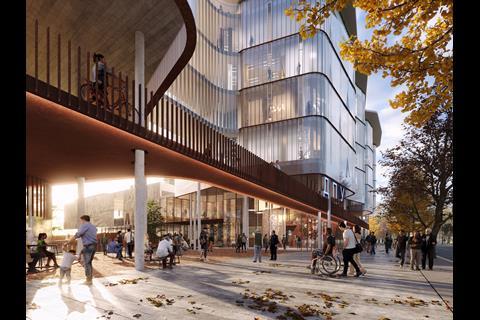
In its design for the STU, Wong said Stantec had aimed to create a building that was “integrated within the city, this very careful stitching of public realm, blurring of the lines between what is an institutional space and what is city space”.
Before the group headed east to Stratford for a look around UCL East Marshgate and Here East, there was just enough time to ask Serebrianskyi which of the buildings he had liked best so far.
The visiting rector gave a diplomatic answer, saying that it was “not possible to tell” because “all the buildings are so unique, so interesting, so different”.
“But the common thing about all the premises we saw is the open spaces which students use to communicate, to speak to each other, to learn, to have this time to integrate with each other.”



No comments yet