



















Local mayors claim Khan did not consult properly on change
Three London councils led by left-wing administrations have launched a legal challenge to the mayor of London’s planned cut to the affordable housing quota.
Last October, Sadiq Khan and housing secretary Steve Reed announced an emergency package of time-limited measures which aimed to stimulate housebuilding in the capital.
Among other things, this included a fast-track planning route for sites delivering at least 20% affordable housing, which essentially amounted to a cut in affordability requirements from the 35% agreed in the London Plan.
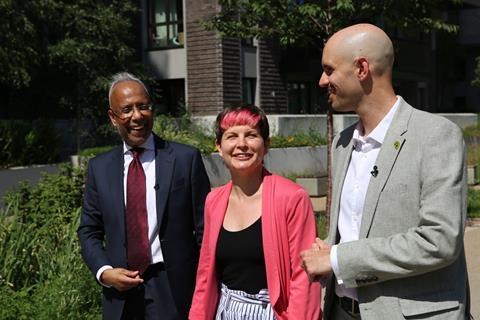
But the move is now being challenged by Tower Hamlets, Hackney and Lewisham - all of which have left-leaning administrations recently elected on a platform promising to tackle the housing crisis.
In the May’s local elections, Tower Hamlets re-elected Lutfur Rahman as executive mayor and gave his Aspire party a majority on the council, while Hackney and Lewisham both elected Green mayors, with the party taking control of both councils.
Rahman wrote to the mayor the same month to advise him of the proposed challenge and was subsequently joined by Zoë Garbett, mayor of Hackney, and Liam Shrivastava, mayor of Lewisham, in filing a judicial review claim with the High Court.
It argues that the Greater London Authority did not use the proper statutory process to amend the London plan, noting the lack of consultation before the change was made and claiming there is a lack of evidence justifying the blanket reduction of affordability quotas.
Four further councils - Lambeth, Southwark, Waltham Forest and Haringey - have formally offered their support to the challenge, bringing the total number behind it to seven.
In a statement, Rahman said the cut to the affordable housing quota was “a scandal” and said London was “increasingly being turned into an investment asset for the super rich rather than a place where ordinary Londoners can afford to live, work and raise a family”.
“City Hall claims this policy will incentivise developers to build homes more quickly. But homes for whom? If ordinary Londoners can’t afford them, they will simply sit empty,” he said.
Rahman also alleged that developers were delaying schemes until the quota came into effect.
Shrivastava said he understood that the mayor of London faced the challenge of “a stalled house building market and a developer-led model that is broken” but said Khan had provided “no justification” for the changes.
“In Lewisham, we’re not anti-development – far from it; we want to work with responsible developers that are respectful of our communities and make a positive difference,” he said.
Garbett warned Khan that he was “no longer surrounded by councils willing to sign off any developer-driven decision he wants to make” and promised she would “go to bat for affordable housing”.
The three councils pointed to the 90,000 children who are homeless and living in temporary accommodation in London and the 10-year high waiting lists for social housing in the city as evidence of the need for more affordable housing.



No comments yet