














To break the recurring cycle of low productivity and late, over-budget projects, the construction industry requires ’integrative authority’ – the means to reconcile very different short and long-term drivers

On 5 March the Institution of Civil Engineers published State of the Nation 2026, its annual snapshot of the issues that are front of mind for those who own, manage, design and construct the nation’s social and economic infrastructure.
This year’s report reminds us of a familiar pattern: projects are late, costs rise, productivity disappoints.
Historically, the industry’s response is equally familiar: governance is tightened, assurance is strengthened, controls multiply.
The diagnosis is rarely wrong – but the response is often incomplete.
Instead of asking only, “Why are projects late and overspent?” we might ask a different question: “At what point did we converge on a framing that excluded the forces that later destabilised delivery?”
That shifts the conversation. Not to blame. Not to despair. But into thinking mode.
Seeing the wider picture
In July last year, the Built Environment Connective published a manifesto, Connect to Change. It is developing into a movement that represents genuine progress.
It urges us to see the built environment as a system of systems. Interconnected. Outcomes-driven. Shaped by long-term environmental, social and economic forces. It challenges siloed decision-making and calls for more joined-up governance.
Seeing the wider picture is necessary for understanding and evaluating the roles and impacts of our industry and all the organisations and activities involved in it. Our industry is itself a system of systems – many organisations interacting together – that carries out activities, from capital projects to repairs and maintenance (interventions) within the wider system of systems that makes up the built environment as a whole. All the parts influence the whole – and the whole influences the parts.
Partial information, siloed decisions and actions that ignore knock-on effects can have significantly negative impacts. And vice-versa.
The challenge now is to embed that perspective into programme design, so that it carries weight when decisions are made. Systems thinking broadens the lens.
You may think that establishing systems thinking as common practice in the built environment is challenge enough. But it’s not. Alongside systems thinking, we need to weave “integrative authority” into our programmes of work.
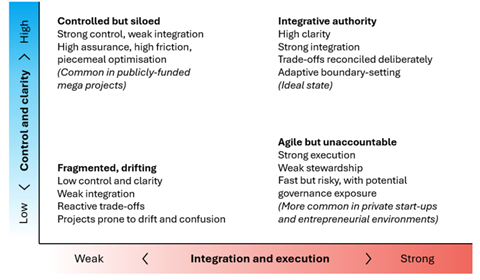
What Is integrative authority? It is about seeing the wider context, addressing it in design and delivery, and having the power to revisit assumptions and alter course when conditions change. Systems thinking requires integrative authority to convert from insight to impact.
Two contracts with society
Mega projects operate under two enduring contracts with society. One reflects stewardship, encompassing public money, regulatory mandate and exposure to fiscal and political risk. It demands accountability, transparency and control.
The other relates to use and impact. Infrastructure is something that people rely on, live alongside and inherit. It demands integration into place, long-term value and minimisation of harm.
These contracts can pull in different directions and are viewed on very different timescales. The stewardship contract tends towards a reductive, easily understood and controlled set of conditions and levers, with time horizons set in terms of regulatory cycles and return on investment. The use and impact contract must contend with often far-reaching social, environmental and economic ripple-effects, spanning generations.
Governance design determines how these contracts are reconciled. The challenge is not choosing between them. It is designing programmes so that they are reconciled deliberately rather than implicitly.
The axes of a programme
In practice, we attempt to manage these contracts through two organisational axes.
The vertical axis carries formal accountability. Funding flows down. Reporting flows up. Assurance frameworks, approvals and escalation routes sit here. It answers the question: who is answerable?
The horizontal axis carries execution. Work moves across disciplines, partners and lifecycle stages. Ground investigation to design. Design to build. Build to operate. Interfaces, trade-offs and community commitments are coordinated here. It answers the question: how does this actually get built and embedded in place?
Both axes are necessary. The difficulty arises when they are not deliberately connected, and when authority to reconcile them is left ambiguous.
When funding and formal authority flow vertically, “speaking truth to power” becomes an implicit expectation placed on individuals. It is therefore understandable that the industry invests heavily in leadership development and high-performing teams.
These efforts matter. But structural imbalance cannot be resolved through individual capability alone. Without a systemic intervention to balance the axes, leaders and teams are asked to compensate for tensions that should be addressed through programme design.
Beyond the cost/quality/time triangle
As a civil engineering student, I was taught to ask my client where the dot should sit in the cost, quality and time triangle – and to hold it there. It was a clear but unrealistic expectation. The real world is dynamic.
Some programmes operate within genuinely fixed constraints. A statutory deadline or explicit public commitment can sharpen decision-making and strengthen integration. When constraints are externally set and cannot shift, trade-offs are surfaced early and owned explicitly.
If time is immovable, cost or scope will flex. If funding is capped, schedule or specification must adjust. The pressure does not disappear. It redistributes.
However, most mega projects do not operate within genuinely fixed constraints. They exist in environments that move. Fiscal conditions change. Policy priorities evolve. Climate risks intensify. Community expectations shift.
The risk is not that trade-offs are made. The risk is that they are made reactively, inconsistently and through friction rather than design.
When priorities shift without a deliberate review of who holds the authority to reconcile them, programmes oscillate. One year the emphasis is speed. The next it is fiscal restraint. Then resilience. Then carbon. Each lens is legitimate.
In the absence of a recognised mechanism to review and, where necessary, recalibrate decision authority, teams are left to interpret competing signals on the ground. Trade-offs become personal rather than structural. Integration gives way to escalation as pressures are managed through hierarchy rather than through clear, shared authority.
Integrative authority provides a stabilising alternative. It creates a legitimate locus for reconciling constraints, distinguishing what must remain fixed from what can adapt, and determining how pressure is redistributed when priorities collide. Without it, there is a collapse into piecemeal approaches which sub-optimise delivery.
When trade-offs become piecemeal
Without integrative authority, the stewardship contract tends to shape formal structure, while the impact contract is managed reactively on the ground.
Trade-offs are made piecemeal. Engineering protects schedule. Commercial protects cost. Sustainability protects carbon. Sponsors protect visibility. Each acts rationally within its own axis.
Yet without a clear locus for reconciling the two contracts, the programme fragments.
The result is rework, duplicated assurance, expanding governance and avoidable organisational fatigue. Decisions are revisited. Interfaces become battlegrounds rather than points of integration.
This is not a failure of intent. It is the absence of designed reconciliation.
From behaviour to design
Much recent effort has focused on collaboration, leadership development and behavioural alignment. These have value but they cannot substitute for clarity in how authority is structured.
If integration depends on exceptional individuals or teams holding the wider view, the system is fragile.
Instead, programmes should make explicit:
• The boundary between accountability and integration.
• The decision rights associated with each.
• The triggers that allow scope or constraints to be revisited.
• The forums where trade-offs are made transparently rather than defensively.
• The authority to challenge and adjust both the governance (vertical) and execution (horizontal) axes when conditions require it.
None of this requires wholesale reform. It requires clarity.
Integration should not rely on individual courage to manage the tensions between the vertical and horizontal axes. It must be deliberately designed into every mega project and programme.
Towards Connect to Change +
Connect to Change challenges us to see the built environment differently.
We have seen strong diagnoses before. The Egan and Latham reports were right about fragmentation and systemic inefficiency, yet many of the structural dynamics they identified persist. Connect to Change offers another moment of clarity. The insight is significant, and the work behind it substantial. The responsibility now is to translate that clarity into durable changes in how authority is designed and exercised.
Connect to Change + means ensuring that mega projects are designed with integrative authority: the explicit mandate to set, hold and, where necessary, reset the boundaries that shape delivery.
Seeing the wider picture is essential. Designing authority to act within it, and to adapt when it shifts, determines whether mega projects deliver with resilience, a lighter footprint on the planet and the taxpayer, and better outcomes for the communities they serve.
This is constitutional design. It is serious work. And it is a conversation the industry is ready to have.
Dr Emma Langman-Maher is an associate director at Aecom, focused on governance, systems integration and transformation across major infrastructure portfolios
Coming up in Building Systems Thinking…
Over the coming months, the Building Systems Thinking content programme will run analysis, opinion, explainers, case studies, reports and events.
To find out more about editorial opportunities contact andrew@mylius.co and for partnership opportunities contact cameron.marshall@assemblemediagroup.co.uk