












With the recent change of prime minister, questions are once again being asked about the future direction of net zero policy. But, while Westminster debates priorities, the buildings being delivered today will shape communities for decades to come. Louis Saunderson argues that regional leaders must continue advancing sustainability regardless of political turbulence
With Labour embarking on a new chapter under Andy Burnham, the future shape of the UK’s net zero agenda is again under scrutiny, and sustainability policy is unlikely to be immune to shifting priorities. The debate over targets, investment and delivery will continue, but for those working across the built environment, school, hospital, and public buildings are still being commissioned, designed and constructed every day.

Those projects will still be standing long after today’s political debates have faded.
Net zero relies on two distinct stages: policy and delivery. National policy sets the direction through targets, standards and funding. Practically, however, how a building actually performs is decided further down the chain – in the brief, the design, the materials, and the way it is procured, built and run. While national policy creates the conditions, local delivery decides the real-world outcome.
That is why the conversation cannot begin and end in Westminster. Regional authorities, contractors and public sector organisations are the ones making these decisions. They lock in how much energy a building uses, how complex it is to run, and how much cost and risk it carries over time.
For them, sustainability is not an abstract policy objective, it is a practical question of what gets built in from day one: public assets which stay affordable, resilient and fit for purpose through their life.
That work cannot pause every time the political conversation shifts. If anything, periods of uncertainty make strong regional leadership even more important.
Sustainability is about long-term value
Across the public sector, sustainability has evolved well beyond carbon reporting. Local authorities, academy trusts and estates teams increasingly view sustainable construction as a practical way to improve resilience, reduce running costs and make public investment work harder. Every pound spent heating an inefficient school is a pound unavailable for teaching, maintenance or pupil support.
Sustainability is not a separate objective sitting alongside cost and programme – it is integral to both. Buildings which use less energy, rely on simpler systems and perform predictably are typically less expensive to operate and maintain.
Most of these outcomes are determined early in the design process, when decisions on building form, structure and servicing establish how an asset will perform over the next 20 or 30 years. Reducing unnecessary material and demand lowers embodied carbon while simultaneously reducing capital cost, programme pressure and long-term operational risk.
Education as a blueprint for regional sustainability leadership
That relationship between policy and delivery is perhaps clearest in education, where public buildings must balance long-term performance with tight budgets and operational demands.
Stoke-on-Trent is not yet a devolved city-region; like much of Staffordshire, it is still making the case for certain strategic powers. That makes the role of the council and its delivery partners even more important in sustaining progress on net zero.
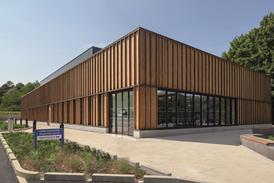
At Watermill SEN Satellite School in Stoke-on-Trent, the starting point was not directly a sustainability target, but a financial challenge: the project returned over budget. Rather than progressing with an inefficient design, the client and delivery team reassessed the scheme as a whole, testing every decision against cost, buildability and carbon performance.
The result was a more efficient building. The design became more compact, the structural grid was rationalised and groundworks were reduced. Each decision removed unnecessary material, lowering embodied carbon while reducing construction costs, shortening the programme and decreasing delivery risk.
The revised scheme returned within budget while avoiding approximately 150 tonnes of construction-phase carbon. It was also designed for future adaptability, using a bolted steel frame that can be dismantled and repurposed rather than demolished.
Existing buildings present a different challenge. At The Orchards Federation in Bolton, the objective is not redesign but improving assets which are already in use and already consuming energy. This reflects the reality for most public estates, where buildings are upgraded incrementally within constrained budgets rather than replaced entirely.
Bolton sits within Greater Manchester, a city-region fromerly led by the new prime minister and aiming to achieve carbon neutrality by 2038 – more than a decade ahead of the national target. This ambition is supported by local energy plans for each of its ten boroughs and sustained investment in retrofitting public buildings.
Here, improvements focus on reducing demand and increasing resilience. Lighting upgrades, improved controls, heat pumps and on-site renewable generation work together to reduce baseline energy consumption and minimise exposure to volatile energy prices.
Net zero will not be defined by policy statements alone. It will be delivered through the consistency of the decisions made every day across the UK’s regions
The programme is expected to save more than 50 tonnes of operational carbon annually, but its greatest value lies in giving the schools greater control over long-term running costs.
Together, these projects demonstrate that sustainability is not about adding “green features”. It is about removing inefficiency throughout a building’s lifecycle, from initial design and construction through to retrofit and long-term operation. They also show that regional leadership is not a single model.
In Greater Manchester, it means an established city-region setting the pace. In Stoke-on-Trent, it means the council and its partners maintaining momentum while the region’s powers catch up. In both cases, it is local decisions, not national announcements, that keep net zero moving.
Regional leadership matters more than ever
Governments can change direction, but decisions on the ground cannot simply be deferred. Councils, academy trusts and contractors continue to balance cost, programme and long-term performance within fixed budgets and on live sites.
National policy can establish ambition – clear, stable direction gives regions the certainty to plan, invest and coordinate over the long term – but it cannot resolve those day-to-day trade-offs. That is the role of regional leadership: turning policy into workable decisions that manage cost, risk and performance together.
Looking beyond political cycles
Healthy political debate is essential, and policy will continue to evolve. But the buildings we deliver today cannot wait for certainty to emerge from Westminster. Councils, academy trusts, contractors and estates teams still face the same challenge: making decisions that balance cost, performance and long-term value for the communities they serve.
That is why the regions have such an important role to play. They provide the delivery continuity that long-term investment depends on, ensuring that public buildings stay affordable to operate, resilient and adaptable across their full life cycle, while national direction may fluctuate.
Net zero will not be defined by policy statements alone. It will be delivered through the consistency of the decisions made every day across the UK’s regions – decisions that reduce waste, improve performance and deliver lasting value for the communities those buildings serve.
Louis Saunderson is a sustainability analyst at Seddon Construction







No comments yet