















The supply chain can only go as far as clients demand. Mathew Evans-Pollard at Hadley Property Group argues that developers must set the sustainability agenda from the outset and explains what a recent strip-out project proved is possible
The construction industry is often criticised for moving too slowly on sustainability. Contractors are told to innovate, supply chains to adopt more circular practices, and manufacturers to take greater responsibility for what happens to products at the end of their first life.

All of that may be true. But it overlooks the influence clients have over what the industry delivers. The market will only move as quickly as clients demand. If developers continue to procure conventional solutions and treat sustainability as something for the supply chain to resolve, conventional solutions are what they will receive.
Clients must set higher expectations from the outset, and remain involved when meeting them proves more complicated than anticipated.
We cannot wait for a perfectly mature market or a supply chain that arrives with every solution already formed
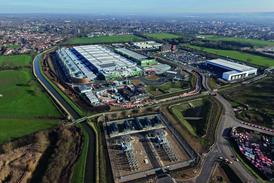
We recently completed the principal strip-out phase at 980 Great West Road, the former GSK headquarters in Brentford. For decades, this was a private headquarters campus, wholly closed off from the surrounding area. Our plans are about bringing down those gates and transforming the 13-acre site into an open and connected neighbourhood, with more than 2,000 homes alongside workspace, a health centre, public spaces and a civic square. Retention and reuse are central to that vision.
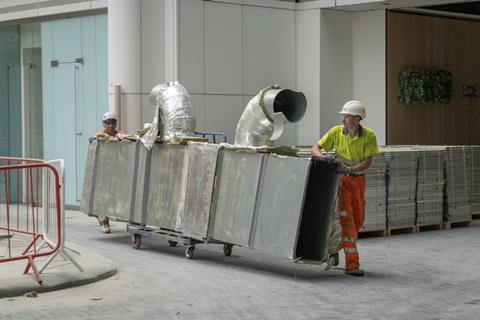
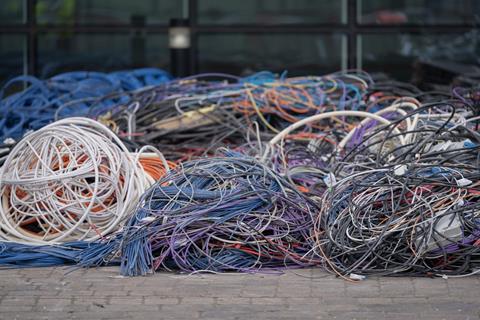
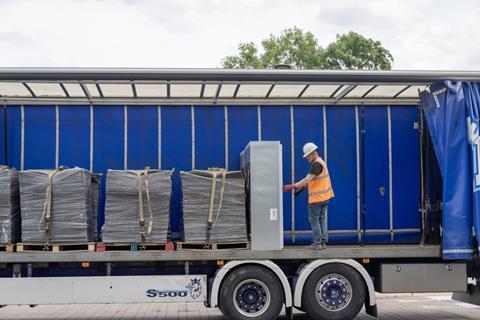
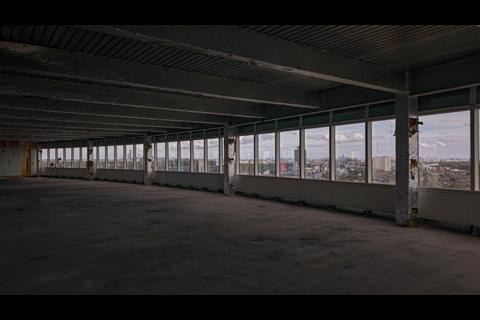
Rather than treating the campus as a blank site, we are retaining and repurposing significant elements of it, including its basement, substructure and landmark tower, and considering what else can be given a second life.
As a certified B Corp, Hadley is committed to considering the wider environmental and social consequences of how we develop. That means applying the same principles to less visible stages such as strip-out as we do to completed buildings. The work at 980 was an early test of whether our circular ambitions could be translated into practical action.
JF Hunt was appointed to carry out the strip-out, with Material Index providing material tracking and reporting. Our brief went beyond diverting waste from landfill or maximising recycling. We wanted the team to prioritise direct reuse and provide evidence of what happened to materials after they left the site.
We wanted the team to prioritise direct reuse and provide evidence of what happened to materials after they left the site
That evidence was important for measuring performance, but also for communicating it. We wanted to share what had been achieved and learnt in a transparent, credible way: demonstrating our commitment to stakeholders, including the local community, while providing practical evidence others in the industry could build upon. If better practice is to become standard practice, it should be shared beyond individual projects.
Delivering the brief required a different way of working. Materials had to be viewed as potential assets rather than a waste stream. The team needed to identify and separate them, assess what could realistically be reused, find organisations able to take them and record their onward journeys. We also asked Material Index to develop a bespoke dashboard recording whether materials were reused or recycled, their weight, destinations and distance travelled. It mapped destinations across the UK and compared the carbon avoided through reuse and recycling with emissions generated by transportation. The destination map was developed in response to our brief and has since helped shape reporting on other projects.
The results demonstrate what can happen when a client sets the expectation. The final dashboard records 41.4% of the material removed as going for reuse, compared with a reported industry average of less than 3%. The remaining 58.1% went for recycling, giving an overall diversion-from-landfill result of more than 99%. The total carbon emissions avoided through reuse and recycling is over 13,500 tCO2e.
These results came from making reuse a requirement, adapting established ways of working and being clear about the evidence we expected. At 980, we followed and recorded the journey of materials leaving the site, giving stakeholders a tangible example: more than percentage on a dashboard, but a visible account of where a material went and how its next life was made possible.
It is one thing to establish that a component is technically reusable; it is another to find a recipient who needs it in the right quantity, condition, location and timeframe
It is one thing to establish that a component is technically reusable; it is another to find a recipient who needs it in the right quantity, condition, location and timeframe. The market for reclaimed construction materials remains fragmented. Storage, transport, certification and programme pressures can all prevent a theoretically reusable product from finding a second life.
These are not reasons to abandon reuse. They are reasons to plan for it earlier and create stronger connections between projects producing materials and those able to use them. The dashboard also helped us assess these tensions. Diverting material from landfill is only part of the picture. If a reusable material must travel hundreds of miles, that journey should form part of the calculation.
This is not about clients dictating every technical answer. The expertise sits across the supply chain and collaboration remains essential. But clients establish the ambition, appoint the team, create the commercial framework and decide what evidence constitutes success.
We cannot wait for a perfectly mature market or a supply chain that arrives with every solution already formed. If clients want construction to change, we must use our purchasing power and our projects to create that change.
Mathew Evans-Pollard is managing director at Hadley Property Group







No comments yet