
















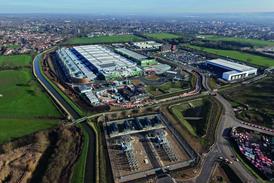


Our ability to meet the almost insatiable demand for more data centres in the UK is being tested to the limits. Ed Phillips, partner at Wedlake Bell, assesses the challenges in front of us

In their Data Centre Construction Cost Index, 2025-26, Turner & Townsend described 2025 as an inflection point for the industry, “where AI data centres move to centre stage”. A combination of political will, huge private investment and rapid AI deployment would, on the face of it, suggest that the UK is well placed to join the US as a global leader in the data centre gold rush. But will the headlines and ring-fenced billions really translate into spades in the ground in the months ahead? If not, what is holding back the UK on the delivery side?
To answer this question, and to understand whether the UK can truly adopt a “build bigger, faster” approach, we must examine the UK’s structural challenges, the position in the US, and how UK plc might navigate those challenges.
Power and grid capacity
The UK’s grid remains under unprecedented strain and, although National Grid expects to connect approximately 19GW of new capacity by 2031 (half of which will be from data centres), a reported 27GW of projects are currently stuck in connection queues and unable to access the grid. Connection delays in first-tier US territories have prompted a shift to secondary markets, but this has not traditionally hindered development.
The UK government has announced plans to assist with grid capacity for certain projects. It intends to remove speculative applications from the grid connection queue, prioritise connections in AI growth zones, and introduce a new “connections accelerator service”.
From April 2027, further assistance will come from discounts on electricity prices for data centres in AI growth zones, lowering operating costs for developments in renewables-rich areas. According to the government, these measures could reduce time-to-power by five years for a major site, which would represent a huge improvement to the existing bottleneck.
Planning complexity
The UK’s planning system has traditionally been a major barrier to data centre development. Unlike in the US, where states can operate a “by right” zoning approach to data centres (essentially removing the risk of a lengthy planning process) and offer certain tax incentives and subsidies to data centre developers, UK local authorities have treated data centres like ordinary industrial developments, with no special status to reflect their national importance.
The planning process is sequential, with developers typically needing planning approval before securing a meaningful grid connection. The process is also managed by local authorities, which can make planning outcomes region-dependent, hard to predict, and at risk of local opposition.
The government has recognised the need for change and is overhauling planning regulations to favour data centres, especially in AI growth zones. By treating data centres as strategic infrastructure, the government is removing traditional obstacles, and creating a more streamlined path to delivery.
Land availability
Unlike in the US, which has vast areas of undeveloped land and a flexible local development environment, the UK is geographically small and densely populated, making it challenging to find suitable sites. Hyperscale data centres are mainly clustered in areas with existing power infrastructure and available land, such as Slough and parts of west London, resulting in high competition for sites.
The proposed revisions to the planning system, with the adoption of a more US-style zonal approach, along with incentives for projects in less populated and post-industrial regions, aims to reduce delays in the site selection phase.
Skills and supply chain
The skills crisis in the industry is well documented, and particularly acute in the data centre sector, which requires specialist levels of electrical engineering and commissioning expertise. In addition, a relatively small pool of suppliers of critical equipment (cooling and HVAC systems, on-site power solutions, electrical power infrastructure) is having to quickly react to the demands – and increasingly large order books – of customers with portfolios across the EMEA region.
The imbalance between the amount of labour and equipment that can be supplied into the UK market, and the demand from the UK, EMEA and further afield, creates supply chain pressure, price volatility, programme uncertainty, and a scramble for lead times.
Contractual frameworks
Contracting practices in the UK differ from those in the US, where contracting has typically been simpler and relies on standard form agreements used across states, with only minor modifications. Lenders and investors in the US are familiar with uniform contract models, making due diligence faster and more predictable.
In the UK, the contractual framework for delivering data centre projects is subject to competing pressures. While developers seek the familiarity of traditional contracting approaches, they must balance this with a need for global – or regional – uniformity across their contract terms.
Furthermore, the scale and complexity of large data centre projects, often with a fragmented procurement structure and a compressed programme for design, construction and cost analysis, lends itself to a move away from adversarial, fixed price contracting and toward a more collaborative approach. Resolving these pressures will require flexibility from the market and an integrated approach from stakeholders.
Closing the gap
While the ability to deliver at speed (and in line with ESG commitments) has been constrained by several factors, recent policy announcements should help to close the delivery gap in the UK data centre market. Reforms to the planning and grid connection system point towards a more flexible, clean energy-led approach, and developments in liquid cooling, microgrid solutions and retrofitting existing facilities align with this.
Resolving the skills shortage remains a significant challenge and it is hoped that a renewed policy focus on STEM, and the developing use of AI (particularly in the pre-construction phase), will help with this. If reforms succeed, the question is not whether the UK can catch up with the US, but how it can define a UK-centric model for AI‑ready, sustainable delivery.
Ed Phillips is a partner and transactional construction lawyer at Wedlake Bell LLP, advising on major construction and engineering documentation across a wide range of sectors, from infrastructure and data centres to manufacturing, logistics and mixed-use developments. He spent six years working as an in-house lawyer for a major contractor and a hyperscale data centre developer, giving him deep insight into project lifecycles, procurement and risk management







1 Readers' comment