















![Group_KIP_logo[43].jpg](https://d3sux4fmh2nu8u.cloudfront.net/Pictures/280xAny/3/7/8/2024378_group_kip_logo43.jpg_235629.jpeg)
This module, sponsored by Kingspan Insulated Panels, explains how embodied carbon is calculated and how environmental product declarations can support whole-life carbon assessment. It also highlights issues to be aware of when using EPDs

In this CPD we will explore how carbon calculations are made, and learn how they are used in environmental product declarations (EPDs). We will also look at the pitfalls to avoid when using EPDs to gather information about construction materials.
Learning outcomes
- Understand the importance of embodied carbon in the context of net zero targets.
- Learn how embodied carbon is calculated.
- Learn about EPDs and issues to avoid when working with them.
- Recognise greenwashing, “green hushing” and other issues surrounding comparisons of construction products.
Climate change and the built environment
Under the Climate Change Act (as amended in 2019) the UK has a legally binding target to reduce greenhouse gas emissions to net zero by 2050. In addition, it is committed to reducing economy-wide greenhouse gas emissions by at least 68% by 2030, compared with 1990 levels, under the UK’s 2020 nationally determined contribution to the Paris Agreement.
The built environment has a major role to play in meeting these targets. Buildings contribute significantly to UK emissions through both their operation (energy used for heating, cooling, lighting and equipment) and through embodied carbon – that associated with construction materials, transport, construction activities, maintenance and end of life.

Operational energy efficiency
UK greenhouse gas statistics show that the “buildings and product uses” sector typically accounts for a fifth of all UK emissions. This is mainly direct emissions from burning fuels in buildings (electricity-related emissions are reported under the power sector).
Thermally efficient buildings help cut carbon emissions by reducing energy demand for heating and cooling. Adding renewable energy sources – such as photovoltaics on roofs – can cut operational carbon emissions further still and even help to meet energy demand.
The other aspect of carbon use that matters when designing buildings and specifying construction products – one that has only more recently begun to be widely recognised as important – is embodied carbon.
What is embodied carbon?
The UK Green Building Council (UKGBC) describes embodied carbon as “the emissions associated with materials and construction processes throughout the whole lifecycle of a building or infrastructure. This is typically associated with any processes, materials or products used to construct, maintain, repair, refurbish and repurpose a building.” (In whole-life carbon assessment, embodied carbon excludes operational energy and water.)
So, for example, the total embodied carbon of an insulated panel would need to include the impact of:
- Sourcing, extracting and transporting the materials used in its manufacture (steel, chemicals, coatings and so on)
- Energy used in the manufacturing process
- Energy used to transport the finished product
- Energy used in the construction process (for example, mechanical handling)
- The carbon footprint of any maintenance that is needed
- Any impacts at the end of the product’s life, including potential recycling or reuse.

Why is embodied carbon important?
According to the UKGBC, embodied carbon from the construction and refurbishment of buildings accounts for 20% of carbon emissions from the built environment in the UK today, with the remainder largely arising from operational energy use in buildings. However, it is important to note that this is a sector-wide snapshot, and that the embodied–operational balance varies significantly by building type, age and future decarbonisation assumptions.
Calculating embodied carbon
A complicating factor when talking about embodied carbon is that some aspects of it are difficult to quantify. Emissions arise across complex, global supply chains and at multiple lifecycle stages, many of which sit outside the direct control or visibility of the organisation commissioning a building.
There is no single, simple way to measure embodied carbon. Instead, different accounting frameworks organise emissions in different ways depending on context. Two commonly used systems are:
- Scopes (1, 2 and 3), which are used in organisational carbon accounting to allocate emissions based on responsibility
- Lifecycle modules (A–D), which are used in product and building lifecycle assessment to allocate emissions by stage of the life of an asset.
These are not interchangeable, but they are often confused because they draw on the same underlying emissions data.
Scopes
Scopes classify emissions based on who is responsible for them, from the perspective of an organisation. A scope sets a boundary around which emissions are being counted, based on where they occur in the value chain and how much control or influence an organisation has over them.
In other words, scopes answer the question for an organisation: “which emissions are we taking responsibility for in this calculation?” In practice, scopes classify emissions by source, for example: direct emissions, emissions from purchased energy, and wider indirect emissions arising from the supply chain.
- Scope 1 emissions are those that arise directly from the operations of the business, such as from manufacturing processes or from running vehicles or climate-control systems.
- Scope 2 emissions are indirect emissions that arise from the generation of purchased electricity, steam, heat or cooling consumed by the business.
- Scope 3 emissions incorporate everything else associated with the business’s operations up and down the value chain, including (in the case of a product) sourcing of materials, in-use emissions, and end of life. These are by far the hardest to evaluate with any accuracy.
While manufacturers may draw on scope 1, 2 and 3 data internally to produce environmental information, embodied carbon in buildings is not generally defined by scopes.
For construction clients and specifiers, embodied carbon typically sits within scope 3 and is more usually described using lifecycle modules (see figure 1 below).
Lifecycle modules
Modules A to D cover different stages of a product’s lifecycle as follows:
- A1–A3: product stage (raw materials, transport, manufacturing)
- A4–A5: transport to site and construction
- B1–B7: use stage (maintenance, repair, replacement, operational energy and water)
- C1–C4: end of life (demolition, waste processing, disposal)
- Module D: benefits and loads beyond the system boundary (such as recycling potential).
![EPD Diagram_KIP[35]](https://d3sux4fmh2nu8u.cloudfront.net/Pictures/480xany/3/7/7/2024377_epddiagram_kip35_818485.jpg)
Lifecycle assessments
The standardised methodology used to assess the environmental impacts of a product or system over its life cycle is the lifecycle assessment (LCA). An LCA delves into every aspect of a product – from design, raw material extraction, manufacture, sale and purchase through to use, deconstruction and recycling – to reveal its full environmental impact.
The way LCA is conducted is governed by international standards including ISO 14040 and ISO 14044, which define LCA principles and requirements; and ISO 14025, which sets rules for environmental declarations based on LCA, such as EPDs. Having a standardised approach such as this helps ensure transparency and comparability.
An LCA can assess a wide range of environmental impacts, including:
- Global warming potential (GWP) – also described as the carbon footprint – measured in kilograms of carbon dioxide-equivalent (kgCO₂e)
- Resource depletion
- Water use
- Acidification – contribution to soil acidification and to acid rain
- Eutrophication – an environmental impact caused by excess nutrients (mainly nitrogen and phosphorus) entering water bodies, which leads to excessive plant and algae growth and degrades ecosystems
- Photochemical ozone formation.
Carbon is just one impact category within an LCA, not the sole focus.
Data is collected on all relevant inputs and outputs at each stage using measured data where available and recognised databases where it is not. The LCA can then form the basis of an EPD, the standardised, independently verified document that reports the environmental impacts of a product across its lifecycle.
Whole-life carbon assessment
Whole-life carbon assessment (WLCA) is another – carbon-focused – application of LCA, primarily used for buildings and infrastructure.
WLCA considers all greenhouse gas emissions (CO₂e) over a building’s life, typically including:
- Embodied carbon (modules A to C and relevant B modules)
- Operational carbon (module B6, and sometimes B7)
- End-of-life emissions.
Results are usually reported as kilograms of carbon dioxide equivalent (kgCO₂e) over a defined study period (commonly 60 years) and often normalised per square metre of floor area.
WLCA is increasingly used to:
- Inform early design decisions
- Compare design options for the same building
- Support net-zero strategies
- Meet planning or policy requirements.
Environmental product declarations
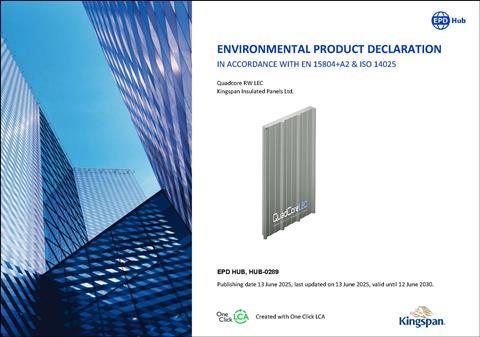
One of the most useful documents to any specifier or designer is the EPD. This sets out quantified environmental data, including carbon impacts, using consistent rules so that products can be compared when these rules align.
EPDs are governed by the following standards: ISO 14025 Type III environmental declarations, ISO 21930 Construction products, and EN 15804 Core rules for construction product EPDs in Europe.
EN 15804 is the key European standard that defines how environmental information for construction products must be calculated and reported. It provides a common framework for the product category rules used in construction EPDs. These are standardised rules that define how LCAs and EPDs must be carried out for a specific product type, so that results are consistent and comparable.
The updated version, EN 15804+A2, introduced changes including updated characterisation factors, revised indicators and reporting formats, and a split of global warming potential into:
- GWP-total
- GWP-fossil
- GWP-biogenic – measures the climate impact of carbon absorbed and released as part of natural biological cycles, such as the CO₂ stored in a tree as it grows and the carbon released or retained when the tree is harvested and used
- GWP-luluc (land use and land use change) – caused, for example, when grassland used to produce silage is turned into a housing estate.
Since 2022, new construction product EPDs issued under EN 15804 have increasingly followed the A2 amendment, although older A1 EPDs remain valid until expiry. According to EN15804+A2, all EPDs must include modules A1-A3, C, and D. Cradle-to-grave carbon reporting (meaning inclusion of embodied carbon until the product’s end of life) rather than cradle to gate is increasingly treated as good practice.
Like the LCA on which it is based, a typical EPD will report GWP (kgCO₂e) and other environmental impact indicators, for the declared life-cycle modules (often A1–A3, with additional modules where declared), such as
- Energy and resource use
- Water consumption
- Waste generation
- Environmental impacts across defined lifecycle stages (such as raw material extraction, manufacturing, transport, use, end of life)
- Ozone depletion potential
- Acidification potential – contribution to soil acidification and to acid rain
- Photochemical ozone formation – covering key sources of air pollution such as NOx (nitric oxide and nitrogen dioxide) and volatile organic compounds (VOCs).
EPD lifecycle modules
As part of EPD certification, total emissions from each indicator are further separated into the different stages of the product’s lifespan – the modules shown in fig 1 – which allows for targeted improvements.
By looking at embodied and operational carbon in combination, designers can understand trade-offs and make informed choices where higher-performing products might, say, increase upfront embodied carbon but reduce emissions over the building’s lifetime.
End of life
A key consideration for embodied carbon is the way we deal with a building at the end of its life – whether products can be easily removed and disassembled, and whether they can be recycled or even reused.
End of life plays a particularly significant role in non-domestic structures where the building envelope is often panellised and modular, which both reduces waste on site – and therefore carbon impact – and allows for some systems to be more easily removed and reused after the building is no longer deemed useful.
Estimates suggest around 7–9% of global energy-related CO2 emissions are associated with the manufacturing of building materials, on top of emissions from operating buildings. Both reducing their initial carbon cost and being able to partially or fully reuse building elements at end of life helps manage and reduce this embodied carbon impact.
Issues with EPDs
EPDs are a vital source of information for specifiers and building designers looking to minimise the impact of their builds. They can be relied on because they must meet an international standard and bring the benefit of independent third-party certification.
However, there are issues you should be aware of when reading – and particularly when comparing – them. A lack of consistency caused by variations in the standards on which EPDs are based, and in the way EPDs are prepared and reported, can cause confusion for stakeholders.
Declared unit versus functional unit
Most construction product EPDs use a declared unit (for example, 1m² of panel or 1kg of material) rather than a performance-based functional unit.
This means:
- Products may not deliver the same structural, thermal or durability performance
- Direct comparison requires careful interpretation
- Additional normalisation may be needed in building-level assessments
- Declared units are suitable for product transparency, but they do not automatically represent equivalent performance.
Declared units describe the impact of a quantity of product, not the performance delivered; building-level assessments must normalise quantities to achieve equivalent functional outcomes before products can be meaningfully compared.
Comparing EPDs
It is essential to remember that you might not be comparing apples with apples across different products and regions. So, for example, while BRE runs a national EPD programme in the UK, several accredited bodies approved by the United Kingdom Accreditation Service (UKAS) can also validate EPDs according to relevant standards, which can include ISO 21930:2017 as well as or instead of EN 15804+A2 depending on the programme operator. (It is important to note that EN 15804+A2 no longer reports on the same categories as ISO 21930: 2017, so may not satisfy ISO 21930:2017 requirements without additional reporting/alignment, and should not be assumed to be a route to compliance.)
The lack of standardisation and compatibility among different LCA software packages can also lead to variations in results, hindering comparability between EPDs generated using different software.
There are potential issues, too, where comparisons do not reflect the same stages of embodied carbon calculations. For example, one manufacturer may have assessed and published stages A-C, while another may only have focused on A1-A3.
Moreover, EPDs produced in one country may not be directly comparable with those from another country thanks to differences in methodologies, databases, and environmental regulations. This lack of harmonisation can limit the usefulness of EPDs for international comparisons.
EPDs can only be meaningfully compared when key parameters align. When comparing EPDs, users should check that they share:
- The same standard and version (e.g. EN 15804+A1 vs A2)
- The same product category rules (PCR)
- The same declared or functional unit
- The same system boundary and modules reported
- Comparable geographical scope and electricity mix (EPDs based on very different grid carbon intensities are not directly comparable without context. Differences in reported GWP may be driven by energy supply assumptions, not material efficiency.)
- Similar data age and validity period
- Third-party verification and programme operator.
Without this alignment, numerical comparisons can be misleading.
Quality of underpinning data
It is also important to recognise that the accuracy and reliability of an EPD depends on the quality of the underlying data used to calculate the environmental impact of the product. This is a potential point of vulnerability, as incomplete or inaccurate data can result in an EPD that does not correctly represent the product’s environmental impact.
EPD module D – benefits beyond the boundary
Module D – which covers the net benefits and loads arising from the reuse, recycling or recovery of energy from building materials – faces particular challenges with data availability and accuracy. Manufacturers may not have enough information about how their products could be disposed of or recycled, leading to incomplete or inaccurate data. The complexity of end-of-life scenarios makes it hard to analyse and understand without making assumptions.
While useful for understanding circularity potential, module D values are scenario-based and uncertain. They are not part of the building lifecycle itself. Many WLCA methodologies require Module D to be reported separately, not netted off against A–C stages. So users should always check the specific WLCA guidance being followed before including Module D benefits in totals.
Embodied vs operational carbon trade-offs
Design decisions often involve trade-offs between embodied and operational carbon. For example, higher-performance materials may increase upfront embodied carbon but reduce operational energy use.
When assessing these trade-offs, it is important to consider:
- Time horizon (for instance, a 60-year assessment period) – a short assessment period may favour solutions with low upfront carbon, while a longer period can justify higher upfront impacts if operational savings accumulate sufficiently.
- Grid decarbonisation assumptions – in the UK, electricity is expected to continue decarbonising, meaning carbon savings from reducing electricity demand in future years may be smaller than today. So measures that rely on long-term operational savings must be tested against realistic grid scenarios. Overestimating future operational carbon can lead to overspecification and unnecessarily high embodied impacts.
- Replacement cycles and maintenance – some low-energy systems or materials have shorter service lives or require frequent replacement, so consideration of durability, maintenance intensity and replacement intervals is therefore essential.
- Future adaptability and end-of-life scenarios – designing for adaptability can significantly reduce future embodied carbon, even if it has a modest upfront cost.
A whole-life perspective is therefore essential.
Despite all of these caveats, EPDs remain the key source of information about the sustainability of construction materials – it is just wise to be aware of their vulnerabilities.
Greenwashing/green hushing
Another potentially problematic source of information about the sustainability of products has historically been marketing materials. Greenwashing has long been recognised as an issue, with products labelled as “green”, “eco” or “recyclable” without solid data to back up what these claims actually mean.
In a bid to avoid misleading claims, the Green Claims Code published by the Competition and Markets Authority in 2021, gives businesses guidance on how they should represent information about environmental claims to ensure that they are not misleading. The code is based on the following six principles:
- Claims must be truthful and accurate.
- Claims must be clear and unambiguous.
- Claims must not omit or hide important relevant information.
- Comparisons must be fair and meaningful.
- Claims must consider the full life cycle of the product or service.
- Claims must be substantiated.
The Code for Construction Product Information (CCPI) reflects similar principles to the Green Claims Code – particularly around clarity, accuracy and substantiation of claims. The CCPI is the voluntary industry code that sets standards for how construction product information is created, presented, and maintained, so that it is clear, accurate, up to date and not misleading. Its aim is to improve trust, consistency and safety across the construction supply chain by ensuring decisions are based on reliable product information.
It is important to note that, even if all data is available for a comprehensive EPD assessment, some organisations may indulge in what is known as “green hushing” – choosing not to disclose aspects of environmental performance, sometimes to avoid scrutiny or accusations of greenwashing.
Generally, the more detailed the third party-verified information supplied, the more reliable the claims can be considered to be. Watch out for missing or misleading data too, such as claims of percentage improvements with no explanation of what the benchmark was.
Finally, always look at the bigger picture – embodied carbon is increasingly important, but it is still only one part of the solution. Ultimately, we need to look at the whole-life carbon story of our built environment to drive lasting change.
Please fill out the form below to complete the module and receive your certifica