











Last month visitors were invited to see the progress being made at 2 Finsbury Avenue - the sixth and final building being redeveloped at Broadgate by Sir Robert McAlpine on behalf of British Land. Build UK’s Open Doors initiative took them to admire a panoramic view of the capital from the heights of the 36-storey office block, aiming to inspire some to pursue a career in construction
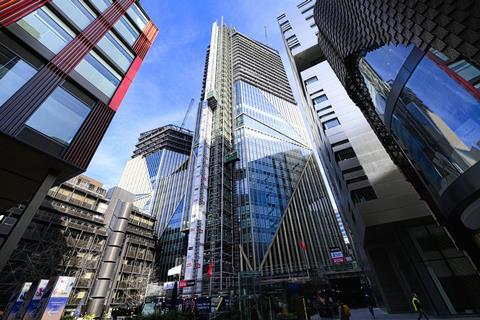
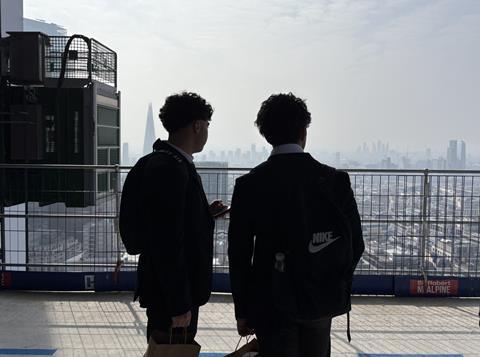
After rising in a hoist 33 floors above Liverpool Street, visitors to 2 Finsbury Avenue were audibly impressed by the scene in spite of a layer of pale mist softening the edges of the City’s towers.
“You usually get a cracking view,” said Neil Doherty, works manager at Sir Robert McAlpine as he pulled out his phone to show a picture-perfect London captured at dawn, when up to 1,000 on-site employees start their work day.
Last month, Build UK’s Open Doors events took visitors behind the scenes of major projects across the UK, hoping to inspire them to pursue a career in construction with similarly memorable experiences.
Attendees at 2 Finsbury Avenue (referred to on the day as 2FA) were invited to see the progress at the final project being developed by Sir Robert McAlpine on behalf of British Land as part of the decade-long redevelopment of Broadgate.
The event showcased a range of careers, from project director to sustainability manager that bring schemes from conception to, in the case of 2FA, solid foundations that make up a 36-storey office block.
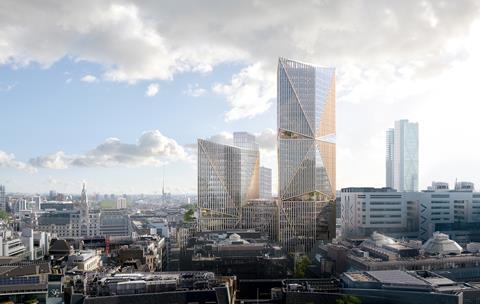
2FA, which was designed by Danish architectural firm 3XN, with Adamson Associates as the executive architect, was one of six buildings picked for the redevelopment of Broadgate. As it reaches the final stages of internal fit-out, the Open Doors group saw behind the scenes of what it takes to build in the capital.
The project
2FA’s construction team has just over a year to go before completing 750,000 sq ft of workspace, including a podcast studio, events venues and a winter garden on level 13 complete with orange trees and a cafe.
“Before, it was this pink granite, very oppressive brutalist building. A lot of people, including architects, liked those buildings and they were horrified that British Land were going to demolish them,” says Sam Lee, senior social value manager at Sir Robert McAlpine.
I wanted to work with children who didn’t have lots of opportunities - that’s how I came into construction
Sam Lee, senior social value manager at Sir Robert McAlpine
As the group stood before 2FA craning their necks skywards, they were met with an imposing vision of countless glassy windows pulled together by the metallic strips that characterise the new tower’s appearance.
“The problem that people had was in the early 1980s when they developed Broadgate,” continues Lee. “It was very much developed for finance and insurance, and it was not supposed to be inviting. It was supposed to keep people out, so there were no outward facing doors.”
She explained that when British Land were looking at redeveloping Broadgate in the mid 2010s, it had a vision to create a destination spot that attracted people seven days a week, rather than just during office hours.
Lee started out as a music journalist and entered the world of TV production before taking a job at her son’s grammar school to keep an eye on him. However, she started to question how fulfilled she felt in this role. “I wanted to work with children who didn’t have lots of opportunities - that’s how I came into construction,” she says.
According to Lee, British Land appointed Sir Robert McAlpine as the principal contractor for every building in the Broadgate redevelopment in order to make the scheme’s delivery as smooth as possible.
Having six different contractors “fighting for space” in a tightly packed area could have made building work difficult and confusing for stakeholders, so Lee stresses the importance of regular communication to “make sure everybody knows everything” with fortnightly construction updates and monthly meetings with stakeholders.
“There’s a lot of people that we’re impacting, not only office workers. On the other side of here is a high-end residential block, but there’s also restaurants and businesses, and [British Land] wanted one contractor so that there was no mixed messaging,” explained Lee.
The tour
A PPE-free stroll took the group to the back of the building to view the cantilever crane and scaffolding, which only took around two to three weeks to install as panels in various locations, whereas traditional scaffolding going all the way around a building would take around three months to put up.
Kenny Ryan, project director at Sir Robert McAlpine, emphasised the importance of pre-fabrication to reduce on-site work and expedite the construction process, particularly for a scheme in the City of London.
A short hoist ride then took the group to the building’s fourth level, where they learned more about its construction process through a presentation and discussions with other members of the team. This included James, who detailed the advance vertical transportation systems in place, while sustainability manager Catherine discussed the reuse of materials, such as steel, from the existing building.
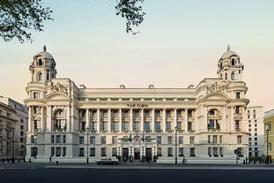
The redevelopment of Broadgate also includes 100 Liverpool Street, which became British Land’s first net zero carbon building as well as 1 Finsbury Avenue, 1 Broadgate, 3 Broadgate and 135 Bishopsgate.
While most of these buildings were existing structures retrofitted for the Broadgate transformation, 1 Broadgate and 2FA were demolished and rebuilt.
The 100 Liverpool Street scheme also involved the relocation of the Fulcrum sculpture – a 55 feet tall artwork by American artist Richard Serra installed in 1987 near the western entrance of Liverpool Street Station.
For 2FA, Ryan explained the team’s top down methodology, which allows building upwards while digging down simultaneously and “saved about nine months in the construction process.” It also unearthed 56 million-year-old clay at the bottoming out stage, according to an archaeologist.
The great thing about Open Doors is that it’s open to everyone
Kate van der Merwe, Build UK
Throughout the tour, Ryan emphasised the importance of connectivity within and outside of the building to facilitate “normal life” where people can work in and around the building as well as socialise. “In the social lobby, you can go in there, have a coffee, you can meet and chat, and it works really well at 100 Liverpool Street,” he said.
Lee pointed out it’s not always obvious when buildings have spaces open to the general public, but encouraged the group to “go [into buildings] and ask if there’s public space, because that’s when you see how office life really works and how the building works.”
The group
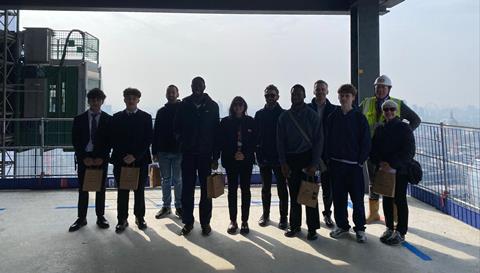
It was time to ride the hoist to level 36, where the views of London clearly impressed the visitors. This particular group was a diverse one. While some Open Doors visits are arranged in collaboration with a school or university cohort, this event attracted attendees from all walks of life.
“The great thing about Open Doors is that it’s open to everyone,” said Kate van der Merwe, communications manager at Build UK.
A retired couple had joined the 2FA tour after attending several other Open Doors events due to a “fascination” with how London develops. “The opportunity to see something like this is just a privilege,” says one visitor gesturing at the city sprawled in front of us.
For another guest who had graduated from a masters in project management two months earlier, the visit could be his way of getting his foot in the door at his first industry job. “It’s a nice way for people to get a feel for working in construction, like a day-in-the-life,” he pointed out.
We were also joined by a couple of friends from a sixth form who were weighing up their post A-level options and a father with an established career in construction, who brought his 15-year-old son to the site for inspiration.
As the group began its descent, the sense of curiosity and enthusiasm felt throughout the day lingered. Open Doors had not only revealed the remarkable engineering behind 2FA, but also the breadth of opportunity within the construction sector.
If the event succeeds in its aim, the visitors who looked out across the city from level 36 may one day be among those shaping it - and perhaps welcoming the next generation on site tours of their own.
Building is media partner for Open Doors






No comments yet