










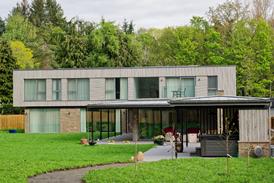








In eight years, the pensions giant has created an 8,500-home for-profit provider with exemplary regulatory gradings. Daniel Gayne spoke to the group’s affordable housing boss to find how it got there and why it’s tempered its growth targets

A lot has happened since 2018. One global pandemic, several world historic conflicts, the exit and return of Donald Trump, and a conveyor belt of six (count them) British prime ministers.
This is the turbulent environment that Shaun Holdcroft has had to navigate at the fledgling Legal & General Affordable Homes (LGAH), as it sought to establish itself as a significant player in the UK’s social housing sector.
Now entering his second year as head of affordable housing, the progress the group has made in those eight years is a matter of some pride.
“I joined L&G to help establish this organisation and have seen it through from being a couple of us around a desk in somebody else’s offices to where we are today,” he tells Housing Today. Where it is today is an organisation that has raised more than £1.5bn of investment, has 8,500 homes under management and another 3,000 under construction.
While this is by no means the story of a plucky underdog come good - LGAH is just one part of a £9bn corporate giant - it nonetheless speaks to how much progress institutional investors and the wider for-profit sector, have made in establishing themselves as a legitimate part of the affordable housing landscape.
“There’s always opportunity to identify other forms of capital that might be interested in finding their way into the affordable housing sector in this country”
Shaun Holdcroft, head of affordable housing, L&G
The sector that LGAH was born into in 2018 was still sceptical of for-profits, despite the decade since they were established by Housing and Regeneration Act 2008. “Inevitably, when you’re trying to do something different and you’re trying to change the status quo, there’s a lot of people […] who doubt motive and intention,” says Holdcroft, recalling the attitudes of the time. “Some of the nervousness was that this would result in substandard products or it would result in organisations trying to build portfolios and then flog them”
In such an environment, it was no sure thing that L&G’s affordable housing venture would come to anything, even with its hefty backing. “When we set the business up, we didn’t necessarily know we’d end exactly where we’ve landed in the world,” says Holdcroft.
If the past eight years have been about proving that for-profits could be responsible participants in the sector, LGAH’s first consumer gradings, published earlier this year, must have felt like a vindication for Holdcroft and his colleagues. The group received the top C1 mark, as well as retaining its previous top gradings on governance and financial viability.
Holdcroft talks with most pride about LGAH’s consumer grading, pointing to a piece of work the group undertook last year examining the factors most likely to lead to tenancy failures. In response to its fundings, LGAH put in place a suite of free-at-point-of-access services available to all of its customers, including a digital GP. Beyond that, it has built another service called Harbour, which proactively reaches out to its most vulnerable 5% of users, with a named individual member of staff helping them to access services.

These technology-led initiatives have been implemented despite the fact that LGAH does not directly manage its own housing portfolio. While LGAH sets the rent and manages stage two complaints, among other things, day-to-day services are delivered through a network of housing associations and management service providers - a group it has gradually trimmed down from 14 to seven. Holdcroft says the model creates “a slightly different challenge as to how you demonstrate adherence to the regulatory standards”, something which it has again tried to manage through technology, specifically a system called Brolly, through which all its management providers as well as its own staff, manage customer data. “That’s the tool by which we are able to create visibility right across the operating model to give […] the regulator confidence in our handle on it,” he says.
As it celebrates its vote of confidence from the regulator on the housing management side, the group also appears to be ramping up its development in response to growing investment appetite from local pension funds.
“If you roll back to February 2025, our pipeline was sitting at less than 1,000 homes in the pipeline,” says Holdcroft. “We had largely limited our bidding for a number of years post the Liz Truss budget at the end of 2022 and therefore we’ve been running with a relatively small pipeline”.
However, since the start of 2025, has seen “appetite for investment into our social housing fund amongst local government pension schemes really take off”, aided by the government’s Mansion House reforms, which lowered barriers for UK pension funds to invest in domestic infrastructure, something Holdcroft describes as a “massive milestone”.
Disappointment over decision not to proceed with strategic partner plus
While investment from local government pension funds appears to be flowing freely, Holdcroft appears less pleased by decisions made in central government.
LGAH was not named as one of Homes England’s strategic partners in the first wave of allocations for the £39bn Social and Affordable Homes Programme’- not especially a problem, according to Holdcroft, as the business accesses most of its grant through continuous market engagement.
More disappointing, in his eyes, is the decision not to proceed with the strategic partner plus (SP+) model that had been mooted in Homes England’s SAHP prospectus. The concept would have opened up the possibility for selected partners to bid for up to £700m worth of grant, enabling organisations to put together large capital structures over the long term.
“I think it’s a lost opportunity, unfortunately, that [it] didn’t come to pass,” he says. “That was a real disappointment for lots of organisations across the sector because it was the type of scale of capital that allowed for long-term delivery of significant amounts.”
Reports suggest that SP+ route for deployment remains under review and Holdcroft acknowledges that “there’s no firm word from government”. However, he stresses: “Our understanding is that strategic partner plus won’t be utilised as a route for deployment under the 2026-2036 programme,” says Holdcroft.
The group has built a fund of more than £770m, which has helped it build a pipeline of more than 3,000 homes that are either contracted or in the process of being contracted. Having launched LGAH using L&G’s own annuity book, the organisation now gets the majority of its investment in the form of third-party capital, predominantly local government pension schemes.
Holdcroft says there is “always opportunity to identify other forms of capital that might be interested in finding their way into the affordable housing sector in this country”, but insists that there is still “a long way to go” with local government pension scheme partners, who he says are “very well aligned” with LGAH’s principles.
While the LGAH team might be riding high on their top regulatory gradings and growing pipeline, the path to where they are today has not been completely smooth, and the bumps along the road have led it to temper its growth ambitions for the rest of the decade.
Last time Housing Today spoke to its chief executive - then Ben Denton - in 2024, the group had set itself a number of stretching growth targets. Back then, the aim was to grow assets under management to £7bn by the end of the decade and ramp up to building 3,000 affordable homes each year.
These, it appears, have been gently amended downwards. LGAH’s current projection is £4bn assets under management by the end of the decade and delivery of a little more than 2,000 homes a year.
Holdcroft explains: “The main reason for that transition is that two years ago we were being very bullish about how much existing standing stock we would acquire from within the existing sector. And that market just hasn’t quite moved as quickly as we expected it to.” LGAH had expected that, under significant financial strain and facing increasingly tough government requirement on the energy efficiency of homes, the sector would be looking to offload a large number of lower grade homes which L&G could buy, retrofit, and return to operation.
”I think the sector has found ways to weather that without needing to dispose of assets to the same extent,” says Holdcroft, noting additionally that the government slightly relaxed its net zero ambitions.
Nonetheless, LGAH remains active in the retrofit space, including through its major partnership with Hyde, launched earlier this year.
The pair are currently in the middle of pricing work for their next transaction, focused on standing stock predominantly in the south-east, which Holdcroft says will happen by the end of the financial year and will result in both RPs in the partnership holding more than 1,000 homes each.
So with its Hyde partnership progressing as planned and with a strong set of regulatory judgements under its belt, is it fair to say that LGAH has arrived? Have they won the argument for institutional investment into affordable housing?
Holdcroft is not so sure. “I don’t think it’s won,” he says, circumspectly. “Today, the market is much more accepting of the value that institutional capital plays […] but it’s a job that it’s necessary to continue to work at”.
Give it another eight years and who knows what place LGAH - let alone the world - will have landed.







No comments yet