













Edge came over to the UK five years ago and now has three office schemes underway in the capital. But it wants more, the firm tells Dave Rogers
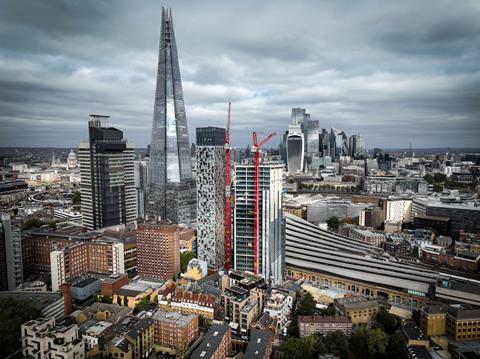
It is generally agreed that, right now, the commercial market in London is fairly so-so. Not in dire straits – but not sky-rocketing either.
Speak to many in the market and the issue of funding, investor confidence and the cost of construction have all combined to put question marks over projects’ viability. Look around the skyline of the capital and there are still plenty of tower cranes working away, but developers and, especially, contractors all look at pipelines.
The roll call of jobs that are, for a variety of reasons, some time away include Hill House, 70 Gracechurch Street, 18 Blackfriars, 1 Undershaft, Silk Street and 55 Old Broad Street.
There is a lot of square footage locked up right now. London is this country’s most important commercial offices market by some distance, but most of those you talk to in it, while not in despair, are sombre. There is a lot of stuff planned but it is a case of which funder is going to blink first.
Still, there are a few developer clients that remain quite active. Established name Stanhope is one, with the firm picking up Landsec’s Red Lion Court scheme last year. It is known to be looking at buying other sites to develop.
Another is Great Portland Estates, which has announced a series of projects recently including its much-delayed St Thomas Yard scheme at London Bridge which will be built by Bovis.
And there is the Dutch firm Edge. Until a few years ago, it had never worked in the UK and was, by and large, unknown over here.
But in 2020 it bought a former immigration office opposite London Bridge station and asked architect Fred Pilbrow, formerly of PLP, to come up with a design. This September, Mace is due to complete the £230m job, a 26-storey block running across 260,000sq ft and known as Edge London Bridge.
The Edge name emerged in 2014 when the company – then known as OVG Real Estate – developed a new building in Amsterdam for accountant Deloitte. It was called the Edge.
Alex Kerr, the firm’s commercial manager in London, says: “At the time it was the most sustainable building in the world. It created so much good PR that we thought, ‘ we’ll have a bit of that’ and OVG was rebranded as Edge off the back of that.”
Edge has been in London for around five years now and, as well as its native Netherlands, also has offices in Berlin and, recently, Paris having bought a site in the French capital. All told, there are around 150 people who work for the business, with 15 working in London out of its office at Great Portland Street.
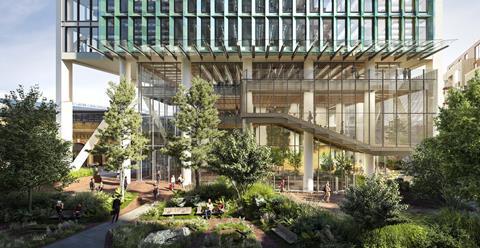
Edge has two other schemes in the capital – Edge Liverpool Street, running across 475,000sq ft and also due to be built by Mace. Erith has been carrying out demolition work there, ahead of piling beginning soon.
It also has a 250,000sq ft site in the West End, at 125 Shaftesbury Avenue, designed by DSDHA and due to be built by Sir Robert McAlpine. John F Hunt has been appointed to carry out demolition and enabling work, which is expected to take the rest of this year.
This job will be rebadged and given a new name with the Edge prefix. Kerr’s boss, commercial director Cornelia de Boinville, says it’s a deliberate strategy: “We don’t step away from the name. We’re very proud of it. We’ve been creating buildings with sustainability in mind since 2009 [see ’A brief history of Edge’, below]. We’ve walked that walk.”
De Boinville, who was working on the Liverpool Street scheme in her previous role at leasing agent Cushman & Wakefield, moved to Edge three years ago.
She says the firm is after sites of 100,000sq ft and more but admits that finding the right plots has been tough in the past few years. “The investment market has been pretty depressed and people haven’t been selling. Vendor price expectations do not meet the buyers’.”
We’ve been creating buildings with sustainability in mind since 2009. We’ve walked that walk
Cornelia de Boinville, commercial director
Still, she remains undaunted. “We didn’t buy anything last year but that wasn’t for the lack of trying.”
Despite approaches from other UK cities, the firm is sticking to London for now and, while its sweet spot is sites of 100,000sq ft or more, it is not rigid in that.
If it was a 60,000sq ft project in the West End, de Boinville says it would take a look. And, while Edge London Bridge is 26 storeys and the AHMM-designed Edge Liverpool Street stands at 20 storeys, it is not afraid of the super-tall stuff either.
“We’ve appraised the situation but, for whatever reason, we haven’t decided to progress with it,” she says. “Absolutely, though, we look at it.”
In a recent update, the City of London said that, according to research by JLL, vacancy rates in the City core stood at just 4.4% in Q4 last year, while the new-build vacancy was less than 1%.
Like most developers, de Boinville knows the appetite for tenants to move is there, but the cost of switching can be prohibitive. “Lots of people are staying put, purely because of the cost of fit-out. It’s a lot.”

Both de Boinville and Kerr say that, in their experience, office staff in London are now usually in for four days a week, with people working their daytime hours more flexibly – earlier starts, earlier finishes and so on. “I don’t think five days will come back but it’s not limiting the amount of space [tenants] are taking,” de Boinville says.
At the end of last year, Edge announced that US software firm ServiceNow would be taking five floors at London Bridge with an option for a further two.
Chris Semones, the boss of asset management at Goldman Sachs, which is helping to fund the project in joint venture with Edge, said at the time: “This first letting validates our thesis, underlining the exceptional quality of the project. The transaction reinforces our confidence that the building will continue to resonate with high-calibre occupiers and drive strong leasing momentum.”
We’re creating destination buildings that people want to come into and be in. Firms need to be able to attract and retain staff
Alex Kerr, commercial manager
Edge is talking to others about taking space at London Bridge, including a global firm of architects.
Kerr has a take on the differences in decision-making between more established businesses and the start-ups. He thinks getting sign-off from the newer firms, such as those in tech and AI, is quicker because there are fewer layers of company bureaucracy. More “traditional” firms take longer with the decision-making process because of partner and shareholder votes. Basically, the start-ups go for it.
Still, whatever the decisions they come to, would-be tenants need certain requirements ticked off no matter what.
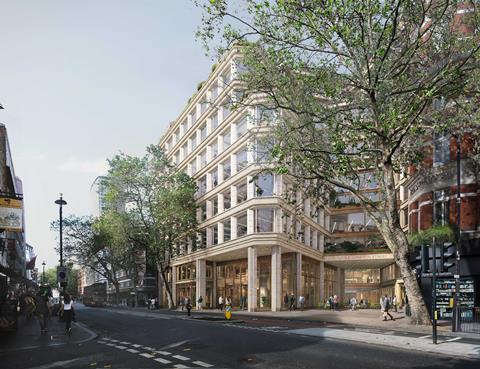
Edge London Bridge, which sits in the shadow of the Shard, is a few yards away from one of the entrances to the nearby station and, says Kerr, nodding to the revamped station below: “Connectivity is critical.”
Employers also have different aspirations for their staff – and the ones they have yet to recruit. Shuttering them away in ‘will this do?’ space no longer cuts it.
“We’re creating destination buildings that people want to come into and be in. Firms need to be able to attract and retain staff.” He adds: “ServiceNow’s view is that this [building] promotes their brand.”
ServiceNow is expected to move from its current address at Salisbury Square in the City into its new home by summer next year, with 500 workers currently on site to meet the autumn deadline.
The building, which at capacity can hold up to 2,500 people, will feature a gym and pocket park as well as more than 40 showers and 500 bike parking spaces. It will also include a café that will be open to the public.
Edge said its letting with ServiceNow “reflected the sustained demand for modern, environmentally responsible offices in central London” with tenants wanting a building to have sustainability credentials, smart technology and flexible workspace
In the meantime, Edge is eyeing a completion date for Shaftesbury Avenue, which will be increased from 11 to 13 storeys, of autumn 2028 and the following summer for Liverpool Street.
It has been talking to a series of architects, including Foster + Partners, RSHP and Fletcher Priest, about future plans. “We talk to architects all the time,” de Boinville says.
In its near 30-year history, it has developed close to 100 buildings – mainly in Europe but a couple in the US too – and de Boinville says there will be more to come in London. “We back ourselves. Edge are in growth mode.”
A brief history of Edge
Edge was founded in 1997 by Dutchman Coen van Oostrom, then aged 27.
It was known as OVG Real Estate until 2014 before it changed its name to Edge – tapping into the publicity its Edge project for accountant Deloitte received when the building in Amsterdam opened that year.
Designed by PLP, it was widely considered to be a revolution in green building design and was awarded a BREEAM sustainability score of 98.36%.
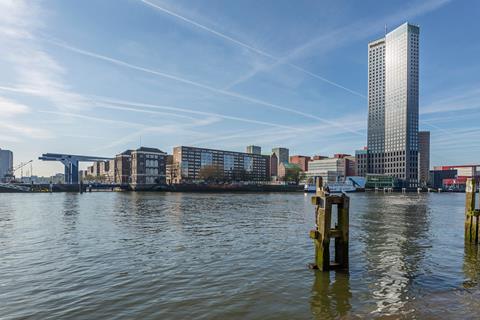
The firm says its breakthrough building came in 2009 with a tower called De Maastoren in Rotterdam. It was the first building to use river water for cooling and heating.
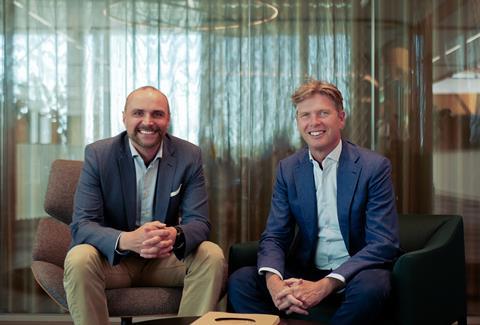
The firm, which saw Australian investor Macquarie Asset Management take a minority stake in the business in 2022, has offices in Amsterdam, Berlin and, most recently, Paris which it opened last year. 2025 also saw van Oostrom move to an executive chair role last May, with former HB Reavis boss Marian Herman become chief executive.
The firm also moved into the BIG-designed Edge East Side tower in Berlin last year, having completed it in 2023. At 36 storeys, it is one of the tallest in the German capital and is mostly occupied by Amazon.
In 2021, it opened a London office after buying a former Home Office immigration office at London Bridge to redevelop. Along with Mitsubishi, Edge bought a third London site, this time at 125 Shaftesbury Avenue, at the end of 2023, having bought a site at Liverpool Street with Mitsui Fudosan the previous year. The job was initially named Edge Shoreditch but later rebadged as Edge Liverpool Street.






No comments yet