














Pair propose repurposing capital’s disused railway viaducts as social bathing spaces inspired by similar models overseas
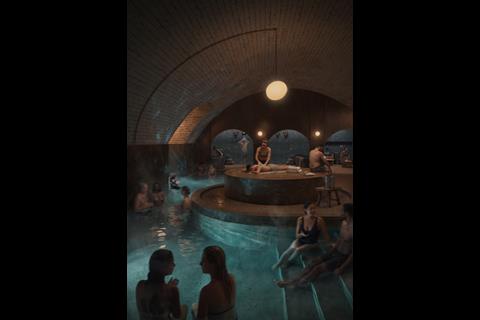
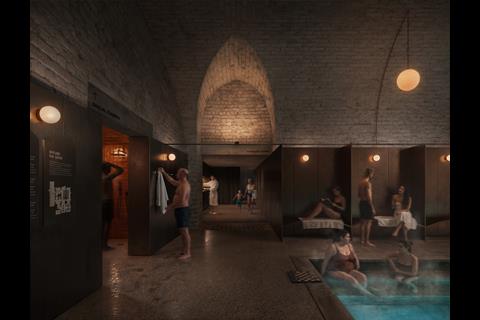
Tuckey Design Studio and Jane Withers Studio have floated a concept for a building a social bathhouse within a series of disused railway viaducts.
The two firms said the idea, which is currently on display at the Royal Academy of Arts Summer Exhibition, is inspired by London’s “lost culture of communal bathing” and part of a wider ambition to establish a new model for urban bathing which is accessible to all.
London had around 100 Turkish baths during their peak in the late Victorian and Edwardian eras, with more than 600 operating across the British Isles.
But the rise of indoor plumbing in private homes led to a rapid decline of the UK’s public bathhouses after the First World War while the introduction of Finnish saunas in the 1950s further changed social habits.
While there is a renewed interest in upscale wellness destinations and smaller community saunas, there remains no “enduring, accessible civic bathhouse” in the capital, the team said.
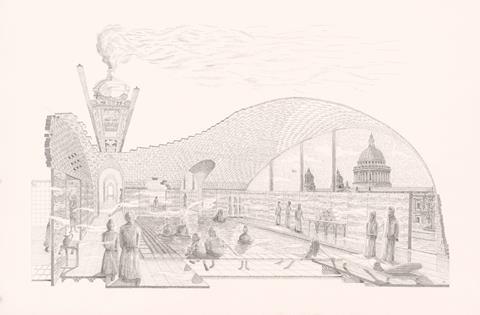
The ‘London Bathhouse’ concept draws on models of civic bathing infrastructure common in cities including Oslo, Tokyo and Berlin, where shared bathing spaces are designed to encourage both social interaction and individual reflection.
The team’s concept envisages the monolithic structures of London’s vacant viaduct arches as ideal sites for creating a “calm interior world” shielded from the city and a new generation of low-carbon and scalable social bathhouses.
The vaulted chambers, with their curved forms, brick construction and repeating modular spaces, share characteristics typical of historic Victorian Turkish baths and hammams, the team said.
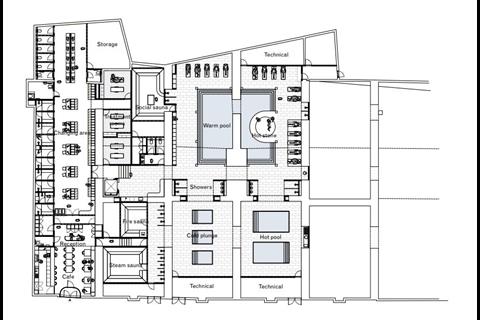
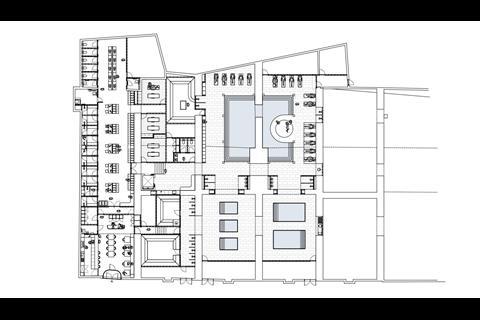
The 600sq m proposal would repurpose a derelict viaduct arch in Bankside as a series of enclosed bathing spaces functioning as a sequential experience, where visitors move from dry areas to progressively wetter and warmer environments.
Images of the concept show bathers relaxing in a series of dimly lit pools and interior spaces finished with natural materials including timber and travertine, a form of limestone created near hot springs which was commonly used by the Romans in constructing bathhouses.
Tuckey Design Studio director Jonathan Tuckey said: “Whenever I visit cities around the world, I envy the place that social bathing still holds in everyday life. London has embraced people, food and culture from across the globe, yet has allowed its own rich tradition of communal bathing to disappear.
“We believe it is time to revive that tradition, not as an exercise in nostalgia, but as a new form of civic space: somewhere affordable and welcoming where Londoners can slow down, meet one another and feel restored.”
Jane Withers, lead consultant at Jane Withers Studio, described the concept as a contemporary take on a lost tradition that “aims to make the pleasure and health benefits of communal bathing accessible to all”.
“Bathhouses were once an important and much-loved part of London’s civic infrastructure,” Withers said. “Much more than places for cleansing, they were community gathering spots for relaxation, restoration and socialising.
“With the invention of the Victorian Turkish Bath in the 1860s we developed our own version of such great bathing traditions as the Romans’ magnificent thermal baths or the Ottoman Hamam. Ornately tiled and veiled in steam, there were once around over 100 Victorian Turkish Baths in London alone and more than 600 across the British Isles. Now only 7 remain.
“But with the resurgence of interest in communal bathing, we see an opportunity to bring back these important civic spaces.”
The London Batthouse concept will be on display until 23 August while a panel discussion featuring bathhouse experts will be hosted at Tuckey Design Studio in London this autumn.





No comments yet