















Clients and government officials mingled with SMEs bringing fresh ideas for building better at this year’s two-day conference in the City of London. With the government’s 10-year infrastructure strategy setting out a clear roadmap for future projects, what does this mean for innovation in the built environment? Tom Lowe reports
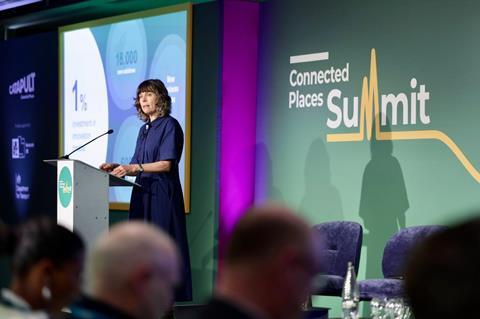
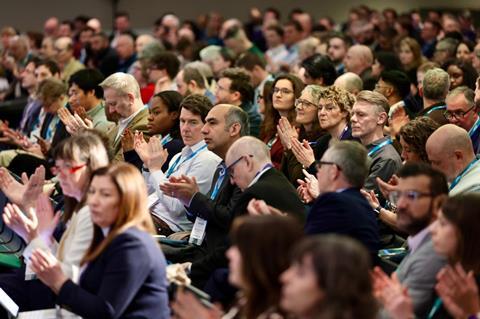
More than 1,000 thought leaders and innovators from across the built environment assembled this week at the Connected Places Summit in the City of London to discuss the latest trends driving change in construction and infrastructure.
The annual conference, organised by Connected Places Catapult, brings together major clients such as HS2, Sizewell C and Transport for London with entrepreneurial SMEs at the cutting edge of industry innovation.
Government officials also attended in droves, mainly from the Department of Transport, the Department for Science, Innovation and Technology and the Department for Business and Trade.
Connected Places Catapult is part-funded by government body Innovate UK and is seen as a key enabler in the development of innovative technologies which aim to solve a whole host of issues, including increasing this country’s perennially low productivity, reducing carbon and cutting costs on major projects.
This year’s conference came at a time of client-side uncertainty and anxiety with energy prices skyrocketing as a result of the ongoing Iran conflict. Like other recent crises, the war is a double-edged sword for innovation funding - on the one hand, it gives greater urgency to the need to cut costs on major projects. On the other hand, the prospect of inflation returning risks prompting decision makers to cut essential funding for research and testing programmes.
But the conversations at the conference largely steered away from the conflict and focused on solving issues which relate to longer term structural challenges within the UK’s infrastructure and construction sectors.
The solutions discussed have the potential to outlive any (hopefully) short term disruption and lead to better outcomes for people who work in the industry and the wider public which benefits from what the industry creates.
The government’s 10-year infrastructure strategy
Much has changed since last year’s conference, notably with the government’s publication of its landmark strategy for transforming the nation’s infrastructure over the next decade. The £718bn strategy was widely lauded at the summit for providing a transformational framework for professionals across the industry to use when planning potential work opportunities.
The certainty it provides has the potential to drive investment and reap accumulating rewards not just for infrastructure but for all of the sub sectors which feed into the 700 schemes contained within the strategy.
Several senior leaders at the government’s National Infrastructure and Service Transformation Authority (NISTA) spoke at the event. In a keynote speech, John Loveday, the organisation’s director of infrastructure, enterprise and growth, spoke of the success of the government’s web page on the 10-year strategy had been getting from the industry. The page has received some 140,000 hits since it went live last July, with around 500 hits a day.
“For a government website, which is relatively specialized to a relatively small element of the UK, we’ve seen a tremendous amount of use,” he said. “A lot of the infrastructure and construction supply chain are using it. They’re using it for business planning, which is what we wanted it to do.”
Much of the public and private capital which will enable projects on the strategy is being mobilised by the National Wealth Fund, a government body based in Leeds. NWF chief investment officer told the conference that the body saw part of its role as motivating local leaders for regional projects.
“There’s a saying that all politics is ultimately local, and I think the same can be said for growth, at least to some degree,” Brown said. “If we’re going to get the UK really firing on all cylinders, that will require truly empowering local leaders to support communities and businesses in their areas, and entrusting those with the insight and understanding to make the right model to enforce the growth that, in turn, will require knowledge and support around financing the big projects that will act as a catalyst for that growth.”
How the pitfalls of HS2 are driving innovation
There is no bigger project than HS2, of course - the largest infrastructure project in Europe and arguably among the most troubled. The programme is currently in the midst of a major reset under its chief executive Mark Wild, who knocked Crossrail into shape during the final years of the delayed London transport scheme. HS2’s reset has been prompted by spiralling costs and drastic programme changes including the cancellation of its two northern legs.
The railway’s director of stations Huw Edwards was frank about the challenges the project has faced since it was given the government go ahead in 2020 - and the reputational damage it has inflicted on the wider infrastructure sector in the UK.
“We have been inconsistent in the UK in infrastructure delivery. HS2 is probably the worst example, but that is why a significant reset of the scheme is required,” he said. “When we look at what the scheme has done over the last five years, we have not been consistent around controlling scope, interaction with government, and appropriate contract mechanisms.”
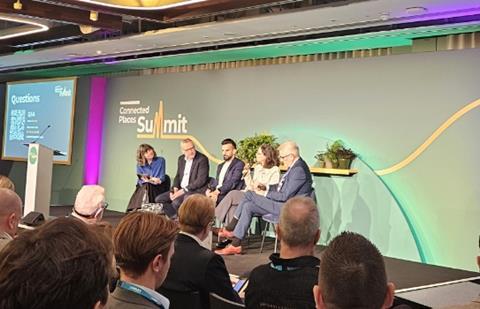
He said the situation the programme had found itself in after Wild took over in 2024 was one in which the supply chain had been “purely focused on sending risk to the public sector…An organisation which wasn’t fit for purpose, isn’t fit for purpose, so the organisation needs to change.”
But Edwards promised that the reset, which he described as almost a “project in its own right”, would drive innovation and new approaches in future programmes. Once the reset is complete, HS2 will “throw open the doors in terms of our learning”, he said.
“I know stuff I can’t tell you, obviously I know stuff about the lessons learned across the last five years, we are pitching to get that information out,” Edwards told the audience. “So we will do that once the reset is complete. I can visualise road shows, forums, briefings, industry events. Why? Because we want everybody, regionally, nationally, to avoid the pitfalls and bear traps that we have fallen into at HS2.”
Charlotte Hills, HS2 head of innovation, spoke later on a panel about scaling innovation in major projects. She shared the challenges of justifying investments in innovation on a project which is under pressure to prove its value. Only around 10% of all productivity-raising or cost-saving innovation technologies had “actually enabled any benefit”, she admitted. But overall, she said those successful ventures had saved the project £380m from its baseline and around the same in terms of cost avoidance.
She gave some advice to innovation leaders on other projects on the importance of measuring and publicising the value of what innovation can bring, and of taking risks on multiple untested approaches to enable big outcomes on those which succeed.
“I think if we didn’t have those key numbers to show that we are delivering impactful value, I think we would struggle to continue as a function,” Hills said. “I think it’s really good at any innovation programme to really ask yourself, are you able to articulate what the value of your programme really is? Because over time, that is absolutely critical.”
How innovators can make themselves heard
The main lobby area at the conference was a hive of networking activity during regular breakout periods as SMEs, clients and government officials traded thoughts and ideas on how new technologies could be applied. But getting a new approach picked up by an organisation is no easy task, even when the benefits of that approach are evidenced and clear.
“We don’t have an innovation problem. We have a scaling and adoption problem,” Connected Places Catapult director of built environment and urbanism Geoffrey Stevens told Building the day before the first day of the summit. That thinking was shared by many of the SMEs Building spoke to during the two days of the event.
One jaded business owner spoke of the difficulty of persuading large organisations to do things differently. “If you go to the Department for Education and say I’ve got this new idea which will save you time and money, they will most likely say no,” he said. “Even if you have evidence from a successful use of a new technology on a project, getting a second client to give it a go is very hard”.
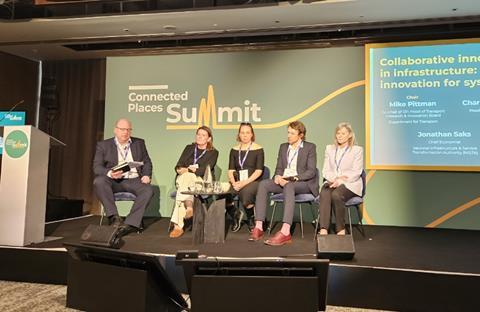
Mike Pittman, head of transport research and innovation at the Department for Transport, said part of the difficulty on infrastructure projects was the long-term nature of programmes in which costs and methodologies are set at the beginning, increasing the risk of applying potentially disruptive new approaches halfway through construction.
Chris Coonick, innovation lead at the National Grid, advised SMEs approaching a large organisation with a new idea to make sure they know what problem they are trying to solve.
“We get quite a lot of solutions coming to us, looking for a problem, which is really challenging for us to do, as an organisation of our size, 31,000 people across UK and US. It’s hard to necessarily find the person in the organisation that has that exact problem,” she said. “Come to us saying, this is your problem, and this is why I know you have that problem. This is the evidence, and this is the solution I have, and this is the value it’s going to bring and this is why it’s going to solve your problem.”

The transport sector’s poor record on carbon reduction
The government is edging towards its 2050 net zero target, and progress is being made in many sectors - except, apparently, transport. The Department for Transport’s chief science advisor Patricia Thornley laid out the scale of the challenge and the stark reality of how far short the sector has fallen behind.
“One of the things that keeps me awake at night is where we are heading in terms of making this all sustainable,” Thornley admitted. “We are nowhere near decarbonising our transport sector. Now I’ve spent 20 or 30 years in academia looking at these numbers, looking at how to reduce carbon, looking at different ways of framing this. And yes, I can quibble about the numbers and I can argue that we’re counting it the wrong way, but none of that changes the fact that transport is not budging in terms of its carbon emissions.
“We are barely making a dent as other sectors have improved, like electricity and heat.”
She called on those in attendance to come to the DfT with ideas about how to tackle the “massive challenges” the transport sector faces. She also spoke of the importance of the government’s industrial strategy, outlined earlier this month, in influencing technological change.
Thornley, a former lecturer who was appointed to her new role earlier this year, said: “One of the things that has really surprised me in the last six weeks, moving from academia into the government side of things, is just how important that industrial strategy is. I knew it was important on the other side, but it really is leading an awful lot of thinking, and so I think it’s really important that the transport sector looks at how we’re contributing to industrial growth.”
How to stop innovation bodies from being a talking shop
Discussions on how to enable better outcomes for giant publicly funded projects lasting a decade or longer and incorporating hundreds of organisations in complex supply chains can naturally veer towards the abstract. But on the ground, the solutions on offer from SMEs in attendance, from new piping technologies to software designed to run multiple systems at once autonomously, deal with very real problems and promise tangible improvements.
The Infrastructure Industry Innovation Partnership, known as i3P, is a forum set up in 2016 to bring together infrastructure clients with their supply chain partners and businesses with innovative ideas. The body was frequently referenced at the conference and while it was at times criticised as being a talking shop, its value was widely recognised.
HS2’s Charlotte Hills said it was “really easy to criticise i3P as just another talking shop, and they run the risk of being that”. But she said one of the reasons she attends its meetings is to try and fight that perception, and encouraged anyone with a negative view of the forum to contribute their expertise.
“If anyone’s got those concerns, just get involved, and don’t just be on the sidelines throwing stones, because actually, we are in a fairly new landscape, trying to solve these problems collaboratively,” Hills said.
She added that the initial idea behind i3P was to “have a big portal where everyone would share their innovations, and they would magically get picked up and then scaled into the next programme - that has not worked.
“And we’re realising actually it’s going to take a different kind of approach. It may be that what we’re trying to do now isn’t quite the right thing, but it’s all an evolution, and we’ve got to be in it now to be part of that evolution to try and solve these problems.”
Building is a media partner with the Connected Places Summit




No comments yet