














Controversial scheme due to be heard by City’s plannning committee tomorrow afternoon
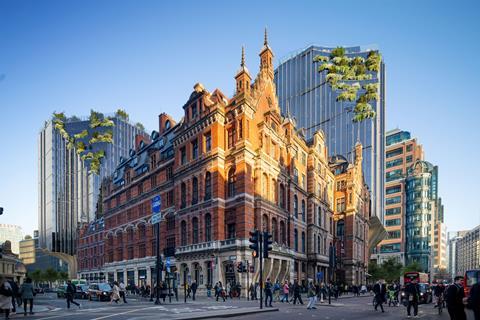
More than 3,500 members of the public are objecting to Network Rail’s £1bn plan to redevelop Liverpool Street station in what has broken records as the highest number of objections ever received by a planning application in the City of London.
Planning officers have recommended the Acme-designed overhaul for approval ahead of a meeting of the City’s planning committee tomorrow afternoon in what is set to be a fraught hours-long showdown between Network Rail and the scheme’s critics.
However, the application has also been buoyed by the highest level of support ever received by a City planning application with some 1,152 members of the public backing the application, bringing the total number of people weighing in on the scheme to close to 5,000.
Tomorrow’s decision comes more than three years after the transport operator first unveiled its plans to redevelop the UK’s busiest station, which have been beset by numerous design and project team changes amid heightened controversy over how the grade II-listed site should be upgraded to meet modern passenger demands.
Network Rail has argued that its latest proposals for the site have focused on protecting the Victorian heritage of the station and the adjoining grade II*-listed former Great Eastern Hotel.
But the total of 3,626 objections to Acme’s plans is now over 1,300 more than the number received by Network Rail’s first push at redeveloping the station under plans developed with Sellar and designed by Herzog & de Meuron which were submitted in 2023 but scrapped the following year due to the scale of a backlash against the heritage impact of the proposals.
The number has grown significantly over the past two weeks following a sustained campaign by The Victorian Society and Save Britain’s Heritage to highlight what the two groups argue would be irreversible damage to the station’s historic character if the scheme is built.
Critics of the scheme, which also include King’s Cross Station expansion architect John McAslan who has proposed his own rival scheme backed by Save Britain’s Heritage, have focused on Network Rail’s proposals to demolish a large section of the station’s Victorian-style extension which was completed in 1992.
The demolition would make way for an 18-storey commercial development above the station concourse containing nearly 90,000sq m of office space, which would be used to fund capacity and accessibility upgrades to the rest of the station, which has become severely overcrowded in recent years and overtook Waterloo as the UK’s busiest in 2023.
Although the original 19th century trainshed which sits north of the concourse would remain untouched, objectors argue the demolition of its 1990s extension, which is built in almost exactly the same style, would fundamentally alter the character of the building.
But Historic England, which strongly criticised Herzog & de Meuron’s original application, which would have also cantilevered the office block over the linked grade II* former Great Eastern Hotel, has not issued a formal objection to Acme’s plans.
While the government heritage advisor admitted the revised scheme would still cause a “great deal of harm” to the site, it described it as a “significant improvement” over the former application in what will be seen as a major boost for Network Rail at tomorrow’s planning committee vote.
A planning decision on the scheme, originally expected late last year, has been repeatedly delayed due to the size and complexity of the application with planning officers finally issuing a recommendation for approval in a 564-page report published last week.
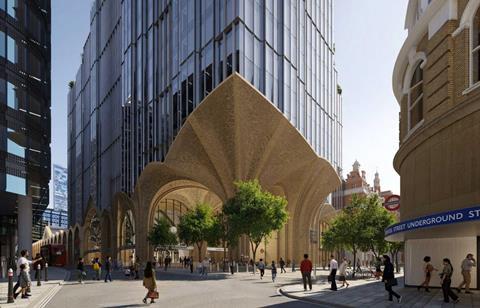
While the report admitted that the proposals would “result in numerous policy conflicts” and “entail the loss of significant historic fabric”, officers argued the proposals complied with the City’s development plan “when read as a whole”.
“The nature of the site and the ambition of the proposal create a singularly nuanced and complex policy balance,” officers said.
But the report concluded that the proposed upgrades to the station would be “transformational” and give the station “significant staying power in relation to future use forecasts”.
A needs report published by Network Rail found the station’s passenger numbers now surpass those seen at Heathrow Airport, Europe’s busiest airport, and are 2.7 times higher than those in 1997 with footfall forecast to increase by a further 35% by 2041 to some 131 million passengers.
Officers also praised Acme’s proposed designs for the scheme, which feature a motif of gothic-style arches around the concourse area, as an “inspired interpretation of Victorian gothic” which would have a “crystalline architectural identity of its own”.
“With an innate confidence and coherence, the design approach would align with the transformational ambition of the proposal,” officers said.
However, the Liverpool Street Station Campaign, a campaign group collective headed by the Victorian Society and including Save Britain’s Heritage, the Twentieth Century Society and Historic Buildings and Places, has described the scheme as “backwardly destructive”.
The collective said the proposals “hark back to the dark days of loss and vandalism” of historic buildings”, arguing both the station and the City of London “deserve so much better”.
The project team includes Aecom on engineering and transport, Certo as project manager, Newmark, previously known as Gerald Eve, on planning, Gleeds as cost manager, Donald Insall Associates on heritage and townscape, GIA on daylight and sunlight and SLA as landscape architect.




1 Readers' comment