
















ROCKWOOL® has responded to the post-Grenfell building safety regime with its new FirePro® range of fire-stopping products. We spoke to Matt Jones, head of fire protection at ROCKWOOL UK, to find out how the firm can help project teams get fire-stopping right
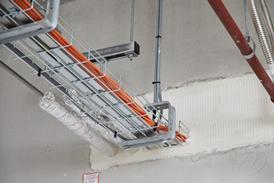
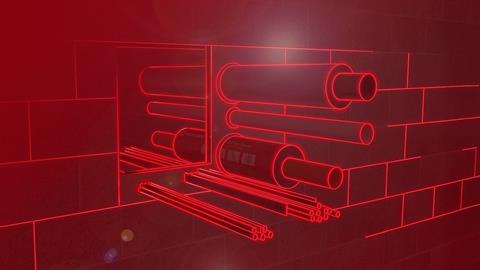
Fire-stopping – the sealing of gaps, joints and service penetrations in fire-resisting walls and floors to prevent the spread of fire and smoke between compartments – is a critical part of compartmentation strategy, and key to passive fire protection. But its effectiveness depends on getting numerous details right – and a mistake at any stage can compromise the performance of the whole system.
From conception to delivery
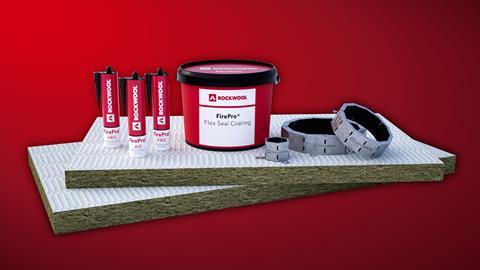
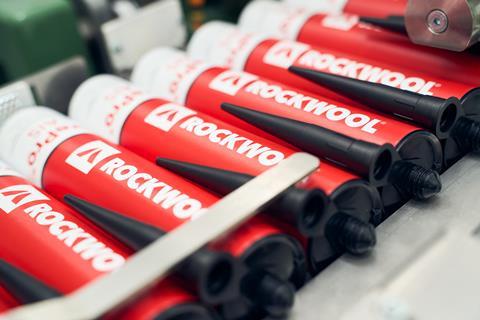
ROCKWOOL UK’s new FirePro fire-stopping range includes sealants, coated batts, pipe collars and wraps, classified for a range of service penetrations and construction details. By developing new formulations and managing the product line from conception to delivery, ROCKWOOL has greater control over product quality, innovation and supply.

Testing and certification
The range has been tested to BS EN 1366-3 and BS EN 1366‑4, with classifications to BS EN 13501-2. This is particularly important given the upcoming change to statutory guidance that will see the BS 476 fire-resistance test standards removed from Approved Document B as a recognised route to demonstrating compliance in England from September 2029.
The FirePro products are also supported by independent third-party certification through testing and certification bodies, which independently certify the products for specific, defined applications.
Finding the right detail
Fire-stopping systems are tested in defined configurations, so a small change in service size, spacing or wall type can take an installation outside the scope of its test evidence.
ROCKWOOL’s fire-stopping standard details guide can help make the specification process easier. It brings together standard fire-stopping arrangements in an online technical reference guide, with drawings, installation requirements, fire-resistance classifications and supporting evidence.
ROCKWOOL is working to make its technical guidance even easier to navigate, with new specification support resources in the pipeline and due out next year.
Making specification easier
One of the main challenges in specifying passive fire protection is understanding how to bring multiple applications and details together; current detail selection tools only point you to a specific detail for a specific application, but what if you have more than one service, differing services or a deflection requirement?
ROCKWOOL has developed a detail designer tool that brings all the elements of an aperture together to produce individual project details with clear spacing guidance, service treatments, links to datasheets and classification documents all in one report that serves as part of the golden thread of information. The detail designer tool is the simplest route to compliance for individuals involved in the specification and installation of passive fire protection.
Reach out to the team
ROCKWOOL’s fire and specification specialists can work directly with design teams to find a suitable arrangement. “If it’s a complex project and what you need doesn’t match with how our products have been tested, then talk to us. We can help you work out what’s needed and what evidence supports it,” says Matt.
Early engagement is particularly valuable because problems that are straightforward to resolve on a drawing can become much more difficult once walls are built and services installed.
Making early engagement real
Matt says that fire-stopping specification has changed significantly in recent years. “Historically, fire stopping was thought of as one of the last elements of a build,” he recalls. “Buildings and services would be in place before anyone even asked how to fire-stop an opening – and then often without considering service separation or the type of wall construction.
”But that’s been flipped on its head and now we are often being called in very early before buildings are being built. It makes a big difference.”
ROCKWOOL encourages teams to get its fire-stopping specialists involved at the design stage. Matt and his colleagues take part in many workshops with architects, main contractors, M&E teams and other manufacturers to look at the services needed on individual projects and how these will pass through compartment walls and floors – and what fire stopping will be needed. The aim of these early discussions is to develop project-specific drawings that everyone involved in a build, from designers to installers, can follow.
Managing spec changes
Specification changes are a situation where problems with fire stopping can unintentionally be introduced. Matt points out: “There’s always risk if you change something at the last minute. So you need to look at the bigger picture. Does the alternative actually fit the project? What support would you get if something went wrong?” He also warns that changing a specified system can carry design responsibilities.
Get it right on site
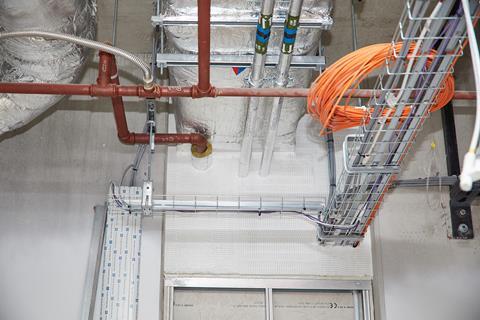
Of course, even the most carefully specified system can fail to deliver its intended performance if what is built does not match the design. Matt says on site is where he sees most issues with fire-stopping introduced. “We can sit through multiple workshops, get absolutely perfect site-specific detailing, but it’s translating that when the building’s being built where things can sometimes go wrong,” he says.
Services still sometimes end up being installed where trades find it convenient rather than where the approved design requires – and with fire-stopping that difference can really matter.
Incorrect service spacing is a recurring problem. To help prevent this, on certain projects ROCKWOOL can offer on-site benchmarking whereby the ROCKWOOL team builds a section of wall, installs services on it, then completes the fire-stopping correctly to create a physical reference for the required standard. This is a quality-control technique that anyone can adopt.
Broader support for the sector
To support the industry more widely, the company provides continuing professional development (CPD) units covering fire-stopping application, installation and common pitfalls.
Practical fire-stopping education is also available at ROCKWOOL’s new Training Academy, which opened at Hams Hall near Birmingham in January 2026. The facility offers hands-on fire-stopping training courses for architects, contractors, installers and other professionals. Matt is a big fan of the courses. “It’s only when you’ve had a chance to handle our products that you really get a proper understanding of how they work.”
Shared responsibility
The Building Safety Act and associated reforms have sharpened the focus on competence and accountability in the industry, and changed the scope of the information needed to demonstrate compliance. In the new environment, no single organisation can guarantee the effectiveness of passive fire protection throughout a building’s entire life.
For ROCKWOOL, playing its part in that shared responsibility when it comes to fire-stopping means supporting customers through the whole process from early design to installation and handover. As Matt puts it, “We have a responsibility now more than ever to help designers, specifiers and contractors be confident in choosing the right fire-stopping solutions.”
Ultimately, effective passive fire protection depends on closing the gap between tested product performance, design intent and what is actually installed on site. For Matt, there are some simple rules to help make sure this happens: engage early, make use of the available expertise, and ensure everyone involved clearly understands the fire-stopping detail they are being asked to deliver – and why it matters.
Find out more
Explore the ROCKWOOL FirePro range at: rockwool.com/uk/products/categories/fire-stopping/
For the FirePro resource hub containing the fire-stopping standard details guide, CPDs and other resources, go to: rockwool.com/uk/resources-and-tools/resource-hubs/firepro-resource-hub
Find out more about fire-stopping courses at ROCKWOOL’s Hams Hall Training Academy at:
rockwool.com/uk/education-and-training/training-academy
ROCKWOOL Ltd is part of ROCKWOOL Group