












A recent roundtable, hosted in partnership with Siniat, examined why so many problems with passive fire protection are still only discovered on site – when fixes are difficult and expensive – and what part earlier engagement with manufacturers can play in preventing potentially safety-critical issues. Mary Richardson reports

Many of the challenges that slow projects down are well understood – for instance, cross-manufacturer compatibility – and the knowledge to get ahead of them exists. What’s less common is the structured space to share it across organisational boundaries, at a point in the programme when it can still change outcomes.
At a roundtable held at last month’s Building the Future Conference and chaired by Building specification editor Hollie Tye, representatives of eight manufacturers – including makers of fixings, fire dampers, plasterboard, fire stopping and smoke shafts – agreed that many problems with passive fire protection originate months or even years earlier, when design decisions are made without the right expertise in the room.
Late to the table
Everyone talks a good game these days when it comes to early engagement with manufacturers, but the feeling around this table was that, when it comes to passive fire protection, there is still too little of it – and it happens too late. Martin Fackrell, managing director of fire-damper specialists Mandik UK, said, “It should be probably at [RIBA] stage 2, stage 3. But, honestly, often, by the time we get to see things, then decisions have already been made – and generally they are incorrect decisions for passive fire.”
Steve Warriner, head of specification at plasterboard and drylining specialist Siniat, agreed: he believes manufacturers are still often consulted only after key design decisions have already been made, which leaves little chance to ensure that the different elements of a passive fire system will work together.
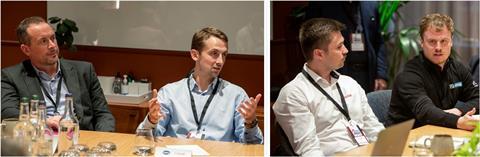
For Richard Chick, technical sales director at Sympafix UK, fixings are the extreme example, where the choice is often made very late in the day. He said, “It is usually a question of ‘We start on site in two or three weeks’ time… What’s the flavour of the month? What’s the best price for the fixings and fastenings?’ The technical aspect of the products is just not spoken about.”
Putting products together to make systems
Joshua Slack, commercial director at passive fire protection systems maker Promat, flagged interfaces as another problematic area. “One of the big topics in fire protection in recent years has been around interfaces,” he said. The issue is that a damper, say, will sit in a partition, fire stopping goes around it and fixings hold it all up, and responsibility for ensuring compatibility at the interfaces between these elements can be fragmented.
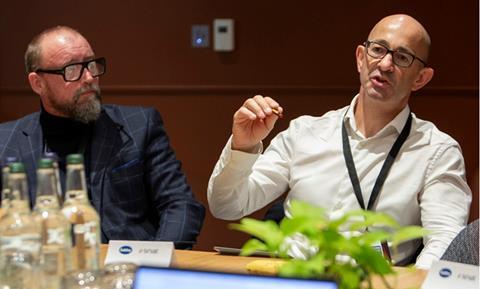
Philip Jay, managing director at Specwall, whose smoke-riser system is designed for fire-resistant smoke-shaft construction, said he is being drawn into projects earlier and earlier, but that interface questions are still often left late. He finds that “people don’t know what damper they want. They don’t know where it’s going. They often haven’t even got the setting-out details for it.”
The solution to all these issues remains the same: “Get the right people in the room nice and early,” said Warriner. “Then it will be easier to put products together to have a compliant system than if you leave it too late.”
Working together is also key for Ross Turnbull, GB trade manager for interior finishing at construction technology and fire protection specialist Hilti. He said manufacturers need the “self-awareness to stay in our lane” and, if need be, as issues arise in passive fire specification, the collaborative attitude required to admit, “I know this is an issue, but I don’t necessarily have a direct solution right now, so I’m more than happy to work with company X, Y or Z to find a solution.”
Improving specification
Vague specification of fire protection also came in for criticism round the table as another common cause of problems on site. Chick said he would like to see the phrases “approved or equivalent” and “suitable fixings by others” taken out of all specifications.
“If an architect cuts and pastes ‘approved or equivalent’ or ‘suitable fixings by others’, what does that actually mean?” he asked. “What is ‘suitable’? What is ‘approved’?” In their place, he would require specifics, such as “must have an EN 1364 part 1 fire test”, “must have site testing for specific base materials” or “operatives must be trained in anchor installation”.
Raising another frequently encountered issue with specifications, Liam Nevins, product technical manager at ventilation and fire protection systems manufacturer Trox UK, called for specs that are “performance rather than brand based”. Fackrell agreed, saying that he writes brand-neutral specifications where “these guys over here can meet it; we can meet it; other people can meet it – if they’re good enough”. “It’s not about dumbing down,” he added. “It’s about bringing everybody in.” For Warriner too, this performance-led approach is the right one because it means a level playing field, where manufacturers can win jobs on the merits of their products.
Evidence nobody understands
There was consensus around the table too that some of the designers and specifiers asking for test results for passive fire products still don’t really understand what they are asking for. Several speakers said they recommend people ask for classification reports – which establish a system’s fire-resistance classification and its field of application – rather than raw test reports. Warriner argued that relying on a report they cannot fully interpret could leave someone with a false sense of security – while still carrying personal risk.

It isn’t only fire tests. Chick said that a pull-out test on fixings is often treated as a guarantee, when what it proves depends on how the work is done. Before checking a test on site, he said, he always asks to see the installer’s drill bit, dust extraction unit and wire brush – which will typically all be needed to follow the installation method set out in an anchor’s European technical assessment (ETA) – but, as often as not, he finds this request is met with a blank look. Contractors often “just want a bit of paper”, he said, adding people also need to remember “We’re not proving the anchor, we’re proving the anchor in that base material.”
Liability fears feed the problem. Jay suggested professional indemnity worries sometimes lead architects to demand test reports for combinations or details that have never been formally tested. For other details, meanwhile, there is no standard to test to. So, for example, as Nevins pointed out, Approved Document B requires compartment walls to accommodate floor deflection during a fire, but does not specify a particular test standard for demonstrating compliance. To avoid misunderstandings and mistakes, the answer in situations such as this, the group felt, must be the same again: get everyone in the room and on the same page and get an agreed decision signed off.
Competence concerns
Competence was a more general worry. “If I have any work done on my gas central heating system at home, I have to get a Gas Safe engineer,” said Fackrell. “But anybody can put in fire safety systems, and that difference seems wrong.” The problem starts within education, he argued, pointing out that on a three-year architecture degree passive fire may be dealt with in as little as a single afternoon.
Charlie Perkins Gillott, senior technical adviser at fire-stopping and cavity barrier manufacturer FSi Promat, agreed, making the point that early engagement works best when there is a strong technical lead – an architect or specialist consultant on a project design team, who has sufficient knowledge to challenge manufacturers and keep a balance between them. Without that, he suggested, the process risks becoming too manufacturer-led and running away in one direction.
To address the industry’s current knowledge gaps, there was agreement around the table on the urgent need for more education about fire protection, through both formal routes and informal routes, such as CPD modules.
Space to build
For Fackrell, the commonest preventable problem with passive fire protection design is lack of space. “The first question that someone always asks is, ‘How close can the damper go to the slab?’” he said. The damper usually needs to sit lower than designers have allowed for, he explained. “That happens on every job.”
And then, of course – others around the table noted – as more and more services are added during development of the design, there is less and less room to fire stop or to maintain anything. Nevins pointed out that the same congestion can leave dampers impossible to reach for inspection or maintenance after handover.
Perkins Gillott, meanwhile, warned that test evidence is not the same thing as buildability: a design can meet the tested spacings and still leave an installer no room to fire stop it properly. But again, these spacing problems are something that the right early conversations with manufacturers should be able to prevent.

Looking to the future
Did the group feel there is any room for optimism? Are things moving in the right direction in passive fire specification?
For Turnbull, the guidance and regulations governing fire protection remain too reactive. “We’re still just reacting to failures,” he stated.
Jay said he felt that the Building Safety Regulator’s gateway process has helped to give manufacturers an early entry into higher-risk building projects at least. He also suggested insurers might help drive positive change. “It’s the insurers who are alive to fire risk more than they ever were,” he said, suggesting that this increased scrutiny could provide an additional incentive for the industry to develop better co-ordinated and better evidenced passive fire solutions.
Warriner meanwhile wondered aloud where responsibility lies when manufacturers recommend technical details. They may provide drawings and advice, but it is not always clear whether they are supporting the design or assuming responsibility for part of it. Greater collaboration, he suggested, requires greater clarity about responsibilities.
Tested combinations
But there was also support for a more proactive and joined-up approach from manufacturers. Turnbull offered a candid reflection. “It’s only in the last 12 months that I’ve begun to realise that perhaps I am part of the problem,” he said. “It’s too easy for manufacturers to blame designers,” he argued, suggesting that manufacturers should instead come together pre-emptively to put together more systems – and make life easier for designers and specifiers.
He proposed manufacturers should go further than joining individual projects at RIBA stage 2 or 3, and instead ought to collaborate – even as competitors – to proactively develop and publish more tested combinations of products. “If we don’t have tested solutions put together before projects reach design, all we’re doing is solving the problems each time as we go along,” he said. Rather than wait to be invited in, he suggested they should proactively offer systems they know work together.
Nevins agreed that the future lies in a system-based approach, and Warriner put it like this: “We need to work together to offer solutions and systems instead of just going, ‘No, I just deal with the wall. You need to speak to someone else about that other bit.’ That doesn’t help anyone.”
Such collaboration would not be without its challenges. Turnbull cautioned that it should not become a way of closing off the market: he felt manufacturers need to avoid “a closed market and closed specifications”. At the same time, Perkins Gillott acknowledged that commercial teams naturally want to sell their own products, while Jay described the appeal of making his firm’s own complete tested branded smoke-shaft solution as a way to guarantee compatibility. But a key aim, the group agreed, must be to develop compatible systems without denying specifiers a choice of suppliers.
Turning goals into good practice
The test of such an ambition will be what happens next, and Chick challenged the group to turn its talk of communication, education and collaboration into action. But if manufacturers can indeed find ways to put tested, openly documented solutions into designers’ hands before projects start, earlier engagement will become more than an aspiration – and could help prevent safety-critical problems before they get designed in.
Round the table
Chair: Hollie Tye, specification editor, Building
Richard Chick, technical sales director, Sympafix UK
Martin Fackrell, managing director, Mandik UK
Philip Jay, managing director, Specwall
Liam Nevins, product technical manager, Trox UK
Charlie Perkins Gillott, senior technical adviseor, FSi Promat by Etex
Joshua Slack, commercial director, Promat by Etex
Ross Turnbull, GB trade manager – interior finishing, Hilti
Steve Warriner, head of specification, Siniat