
















From skills shortages and siloed thinking to confusing career pathways and policy churn, industry leaders gathered to ask whether it is time to rethink how the built environment attracts and trains its future workforce – and what a more accessible, collaborative and work-based model could look like
The built environment has rarely faced such a complex set of challenges: decarbonisation, digital transformation, regulatory reform and persistent skills shortages are all reshaping what it means to deliver projects. Yet, as one participant at a recent roundtable observed at the outset, “educational pathways have pretty much stuck in the past”.
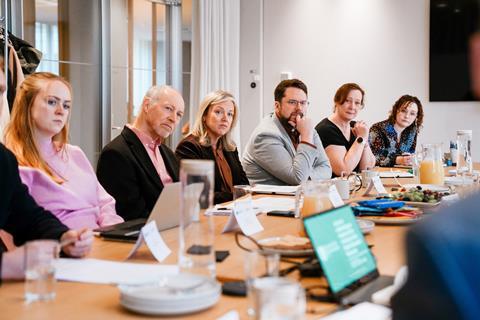
That tension – between a rapidly evolving industry and slower-moving education systems – framed a wide-ranging discussion, hosted by Building in partnership with Northumbria University, Ryder Architecture and the University of the Built Environment, among senior figures from across practice, academia and training.
At the heart of the debate, which was chaired by Building’s technical editor Thomas Lane, was a simple but provocative question: are traditional, single-discipline academic routes still fit for purpose?

A perception problem – or something deeper?
For many around the table, the issue begins well before formal education. “There’s a perception issue,” said Aled Williams, pro vice chancellor at the University of the Built Environment. “We need around 250,000 new entrants by 2030, and a large proportion of those are technical roles. But we have both an attraction issue and an absorption issue.”
That mismatch between demand and appeal was echoed by Emma Barnes, head of impact at the Construction Youth Trust, who works directly with young people entering the sector.
Many teachers still think construction is just bricklaying and manual work. We’re not explaining the amazing diversity of career options in the sector and the stepping stones clearly enough
Peter Barker, consultant, Ryder
“Young people want to go where the money and the opportunity is,” she said. “Construction doesn’t yet have the glamour of sectors like tech or finance. And the landscape is incredibly confusing – there are so many different routes and qualifications, and they don’t always connect.”
She pointed to cases where even well-intentioned reforms fall short: “We’ve had young people doing T-levels being told they don’t qualify for higher apprenticeships. They’re falling between the cracks of different systems.”
For Peter Barker, consultant at Ryder Architecture, the problem is compounded by a lack of coherent messaging. “There doesn’t seem to be any cohesive approach to communicating what the sector is,” he said. “Many teachers still think construction is just bricklaying and manual work. We’re not explaining the amazing diversity of career options in the sector and the stepping stones clearly enough.”
Yet Liz Male, founder of Liz Male Consulting and a member of the ARB board, cautioned against overstating the negativity. “There has been a fundamental shift,” she said, referencing recent research. “There’s a growing backlash against the cost of degrees and a recognition that construction offers strong careers. We need to stop repeating outdated stereotypes.”
Round the table
Chair: Thomas Lane, technical editor, Building
Peter Barker, consultant, Ryder Architecture
Emma Barnes, head of impact, Construction Youth Trust
Susan Dawson, associate professor, and lead for educational partnerships, Northumbria University
Clayton Knevitt, board director and head of learning and development, Rolton
Rian Lamb, senior technical co-ordinator, Barratt London
Liz Male, founder, Liz Male Consulting
Peter Sofoluke, director, BPTW
Paul Sperring, associate director, Cundall
Caroline Sudworth, lead, Technical Apprenticeships Consortium
Aled Williams, pro vice chancellor, innovation and partnerships, University of the Built Environment
The case for change
If perception is one challenge, the structure of education itself is another.
Participants repeatedly returned to the idea that early specialisation may no longer reflect how projects are delivered.
“It’s not binary – you need both breadth and depth,” said Williams. “A broad-based, interdisciplinary route at level 4, followed by specialisation later, could cover a huge range of roles. You give people exposure first, then allow them to focus.”

That approach resonated with Rian Lamb, senior technical co-ordinator at Barratt London, who experienced both traditional and alternative routes.
“I joined the PlanBEE apprenticeship in 2016, then went to university,” he said. “PlanBEE felt much more in touch with the industry. University, in comparison, felt out of touch with the skills required now.”
For Susan Dawson, associate professor at Northumbria University, this speaks to a deeper shift in what education should deliver.
“We value people being able to make professional judgments,” she said. “That’s something traditional degrees haven’t always been able to develop. Exposure to different disciplines makes you more aware of how others think and where collaboration can improve outcomes.”
Work-based learning and the ‘PlanBEE effect’
Models like PlanBEE – combining paid work placements across multiple organisations with structured learning – featured heavily in the discussion, though not uncritically.
For Paul Sperring, associate director at Cundall, the benefits are clear. “We’ve diversified who we take on – not just traditional apprentices but digital ones too,” he said. “That blend is important. It’s about building a workforce that reflects how the industry actually operates.”
He added that such routes can accelerate development: “They’ve got a better foundation and they progress much quicker.”
We value people being able to make professional judgments. That’s something traditional degrees haven’t always been able to develop. Exposure to different disciplines makes you more aware of how others think and where collaboration can improve outcomes
Susan Dawson, associate professor, Northumbria University
The rotational element was seen as particularly valuable. Barker described it as “the bit that’s most important”, allowing learners to experience different disciplines while earning a salary and to avoid being locked into early decisions.
But participants were keen to stress that no single model should dominate. “It doesn’t have to be one-size-fits-all,” Barker said. “What matters is giving people a well-rounded base and clearly signposting their options early, with opportunities to specialise later without creating an overly long route to qualification.”
Barriers to scale: employers, education and trust
If the benefits of more integrated, work-based models are increasingly recognised, scaling them remains a major challenge.
A recurring theme was the difficulty of engaging employers. “There’s still a lack of faith in the further education system,” Barnes said. “Some employers won’t even consider candidates coming through FE routes.”
For Clayton Knevitt, board director at Rolton, part of the issue is mindset. “Taking on apprentices is seen as a risk – but it’s an investment in the future,” he said.
He also highlighted the importance of early engagement. “Getting students in for work experience is key. It’s amazing how many people go through a degree without understanding what the job actually involves.”
Meanwhile, structural challenges within education are also holding progress back. “There’s an extreme shortage of FE tutors, especially in construction and maths,” Male noted. “That’s washing away the foundations of the system.”
Dawson added that delivering consistent experiences across a fragmented employer base is difficult. “We work with hundreds of employers – from SMEs to major contractors – and the level of support varies hugely,” she said.
Policy churn and a ‘confusing landscape’
If employers and educators face challenges, many around the table argued that government policy is making matters worse. “There is a constant stream of policy change,” said Caroline Sudworth, lead at the Technical Apprenticeships Consortium. “We’ve had apprentices go through three different versions of a standard during their course. It’s ridiculous.”
Barker was more blunt: “I don’t understand the logic of constantly tinkering with something over five years. It erodes credibility, creates uncertainty, and employers won’t commit.”

Changes to higher-level apprenticeships were cited as particularly disruptive. “We saw uptake soar from 2017,” said Peter Sofoluke, director at BPTW. “But since recent changes, we can’t support it in the same way. The diversification we were seeing has come to a hard stop.”
There was also frustration at a lack of co-ordination across government bodies. “The left arm isn’t always talking to the right arm,” Sudworth said.
A system that isn’t joined up
Beyond policy, participants pointed to a more fundamental issue: a lack of integration across the skills system.
“There’s a disconnect,” said Male. “Central government looks at education, skills and employment in silos, while regional initiatives are trying to bring everything together.”
It’s not binary – you need both breadth and depth. A broad-based, interdisciplinary route at level 4, followed by specialisation later, could cover a huge range of roles. You give people exposure first, then allow them to focus
Aled Williams, pro vice chancellor, innovation and partnerships, University of the Built Environment
Barker reflected on how local partnerships had helped PlanBEE succeed. “In the North-east it was employer-driven, founded by Ryder with a receptive FE college (Gateshead College),” he said. “In Manchester, the city council got behind it and gave it momentum.”
For Williams, this kind of joined-up thinking is essential. “We need a connected network – education providers, employers and government working together – to ensure people move into jobs and stay in the industry,” he said.
Inclusion, access and ‘untapped talent’
While much of the discussion focused on structure and policy, the issue of inclusion remained central. “There are nearly a million young people not in education, employment or training,” Barnes said. “We can’t just focus on upskilling existing workers – we need to bring new people in.”
Encouragingly, alternative pathways appear to be helping. “We’ve seen much more diverse cohorts through apprenticeship routes,” Dawson said. “They’re more accessible and better aligned with people’s lives.”

But barriers remain, particularly around geography and social value requirements. “Sometimes projects require apprentices to come from specific boroughs, even if better candidates are nearby,” Sperring said. “It becomes a blocker.”
Looking ahead: what needs to change?
Despite the challenges, there was a strong sense that change is both necessary and possible. For Williams, the priority is clear: “We need strategic workforce planning, alongside upskilling and reskilling, and a focus on future-facing skills.”
Others emphasised the need for stability. “Stop changing the rules,” Barker urged. “Give employers confidence to invest. Employers are willing to help, as evidenced by the apprenticeship Trailblazer system instigated by Institute for Apprenticeships and Technical Education [IfATE – now part of Skills England] of which Ryder and other employers have been a key component.”
Sudworth called for simplification: “Remove the red tape. Let employers use the levy more flexibly.”
And for Male, the solution lies in learning from what already works. “We need to share success factors and scale them,” she said. “I don’t see enough leadership from central government on that.”
From ideas to action

While no single solution emerged, several themes stood out:
- Broader, interdisciplinary early-stage education, made affordable by salaried employment, followed by later specialisation
- Greater integration of work-based learning into all routes
- Stronger employer engagement, supported by simpler government systems
- More stable, co-ordinated policy frameworks
- A clearer, more compelling narrative to school pupils about careers in the built environment
As Lamb’s experience illustrates, alternative pathways can already deliver results. The challenge now is whether the industry – and government – can create the conditions for them to thrive at scale.
Or, as Knevitt put it: “It’s about exposure, opportunity and mindset. If we get those right, the talent is there.”
What would next steps look like?
While views differed on the best route forward, there was broad agreement that improving built environment education will require co-ordinated, practical action rather than further structural overhaul. Participants identified a series of near-term priorities for industry, education providers and government:
1. Create a clearer, joined-up skills system
A recurring concern was fragmentation across education, policy and industry. Participants called for a more co-ordinated approach – bringing together employers, FE colleges, universities and regional authorities to map skills needs and align pathways accordingly.
2. Stabilise policy and reduce complexity
Frequent changes to apprenticeship standards and funding rules were seen as a major barrier to employer engagement. The priority now is consistency and simplicity.
3. Make it easier for employers to participate
Employers remain central to any work-based model, but face administrative and financial barriers. Suggested solutions included:
- Simplifying access to apprenticeship funding
- Expanding rotational apprenticeship models, adopting a single centralised apprenticeship company to employ the apprentices and simplify the rotational placements (as seen in PlanBEE)
- Providing clearer guidance on entry routes and progression particularly in schools.
4. Strengthen further education capacity
A shortage of tutors – particularly in construction, maths and engineering – risks undermining the system at its foundation. Investment in teaching capability and sector expertise is critical.
5. Embed work-based learning into all routes
Rather than treating placements as optional, participants argued that real industry experience should be integral to learning – whether through apprenticeships, hybrid degrees or rotational models.
6. Expand early engagement and outreach
Improving perceptions and awareness requires earlier, more consistent exposure to the sector:
- School outreach and work experience
- Clearer communication of career pathways
- Better alignment between schools, colleges and employers
7. Scale and test alternative models
Models like PlanBEE should be replicated, adapted and stress-tested in different regions and sectors, rather than treated as one-off initiatives.
8. Focus on outcomes: jobs, competence and retention
Ultimately, success should be measured not just by qualifications, but by:
- Employment outcomes
- Professional competence
- Long-term retention in the industry