











ROCKWOOL’s extensive offering for flat roofs can handle anything from solar PV to green roofs. We went to meet their top roofing expert to get the full picture – and found him keen to debunk some myths about stone wool on roofs
We talked to Justin Lewis, national sales and specification manager for roofing at ROCKWOOL®, who was keen to explain exactly why the firm’s rigid stone wool insulation boards are specifically engineered for flat roofs

Some people associate ROCKWOOL primarily with walls and facades – how extensive is your offering for flat roofs?
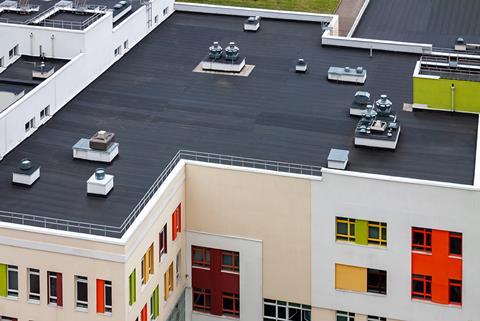
That’s a common misconception I’d like to correct. In fact, we offer a comprehensive range for flat and pitched roofs. We have boards that work with all kinds of flat roofing – single-ply, bitumen, liquid, GRP solutions. We can go in metal systems; under plant equipment; on green roofs and on blue roofs. We even have tapered offerings where we can create the fall across the roof with the insulation.
Our stone wool is specified frequently in Passivhaus builds too because our manufacturing tolerances of 2-3mm fit within their tough standards and the boards are inert and dimensionally stable. You can read (below) about our boards working well on one technically complex scheme at Peacehaven, which is the largest curved green roof in western Europe. Our products were used on the largest blue roof in London too, Plough Lane, part of the Wimbledon Grounds redevelopment scheme. That one is 14,000m²-plus of blue roof, ballasted, with solar PV all over it, no spreading layer, no support layer – just our product. Once specifiers and contractors understand what our products can deliver, they specify us again. It’s about proven trust and performance.
Why do you think people don’t associate ROCKWOOL with flat roofs?
This is another myth I really want to put to bed. People are familiar with soft, “squishy” stone wool insulation for lofts and cavity walls. What they don’t always realise is, if you engineer stone wool in a different way – slow down the machinery, make a denser product, cure and press it – the same material can be formed into strong, rigid boards with very different properties. These boards have high compressive strength and are ideal for flat roofs. It’s not a different material – it’s stone wool, but engineered differently. The manufacturing process creates a denser, more rigid product suitable for roof applications, while retaining the same inherent properties of stone wool.
Which of your product ranges would you recommend for flat roofs?
The exact products you need will depend on the precise details of your project. Products in our flat roof range include: ROCKWOOL HardRock® Multi-Fix(Dual Density), our HardRock Recovery Board, and HardRock Underlay Slab, as well as options for tapered roofs and the ancillaries that support our flat roof range like our HardRock Multi-Fix Angle Fillets and Acoustic Infills.
We’ve got a solution for the vast majority of flat roof projects and we’re happy to help you find the right one. The best way to contact us initially is through myself and the flat roofing team or through the flat roof project form on our website, where you can input details of your project to get tailored recommendations and advice.
Where in the roof build-up do the insulation boards sit?
Our insulation boards sit beneath the waterproofing layer in warm roof build-ups or beneath the tiles and battens in a pitched roof.
Let’s talk about compressive strength. How do ROCKWOOL boards measure up?
The key thing to understand is that our flat roof boards are engineered for high compressive strength – they are ideal for roofs supporting plant, solar PV and other heavy loads.
Compressive strength is simply how much weight and pressure a material can handle before it starts to compress or fail. Think of it like stepping on a sponge – a weak sponge squashes easily, but a strong one resists. It is expressed in kilopascals (kPa) – the higher the number, the more load the board can carry without significant deformation. Our flat-roof boards have a compressive strength of around 70kPa at 10% deformation, which is well in excess of the typical loads imposed by a flat-roof buildup, including waterproofing and ballast.
But here’s where it gets clever, our dual-density boards – such as HardRock Multi-Fix (DD) – go a step further, because they have a reinforced extra high-density top layer to help resist indentation from concentrated, sustained point loads – like the feet of solar PV mounting systems or access walkways – while the lower-density bottom layer accommodates substrate unevenness and delivers the bulk of the thermal performance.
What about compressive creep – strength over time?
On roofs where the boards are going to be subject to significant ongoing weight, you need to consider long-term compressive creep – the board’s ability to resist slow, ongoing deformation under a sustained load over time. This is quoted as a figure like σc(2%), which would tell you the maximum steady load theboard can carry so that, over its design life, it won’t squash by more than 2% of its original thickness.
Long-term loads – the permanent weight of waterproofing, ballast, paving, plant or PV – are what compressive creep strength (σ(2%)) covers. Those sustained loads typically sit between 1kPa and 5kPa depending on the build-up. Our boards have a substantial safety margin for the full design life of the loads you will encounter on most roofs. For a typical flat-roof build-up, we would advise a maximum evenly distributed load of 1,000kg per m². But even with really heavy loads, you can do other things: take it back to the substrate or introduce a spreading layer. In scenarios where heavy loads are distributed across smaller areas, creating a concentrated load, we can accommodate solutions that use a series of pedestals to ensure the maximum allowable deflection (2% or 3mm) is controlled.
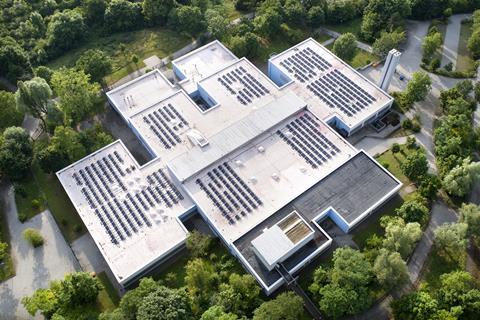
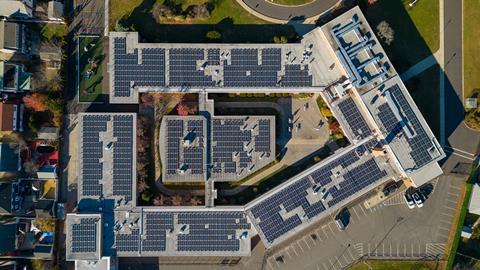
With the Future Homes and Buildings Standards set to see much more rooftop solar installed, what would your advice be for anyone seeking to use ROCKWOOL boards for a flat roof that will hold PV?
Here we need to talk about point loading, and here there’s another well-worn idea that I’d like to challenge. When it comes to feet and supports for paving on roofs, the industry has always had a mindset that smaller is better. Driven by a desire to cut costs, people often want to go with the cheapest 80mm-diameter feet.
But the industry standard today is to work with nothing less than 170mm diameter. Circular or square, I would suggest you really need 170mm base plates to take the load. And some people are even shifting to 200mm or 220mm diameter.
Based on testing we have undertaken to maintain maximum deflection of 2% or 3mm, a typical load of 500kg can be accommodated across a set of six 200mm x 200mm pedestals. We are undertaking further research and development to introduce products that can accommodate significantly higher loads.
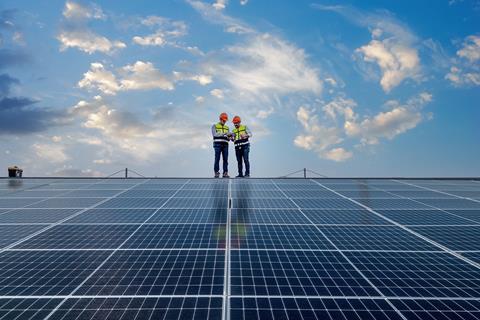
You absolutely can put PV on warm roofs with a waterproofing system, you just need to take advice on the best way to do it – whether that’s working with a rail system, ballasted trays or taking posts back to the substrate.
CASE STUDY
Peacehaven wastewater treatment works
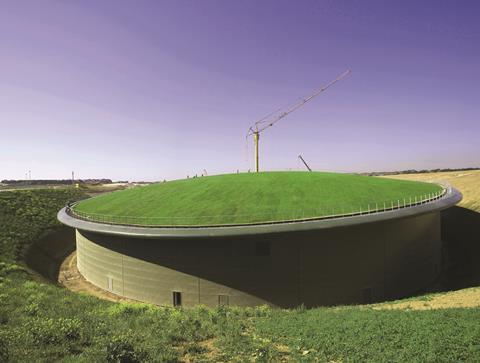
Southern Water’s £300m plant is concealed beneath a 17,800m² green roof. With 200mm of substrate as a permanent load, the warm flat roof buildup was specified with 85mm ROCKWOOL HardRock® Dual Density, chosen for its combination of thermal, fire, and long-term compressive performance.
“Given the complex shape of the roof, ROCKWOOL was the most suitable product because it offered a degree of flexibility.”
Paul Webb, Peacehaven project manager, Prater
What about the other properties these products have?
With stone wool, you are addressing multiple specification priorities with a single product because of the inherent properties of stone wool itself: acoustic performance, thermal performance, and fire resilience. Stone wool can also be endlessly recycled without any loss in performance, and you can learn more about our recycling programme on our website.
Our roof boards typically have a thermal conductivity of around 0.039W/mK. Because of their acoustic properties, our roof boards are often selected for high profile projects where acoustics form an important part of the strategy. The O2 arena, the London Stadium and Royal Academy of Music are just a few examples of where are products have been used to support acoustic strategy. Often the aim is to ensure visitors have a great experience while protecting surrounding areas from noise. Similarly, in schools, hospitals and residences our roof boards can reduce unwanted airborne or impact sound from aircraft or rain noise.
Another property of these boards is that they are water-repellent. During manufacture, a hydrophobic treatment is applied to each fibre, so liquid water beads off rather than wicking into the board, while water vapour can pass through the fibrous structure freely. So, it both repels moisture and is air-permeable.
You can have peace of mind because all our boards are classified Euroclass A1 or A2-s1,d0 for reaction to fire, which indicates non-combustibility, and the underlay is classified A1. And, as an example, when it comes to fire resistance, HardRock Multi-Fix (DD) has been tested within flat-roof assemblies to achieve REI 60, REI 90 or REI 120 depending on thickness. REI is the three-part fire resistance rating for loadbearing capacity, integrity and insulation, with the suffixing number denoting the minutes all three criteria hold for.
Anything else you’d like to tell us about ROCKWOOL boards on flat roofs?
One final but really important thing I want to point out is the ease of fixing. If we’re in a mechanically fixed single-ply system, we can use as few as one fixing per board. When you see other systems with so many more fixings, that’s something else that’s a real advantage of the ROCKWOOL products.
To find out more about using ROCKWOOL stone wool on flat roofs, visit: rockwool.link/building-june26.