

















Nearly 17,000 people from the built environment, finance and local government trekked to a rainy and overcast Leeds for the annual real estate investment event this week. From navigating political turmoil and combating viability issues to debates around HS2 and devolution, there were many talking points. Here we round up the key takeaways.
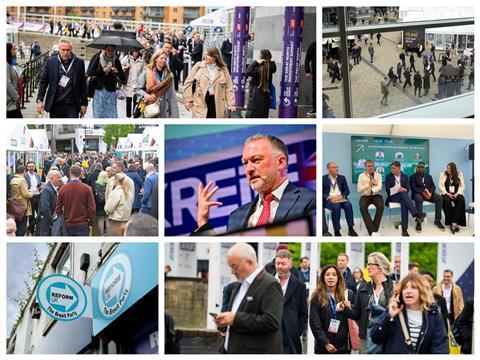
Up until two weeks ago it seemed as if the chief topic of conversation at this week’s UKREiiF was likely to be the impact of the Iran conflict. While the war has rattled investors and driven up the price of energy and materials, it was barely mentioned at the three-day conference in Leeds.
Instead, it was a newer crisis that stole the limelight: the prospect of another government collapsing mid-term and dragging businesses back into a fresh round of prolonged uncertainty.
Fears that policies laid down by Keir Starmer over the past two years on tax, planning and capital expenditure could soon be ripped up shaped much of the chatter at the event.
It didn’t help that none of the prime minister’s potential replacements appear to have any kind of coherent plan about what comes next, or that Andy Burnham, the favourite to win any upcoming leadership race, failed – perhaps not surprisingly – to show up to any of the five events he was scheduled to attend on Wednesday.
The past decade may have taught industry bosses how to ride this kind of thing out, but with 2026 already having two crises under its belt at month five, it is proving to be a vintage year. There was a palpable sense of frustration among the 17,000 attendees in Leeds – representating every construction discipline – that a recovery in the sector, which appeared to be building momentum in the first quarter of this year, as borne out by recent GDP growth figures, faces being knocked off course.

“What I really yearn for is some consistency,” JTP Architects managing partner Marcus Adams told one audience at a panel discussion on new towns, “and I can see there’s a real danger that all of the good work that’s gone on will go backwards.”
Stantec planning director Jane Beckett expressed a similar view. “Everything just seems to be delayed at the moment until we get some clarity – but then when we do, it just depends on what happens to government,” she said, adding: “They need to stick in one place and let developers and housebuilding bodies just crack on.”
The fact that Labour campaigned on a platform of stability and ending years of Tory psychodrama in its 2024 election victory but has failed to keep that promise, despite winning a huge majority, is perhaps what is most unsettling. But, against all odds, the mood at UKREiiF was not one of despair.
“I get the feeling that people just want to press on,” Building was told by one planning consultant. Indeed, “we have to keep going” was a commonly heard refrain at the event’s panel discussions.
Impatience was in the air but also a determination to stay optimistic. Here is a summary of the key takeaways.
How will the industry navigate political turmoil at a local level?
The consequences of this month’s dramatic local election results were a big talking point this year and the focus of a session, run by Cratus, analysing the new political maps specifically in England. The collapse of the Labour vote and the rise in support for other parties, particularly Reform but also the Greens, has led to a large number of councils now with no overall control, fundamentally changing how local authorities are run.
Council AGMs are happening now and will decide who leads the councils, who chairs key committees and, in many places, whether there will be formal coalitions, looser voting agreements or fragile minority administrations.
In more finely balanced councils, the speakers predicted intense deal‑making and fragile governance.
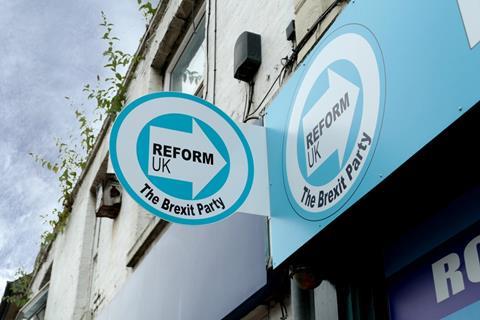
The growing presence of Reform and Green councillors adds another layer of complexity, with both parties, in many cases, “learning on the job”.
In areas with combined authorities, mismatches in the political colour between mayors and constituent councils are likely to create friction and make cross‑boundary working harder.
Reform-led councils are already pushing against green belt development. One senior officer at a borough council told Building he has no brownfield sites left and his new political masters don’t want green belt development, which makes hitting figures in the adopted local plan extremely challenging.
Meanwhile, there is a deep distrust of the Greens in London – not surprising, given the party’s anti-developer rhetoric.
Labour and Reform talk stimulating the market and deregulation
This year’s event took place in a context where housebuilding in London has ground to a standstill. Just 937 homes were registered with the National House Building Council (NHBC) in the first quarter of 2026, down 37% year-on-year and a huge decrease from the 6,000 or 7,000 annually seen 10 years ago.
As one delegate said, viability was a buzzword at this year’s event. Stagnating land values, particularly in London, are combining with soaring costs to render schemes unviable.
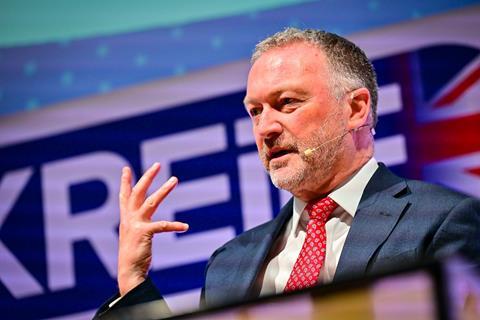
So, what is the answer? Secretary of state for housing Steve Reed (pictured above) hinted at forthcoming demand-side measures and said conversations are needed with the Treasury about a stimulus, which housebuilders are hoping will be something along the lines of Help to Buy.
Meanwhile, Reform politicians at the event put an emphasis on deregulation and tax incentives to boost growth.
Richard Tice, the party’s deputy leader, suggested Reform would abolish regulations such as gateway 1 and requirements for heat pumps and said it could simplify the planning application process to require less detailed drawings and separate the conditions process from councils, describing the current system as “so dysfunctional”.
Devolution: combined authorities powering ahead…
The devolution agenda is in many ways one of the big drivers behind UKREiiF’s expansion, with different city regions proudly showing off their projects and pipelines in pavilions emblazoned with their logos.
Panellists argued that the English Devolution and Community Empowerment Act puts regional regeneration firmly back on the agenda, with combined authorities able to drive large-scale change across wider geographies after years of under-investment brought by austerity policies.
Under the new arrangements, combined authorities and combined county authorities will be expected to prepare spatial development strategies and local growth plans that look across whole regions rather than single council areas.

They will gain clearer powers to call in planning applications of strategic importance, to create mayoral development orders and mayoral development corporations, and to levy a mayoral community infrastructure levy (CIL) to fund major infrastructure.
Greater Manchester is using a 10‑year investment pipeline and six tax‑advantaged growth locations, backed by a single integrated settlement and work with the National Wealth Fund, to provide long‑term certainty.
West Yorkshire has secured an integrated settlement, agreed a £230m investment pipeline across its five constituent councils, and is moving ahead with bus franchising, mass transit and the Weaver network – which integrates buses, trains, cycling and walking under one brand identity. It is also creating a mayoral development zone in Leeds around Elland Road football stadium and the Royal Armouries (announced at UKREiiF) as a potential focus for the new development powers and future mayoral CIL.
By contrast, newer bodies such as the East Midlands Combined County Authority, which formed only in 2024, are still building governance and capacity but see the powers as an opportunity to unlock “tricky” high‑priority sites, especially in the freeport and mixed rural‑urban growth corridors.
Across all three areas, the effectiveness of these new powers will depend less on formal legal provisions and more on collaborative governance, early sharing of plans and maintaining the expertise of local planning authorities, using regional powers selectively where they add value rather than routinely overriding local authorities.
…but many traditional borough and districts left in limbo
While the combined authorities are pushing ahead with confidence, many traditional borough or district councils are in a state of limbo due to local government reorganisation.
They are not as easily eligible for funding as combined authorities or city regions, and many do not know whether they will be around for much longer or who they may be combined with to form new unitaries.
“We can’t plan for any new development at all,” one local government leader grumbled to Building.
Meanwhile, mayoral development powers have been flagged as an exciting and promising tool to deliver regional placemaking ambitions, but some authorities want even less government intervention.
The mayor of the Liverpool city region told Whitehall to “back off” and give local authorities more flexibility around funding pots to accelerate housebuilding. Steve Rotheram said brownfield funding reforms are needed to support the regeneration of sites that were heavily bombed during the Second World War – a place-specific challenge for which central government funding does not currently cater.
Building safety delays – improvement but frustration remains
It is now more than two years since the key provisions of the Building Safety Act came into effect, including a new system of gateways whereby regulatory approvals must be sought at different stages of construction. Projects being on hold while schemes pass gateway 2 have dominated the headlines, but with the backlog of delayed projects reducing substantially in recent months, are people now feeling more positive?
The answer, based on conversations at UKREiiF and in panel sessions, is yes, but only up to a point.
Some, such as Sasha Pirbhai, a partner at law firm Devonshires, point to improvement in the industry’s processes for meeting the requirements, saying there is now a better understanding of formats to use to submit applications.
She did, however, take aim at the lack of dialogue during the process, saying the lack of opportunity to discuss applications with the regulator was a “shame”.
The gateway 2 process was defended robustly by Neil Hope-Collins, operational policy lead for higher-risk buildings at the Health and Safety Executive.
He said the new regime requires a change in attitude to when firms spend money, moving to a front-loaded design. “The payback is that if you design it right first time, then build it, you are less likely to have to face change through the construction phase, and you are more likely to have an easier run through gateway 3.”
On the point about lack of dialogue, he was very direct. “Do you want it to be done quick, or do you want the dialogue? Because you can’t have both.”
Build, baby, build affordable housing – but not too quickly
Wider market sentiment around housebuilding has been dampened in recent months, amid geopolitical uncertainty and fears of rampant inflation. But one sector that has perhaps been more confident – in light of a favourable spending review settlement – is affordable housing.
Social housing providers submitting initial bids under the £39bn Social and Affordable Homes Programme were certainly eager to get a handle on how it is all shaping up, and Homes England chief executive Amy Rees told Building the sector has “stepped up and been ambitious” in its bidding.
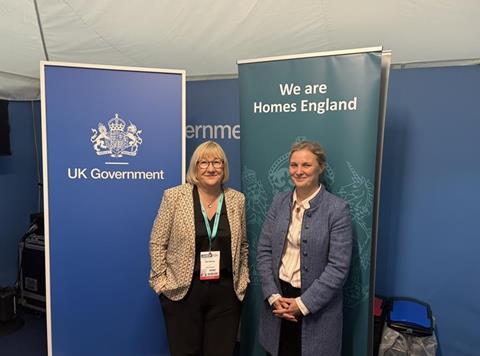
Maybe they have even been too ambitious, if such a thing is possible. The programme is oversubscribed, but there is an issue with the amount of grant that providers are hoping to get paid in the early part of the 10-year programme.
Homes England set tongues wagging at UKREiiF by sending out letters to providers earlier in the week asking them to look at reprofiling their funding bids so that more of their grant payments – which are made when providers incur development costs – are paid later in the programme.
This, of course, is sensible as the Treasury would not allow £39bn to be paid in one year for a 10-year programme.
However, it has led to a bit of grumbling among providers, which were pushed to “build, baby, build” by housing secretary Steve Reed and submit bids for early development, only now to be told to pull back on activity.
Elsewhere, there was also concern about the potential of inflation to once again disrupt the SAHP.
Rebecca Bennett Casserly, corporate director of development at housing association WHG, said providers are “in a race to beat build cost inflation”.
But Rees said the agency has been through this before with Ukraine and that it would do everything possible to provide loans and guarantees quickly. However, she pointed out that ultimately the agency is counter-cyclical and is there to stimulate the market. “This is why we have a decade-long programme,” she said.
1.5 million homes target – totally unachievable or just ‘incredibly stretching’?
Is the government’s landmark pledge to build 1.5 million new homes before the end of this parliament ambitious or unrealistic? According to UKREiiF delegates, the answer is both.
In a speech opening the conference, housing minister Matthew Pennycook insisted Labour will “stay the course and finish the job” but acknowledged that the target is “incredibly stretching”.
As well as reeling off initiatives already brought in by the government to support housing and infrastructure delivery, from the Planning and Infrastructure Act to the proposed New Towns Programme, he highlighted the need for further interventions, including finalising a range of legislative and policy measures.
In the same speech, he announced the national rollout of the small sites aggregator programme following successful regional pilots, in a bid to enable SMEs to get spades in the ground. He also revealed that the government is working with 23 local authorities to create a pattern book of standard house designs due to be published by the end of the year.
“It’s going to be horrible,” lamented a couple of sector members over a pizza dinner. “All the homes across the country are going to look the same.”
Liverpool city region mayor Steve Rotheram described the “aspirational” 1.5 million target as “the right thing to do” amid a housing crisis. But Tim Mitford-Slade, senior director at BNP Paribas Real Estate, said the figure is “almost certainly beyond us and we need to assess what is achievable”.
Euston and HS2 and a comeback for PFI?
On the first day of UKREiiF, the news dropped that HS2 was going to be costing £100bn-plus (not much of a surprise to many) and was not going to make it to Euston until 2043 – another 17 years away. One-year-olds now will be adults by the time it gets into central London.
Leaving aside the frankly mind-boggling timescale (can we not do this any quicker?) it was perhaps appropriate, then, that one of the first sessions at the conference was Euston as a platform for UK growth. Speakers included the global investment firm Capital Formation’s head of Asia, Diane Lin, who said the area “will become a valuable platform for Asian investors”.
She also reckoned few people in Asia had heard of many places in the UK other than London – saying this while sitting next to Catherine Hadfield, strategic lead of the Birmingham Knowledge Quarter. Hadfield was savvy enough to admit that “Euston’s success is very important to Birmingham”.
A few hours later the HS2 reset dropped, and it no doubt got many thinking: go to places outside London and the public transport experience is markedly different. For example, Building reporters lingering late in Leeds were surprised to find only one train an hour to their accommodation in Harrogate after 8.30pm.
The UK is spending more than £100bn on a line from Birmingham to London. Even HS2’s most enthusiastic supporters must have been scratching their heads on Tuesday afternoon about how it’s come to this.
More broadly, the conference saw much debate about funding infrastructure through a return to a form of PFI-style financing.
Kamal Patel, a partner at EY, said the reputational battle over PFI was perhaps lost in the past but said 95% of projects funded through the scheme were completed on time. Patel talked about the UK’s “huge” infrastructure funding gap.
He said: “How do we ensure that we get that remaining infrastructure built and delivered that generates jobs, taxation, economic growth and societal benefit? The only way we will do that is by involving the private sector to accelerate that and to take some of the burden off government.”
Ensuring a skilled workforce
An age-old question was posed by Liverpool mayor and former bricklayer Steve Rotheram: “Would you”, he asked, “get on a plane and rely on a nearly competent pilot?” No, so why does construction?
In an event sponsored by the Construction Skills Certification Scheme, Rotheram suggested the idea of issuing cards or a digital passport showing competency could be rolled out to other industries.
Construction is an industry that has relied on CVs in the past, prompting veterans to wonder why they need to prove competency. But getting more professional, which includes getting more women into the sector, is part of the solution to the skills gap. No magic bullet was proffered, however: it will take time and shifting attitudes across the generations.
Stadiums as regeneration landmarks
One of the key topics at this year’s event was how redeveloping stadiums – usually football grounds – can kick-start regeneration.
Fans of Leeds United – whose COO was attending the event – might disagree, but the two biggest stadium redevelopments in the pipeline are Manchester United’s Old Trafford development and the upgrade of Twickenham – the home of England rugby union now know as the Allianz Stadium.
Manchester United’s plan is to rebuild the ground under a design drawn up by Foster + Partners, which is likely to go in for planning towards the end of next year. Announcing it last year, co-owner Jim Ratcliffe said, perhaps optimistically, the stadium could be ready by 2030.
Twickenham also has upgrade plans in mind but needs to bankroll them. It wants to be allowed to raise the number of concerts it can hold each year from the current three to fifteen. The idea been kicked into touch once by the local council but Twickenham is giving it another go, with stadium development director Alex Cohen telling Building its fresh attempt would go in the following week.
Leeds, meanwhile, has begun work on its job to rebuild Elland Road’s West Stand, although COO Morrie Eisenberg declined to say who will build it (it’s looking like Sisk) and when it will be finished – which was a shame given he’d spent a session telling attendees, quite a few of whom appeared to be Leeds fans, that he was “really excited we’re building”. He said that when it does complete, it will take capacity up from 38,000 to 45,000. Good news for fans of a club with a waiting list of 25,000.
The key takeaway from various events is how stadiums are much more than the sum of their parts. Cohen said that Twickenham wants to increase the number of concerts for commercial reasons, pointing out that many big-name acts are citing concerns about the environmental impact of packing up at one venue and moving on to the next. “They’re not going around four or five stadia,” he said. “They’re picking one.”
Leeds is hoping its redevelopment will kick-start the regeneration of a deprived area around south Leeds. Former footballer Jimmy Floyd Hasselbaink, who played for Leeds between 1997 and 1999, pointed out the ground had barely changed since he left. Redeveloping a stadium brings a real value to an area, said the Premier League’s corporate affairs director, Max Chambers. “It’s the accordion effect.”
Getting to grips with inertia
A quick chat with Kier’s chief executive, Stuart Togwell, brought attention to a concern that worries bosses like him and Morgan Sindall’s John Morgan, another UKREiiF attendee: inertia.
Togwell was upbeat, citing increases in water and defence spending, the plans for prisons and hospitals – with events for the New Hospital Programme being especially well attended this week.
But he warned about the creep of inertia, that jobs get paused, delayed, or go a bit more slowly than they should do. He was at an eve of UKREiiF event attended by chancellor Rachel Reeves – the Leeds MP was another visitor to the event on the Wednesday – and Togwell’s take on it all was pretty much thiss: the government wants growth, so get building. Don’t let inertia win.







No comments yet