

















Technology firm Senze has demonstrated that live monitoring of homes can slash retrofit costs by identifying precisely targeted improvements, rather than relying on flawed EPC assessments. This raises questions about the government’s fabric-first funding approach for social housing decarbonisation, Thomas Lane reports

When David Partridge, the chair of the Net Zero Carbon Building Standard, discovered that a gas boiler needed replacing in a flat that he rented out, a like-for-like replacement was not an option. “I was about to publish a standard that insists on no fossil fuels. So, if I am seen to be doing the wrong thing, that wouldn’t look good,” he recalls.
“So, I thought, I’ll do what I am supposed to do by putting in an air-source heat pump, batteries and a Sunamp [thermal storage] and all the wizzy bits and pieces.”
But these noble aspirations did not turn out as he hoped. “It was a complete disaster, the heat pump was far too big, and the batteries were fighting each other and drawing down electricity when they shouldn’t have. The poor guy living there couldn’t afford his energy bills, and I’m not sure if we saved any carbon – or I have ended up shoving loads more into the atmosphere.”
This experience prompted Partridge to stop and think about the implications of what he had just done. “If I am the guru of all of this, and finding it hard, then what about the rest of the 29 million homes in the UK who don’t know what to do? Who do they ask what to do? There must be a better way for ignoramuses like myself to embark on improvements to their individual homes.”
If I am the guru of all of this, and finding it hard, then what about the rest of the 29 million homes in the UK who don’t know what to do?
David Partridge
From this experience, and with Joseph Michael Daniels – who set up flatpack eco homes manufacturer Project Etopia – and Tom Fenton, who was using technology to verify the energy performance of new homes, Partridge set up Senze, a new company to help people make targeted, cost-effective improvements to existing homes.
How does the technology work?
Senze uses sensors installed in each room of a home to monitor temperature, humidity and pressure over a three-week period. LIDAR (light detection and ranging) scanners are used to establish the dimensions of each room, and the data is then used to create a 3D digital twin of the home.
Publicly available data, such as the orientation of the home, which helps to inform sensor positioning is scraped to save time on site, and local weather data during the survey period is also collected. This information is all fed into a software tool to create what Fenton calls a living energy model.
This includes all the heat loss factors such as air infiltration, the temperature difference between the inside and the outside, ventilation losses and the building fabric to arrive at the heat loss coefficient. All this data is then used to produce a range of effective retrofit upgrade options to meet a specific energy performance target.
Fenton says there are other companies out there using smart technology to determine home energy performance, but these are either using flawed information or not providing a complete picture of a home’s energy use and the improvements that could reduce this cost effectively.
There are a lot of companies out there that will put sensors into the building, but they give you raw outputs rather than insights
Tom Fenton
“There are a lot of companies out there that will put sensors into the building, but they give you raw outputs rather than insights. Others do digital twins to understand the building size, but then they apply theoretical data to it rather than real data,” he says.
For example, some use publicly available EPC data and energy meter readings to determine the energy performance of a home, but this does not account for unexpected energy demand, such as a hot tub in the garden which completely skews the results.
“They take the meter reading and scrape the data on the home without actually visiting it. You get a complete misreading of the situation,” Partridge cautions. “You wouldn’t know and could easily make some silly decisions.”
How accurate is Senze?
What gives Senze credibility is the results of a pilot scheme undertaken in partnership with Bromford Flagship Livewest (BFL), a registered social landlord (RSL), to monitor heat loss from 121 homes with the data used to produce a range of cost-effective retrofit solutions. The options were compared with the costs of retrofitting the homes using the data from an energy performance certificate.
The pilot was funded by Lloyds Bank, which provides funding for social housing retrofit and therefore has an interest in solutions that deliver cost-effective results.
A key question was how accurately the technology assesses energy use. Birmingham City University provided third-party verification of the Senze technology, which included benchmarking it via a co-heating test.
A co-heating test involves heating up a home – in this case one built in a controlled environment at Salford University’s Energy House 2.0 facility – and measuring how much energy is expended to keep the house at a known temperature. This found the technology measured heat loss to within 1.3% of the actual energy used for the co-heating test, confirming its accuracy.
The homes monitored for the pilot represented a wide range of British house types and ages, including pre-1900 terraces, 1930s semi-detached homes, bungalows and those built after 2000. Each home was monitored for an average of 22 days.
What did the monitoring reveal?
For registered social landlords, an EPC C rating is the benchmark many aim for when deciding which homes should be retrofitted. Retrofit measures are determined by the current EPC and accepted best practice. For example, older homes with solid walls will be prioritised for internal or external wall insulation whereas newer homes, certainly those dating from the 1990s, will be presumed to have some insulation within the wall cavities.
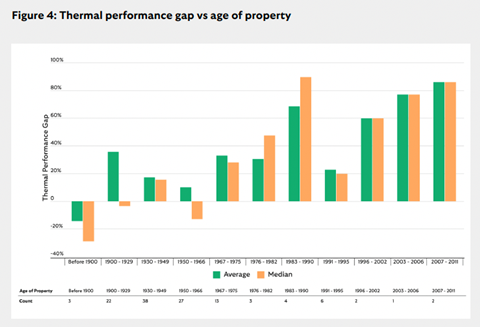
Overall, the pilot found that, on average, the measured performance of the homes was 25% worse than when modelled by the EPC rating methodology. But the pilot found wide variations in the performance of homes of different ages.
Old homes with solid walls which pre-date 1900 were found to have better measured performance than predicted, while newer homes were worse. Research carried out by BRE and others has shown that the default U-values used in the EPC calculation software for solid walls are too conservative, with these performing much better. The poor performance of newer homes could be partially down to poor-quality construction.
Ultimately, what the pilot shows is that EPC-driven retrofit interventions can result in poorly targeted and even wasted funding. For example, monitoring of a terraced house built in 1900 revealed its performance was equivalent to an EPC C thanks to its solid walls offering better performance than the default values in the EPC calculation package RdSAP which gave it a D rating.
BFL had allocated £36,000 to fit external wall and loft insulation, and new windows and doors. Given the revised performance rating, this home did not need any money spending on it.
In situations where monitoring reveals a home energy performance that is worse than an EPC C rating, money can still be saved by precisely targeting cost-effective improvements to raise the EPC rating to a C.

A 1930s semi-detached home with a measured and modelled EPC D rating had £58,000 earmarked for external wall and loft insulation, a heat pump and new doors and windows. The monitoring revealed that improving airtightness and fitting solar panels was sufficient to bring the home up to a C rating at a cost of £15,000, saving £43,000 over the original budget.
It also showed that a 3.8kW heat pump was sufficient, avoiding an oversized 10kW unit that had been specified on previous retrofits.
On the flip side, another 1930s semi-detached home had already been retrofitted at a cost of over £42,000 to bring it up to an EPC C. Monitoring revealed that this was insufficient, with the home performing to the equivalent of EPC E after the improvements had been made. So more investment was needed in wall and floor insulation to bring it up to the EPC C standard.
What is being done to improve EPC accuracy?
The results reveal some of the shortcomings of current EPC modelling, which include data based on non-intrusive, often cursory visual inspections. “You can’t understand how well insulated a wall is simply by eyeballing it, no matter how good you are,” Fenton says.
You can’t understand how well insulated a wall is simply by eyeballing it, no matter how good you are
Tom Fenton
Among other shortcomings are the fact that fitting a heat pump to reduce carbon emissions can downgrade the rating as energy costs are included in the rating and electricity is more expensive than gas.
In recognition of these failings, the government consulted on reforming the EPC framework in December 2024 and has since confirmed that it will widen out the metrics on which the EPC rating is based from a single energy efficiency rating to include energy cost, fabric performance, heating system and smart meter readiness. But there are no plans to allow a valid EPC to be generated using measured data from assessments such as those carried out by Senze.
The Department for Energy Security and Net Zero is currently consulting on EPCs that will be produced by the yet to be launched home energy model, which will eventually replace the current EPC calculation tool, the standard assessment procedure. This includes a question on whether to include smart meter and internal temperature data in the EPC assessment, which could provide a more accurate measure of fabric performance – a move welcomed by Fenton.
“This would be great because some properties could jump to an EPC C simply by measuring them right, without having to do anything to it,” he says. “So there are a lot of benefits to be had.
“But it’s still very much up in the air as to when they are potentially going to start to adopt this type of technology into EPC assessments.”
Why is EPC accuracy so critical?
The reason why EPC accuracy is so critical is because the government mandates a PAS 2035 approach for social housing energy efficiency improvements as a condition of retrofit funding. PAS 2035 is a standard for housing retrofit where an assessor produces a retrofit plan for the home based on the EPC rating.
PAS 2035 mandates a fabric-first approach, which means if the EPC indicates this is performing poorly, fabric performance must be improved before other measures can be taken – even if energy use monitoring suggests this is unnecessary.
It’s really important for us as a sector to understand how we can use data to get more accurate information about the energy efficiency of homes
Michael Craggs, BFL
“A data-led approach is far more accurate than an assessment-led one,” explains Michael Craggs, the development and asset management innovation lead for BFL. “It’s really important for us as a sector to understand how we can use data to get more accurate information about the energy efficiency of homes.
“If we used the data-led approach, I would say in most cases we would be spending less than what would be predicted [by an assessed EPC]. And the other bit is we won’t be so reliant on grant funding because grants make us do the wrong things.”
The problem for BFL and other RSLs is they must match grant funding. As the pilot demonstrates, complying with the PAS 2035 approach could be more expensive even with government grant funding, as it must fund half the cost.
The other challenge is the government has mandated that all RSLs retrofit their housing stock to at least EPC level C by 2030 unless there are exceptional circumstances. Spending money on unnecessary retrofit measures means less money for new social housing.
“While they are delivering that target, they take their eye off providing new homes,” Craggs says. “We are fortunate that we’re quite highly geared, so we can do both. But some of the smaller housing associations will suffer so they will either do one or the other.”
The potential offered by Senze has persuaded BFL to sign a deal for it to monitor another 250 homes and implement the recommendations made by the technology. BFL can take advantage of grant funding where fabric improvements are worthwhile, and use its own funds for more targeted, cheaper interventions.
Once the homes have been retrofitted, Senze will continue monitoring the homes to prove that the retrofit measures perform as predicted. There is an option to monitor and improve another 750 homes if the first part of the deal is successful.
Senze costs £1,500 per home for the monitoring, which is the same as employing a retrofit assessor to prepare a report, a function the Senze software does automatically. And fewer grant applications will save money too.
As Craggs says: “You don’t have to go through mountains and mountains of bureaucracy, paperwork and assessments when Senze just runs you a report from the data.”
What’s next?
Looking ahead, the technology offers the potential for an asset owner to decarbonise a group of properties without needing to invest in expensive technologies such as PV panels. Homes could be fitted with heat pumps and live monitoring of energy use providing a development-wide picture of energy flows.
A centralised battery could be charged up at night from 100% renewable-generated energy when tariffs are low, then used to power heat pumps or charge electric cars in the daytime when tariffs are high and electricity is being generated with fossil fuels to meet higher demand.
The advantage of this approach, other than saving money, is it takes pressure off the grid – which is already very constrained in some areas.
And this is a problem likely to get worse with greater adoption of electric cars and heat pumps. Live monitoring would also help to detect issues with heating and ventilation systems.
BFL budgets over £58,000 for wall and loft insulation, a heat pump and new doors and windows for homes below an EPC C rating. Of the homes in the survey, 59% failed to achieve EPC C whether monitored or modelled. Adopting the measures recommended by Senze, and using commercial procurement routes, could reduce the cost of achieving an EPC C to just £10,325.
Unsurprisingly, given the scale of the potential savings, Senze is talking to other social housing providers about adopting the technology. These include Barnet and West Northants councils, the Northern Ireland Housing Executive and the NHS.
Last autumn, the National Audit Office found that 98% of homes fitted with wall insulation funded by government grants were found to be defective. And in April, four people were arrested on suspicion of defrauding an estimated £44m from this scheme.
Given that in many cases these homes probably did not need wall insulation in the first place, and that current social housing retrofit funding schemes are driving RSLs down the fabric-first route, it could be time for the government to rethink its funding strategy, so that it still achieves its decarbonisation goals while saving precious taxpayers’ money.







No comments yet