
As Lendlease’s huge project at Elephant & Castle finally approaches completion, Daniel Gayne spoke to the team behind the scheme to find out how it has changed over more than a decade of work, and the challenges facing developers today

From the top of the Park & Sayer tower in Elephant Park, it is easy to be distracted by the view out over London’s skyline. After all, if you drag your gaze downwards, the view will not leave you awestruck.
Elephant Park may be one of the biggest and most controversial regeneration schemes that the capital has seen in recent years but, as it approaches completion after more than a decade in the works, the development presents itself in more modest terms.
The mix of towers and blocks spread out across the neat masterplan below is the kind of smart, unassuming urban style that has become commonplace in major London redevelopments. But, if you know what you are looking for, this pleasant-but-plain scheme tells a fascinating story about the shifting sands of real estate finance, market demand, and the geopolitical changes driving both of them.
From the very start, this scheme has had to battle with the vagaries of the market and a sceptical public. Lendlease, the developer responsible for Elephant Park, was selected in 2007 by Southwark council to lead on the regeneration of the Heygate, a 1,200-home postwar housing estate which had, for better or worse, become a symbol of the Elephant & Castle neighbourhood.
The project was unpopular among many, with critics lambasting the plan to demolish huge swathes of social housing and replace them with a mixed-tenure, privately-led scheme as a form of social cleansing. Things were complicated further when the global financial crisis hit, sending the UK real estate market spinning.
“We worked really closely with Southwark over the course of the next few years to find a way in which we could still be partners to deliver the regeneration,” recalls Angela Brennan, head of operations, development, at Lendlease and and former project lead on Elephant Park. It would not be until 2010 that the pair would sign a regeneration agreement and begin community consultation on a masterplan.
The original outline planning consent, which was submitted in 2012 and consented the following year, set out its vision of a scheme focused on housing for sale, along with an affordable component.

The plan worked this way for a few years, with work beginning on the first two phases before the next upheaval arrived: Brexit. “The sales markets just died,” remembers Brennan.
This big drop in demand for the kinds of homes that Lendlease was planning to sell at the site left the developer with three choices: pause, pivot, or press ahead. In the end, they went with the second option and introduced build-to-rent into the scheme.
The Canada Pension Plan Investment Board forward-funded a series of phases of residential development along these lines – Park Central East and Park Central West made up phase three, with 660 build-to-rent homes delivered alongside an affordable component, followed by City Lights Point, delivered in 2022, and Park & Sayer, completed last October.
But the post-Brexit rethink also gave the developer an opportunity to look at introducing non-residential elements. “We had the opportunity to take a step back and reconsider what we were going to deliver on plot H1, and we brought forward the office scheme, which was around 500sq ft,” explains Brennan.

That decision was born out of the evolution of London’s commercial market, she explains, which saw “the South Bank with rising rents – probably the fastest rising rents in London from a commercial perspective – but also the lowest vacancy rates”.
Given the proximity of Elephant & Castle to Waterloo and London Bridges, “it was a natural extension”. An office component was also something which Southwark had “always felt they weren’t able to capture as part of the original masterplan”. When the scheme had originally been consented in 2013, “the market just wasn’t there”.
Lendlease was starting to pivot in terms of the way we saw our role going forward on future big regeneration schemes to become more of a master developer
Angela Brennan, development management executive director
The office scheme was “controversial to some”, Brennan says, and was refused at planning, before eventually being consented on appeal in 2023. By that point, yet another globally significant event had rocked the market, prompting a volte-face on the office idea.
“Obviously, all through that period, covid happened, the workplace was questioned, in general in terms of what its role was […] and Lendlease was starting to pivot in terms of the way we saw our role going forward on future big regeneration schemes to become more of a master developer,” says Brennan.
In 2024, Lendlease made the decision to sell plot H1, marking the end of the office plan. The buyer, HUB, is now bringing forward a scheme centred on co-living.
This left Lendlease with just one more part of the Elephant Park scheme to be completed. The Wilderly, which includes 259 homes for sale, split across two buildings, is being delivered in a joint venture with Daiwa. The partnership can be read in two ways.
On the one hand, you have Japan’s biggest housebuilder investing for the first time in UK real estate – a vote of confidence in the country’s residential market. On the other hand, Lendlease’s decision to move risk off balance sheet on a scheme it has been working on for more than a decade could be interpreted as hesitancy about that very same market.

Nick Watson, development director at Lendlease and current project lead at Elephant Park, explains that the firm’s relationship with Daiwa, which had already been established on other schemes abroad, was based on “a very strong cultural alignment”, but admits that the decision to bring them onboard in south London was ultimately “a reaction to market conditions”.
He adds: “Most of the scheme was done on balance sheet. Obviously, macroeconomics have shifted a lot [and] we wanted to find a partner to bring in some capital to deliver that plot to help derisk it and reduce the burden on our own balance sheet.”
Subsequent developments have shown this caution to have been wise. The housing market in London continues to be tough and, Watson says, sales momentum “hasn’t been as strong as we would have liked”.
We believe in the product and we believe in the place. We don’t want to have a knee-jerk reaction and nor do we want to compromise
Nick Watson, Lendlease development director and project lead
While he says this has “tested the relationship”, Watson insists that the pair have nonetheless been “able to stand side by side” through the challenge.
“We believe in the product and we believe in the place,” he says. “We don’t want to have a knee-jerk reaction and nor do we want to compromise on the product and start compromising on quality because of that.”
Watson says the appetite for UK property among foreign buyers has cooled and notes that the market is not only competing with other real estate markets, but all other options for investing wealth. He explains: “If you go back 10 years, people felt real estate was, maybe not quite a one-way bet, but it’s like: ‘I’m going to get an income stream from renting it out [and] I’m also going to see capital growth’.”
Now, he says, that is not so clear – although he emphasises that he thinks “the UK still has an incredible offer for overseas money”.

The mansion block element of the Wilderly is due to completed early in 2026, with the tower set to follow in June. Both are being built by Bovis Construction, which (most Building readers will know) was until very recently known as Lendlease Construction. The developer sold its UK contacting arm at the beginning of last year, as part of the aforementioned “pivot” towards more of a master-developer role.
“Shareholders had a view about where the business was best placed to drive value,” explains Watson. “The construction element in the UK didn’t have the scale and the dominance and presence in the way that the Lendlease construction business does in Australia.”
He says the newly-christened Bovis is “doing a great job”, adding: “It was an amicable divorce.”
It is that public amenity that says that this place and this destination is ingrained as part of a broader fabric of the city that it fits within
Angela Brennan, development management executive director
The sale of the construction arm does not mean the UK development business is pulling back, however. It has a number of schemes in the works, including Silvertown in east London; a scheme at Euston; Smithfield in Birmingham; and Thamesmead, where it is involved in partnership with Peabody.
The approach they are taking with these schemes reflects some of the changes in market demand over the past decade, with a diversity of tenures designed in from the start, rather than being introduced haphazardly through successive consultations, as on Elephant Park.
“I’m not sure anyone really would have known what co-living was 10 years ago, or even PBSA,” notes Brennan in defence of the approach taking on the south London scheme, adding that even build-to-rent “wasn’t really much of a concept in the UK” when it was first drawn up. Covid, she says, has been a major “disruptor in terms of what people wanted”.

The same shift that made office development less viable, muses Brennan, may have boosted demand for co-living, with affluent midweek office workers looking for a relatively cheap second home where key amenities are provided communally.
Of course, it is not just the demand side of the market that has shifted substantially since Elephant Park was conceived. Recent years have seen labour, material and financing costs rise, as well as new building safety requirements.
Regarding the last of these, Brennan says nothing has been as significant as the introduction of the second staircase requirement. These myriad upward pressures on cost have brought development in the capital – particularly residential development – to a near standstill, and triggered a widespread debate about viability.

If the scheme were starting again today, one wonders what would have to be sacrificed. The London mayor and Ministry for Housing, Communities and Local Government have responded to the viability crisis by slashing affordability targets from 35% to 20%, meaning a similar development today would be less likely to hit the 25% affordable component that Lendlease has delivered here. And it is not just affordability that is on the line.
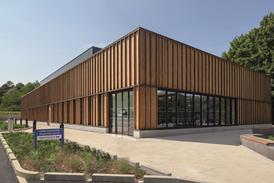
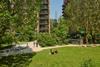
When Brennan speaks about the legacy of Lendlease’s scheme at Elephant Park, she stresses the investment in the public realm. Between the huge concrete blocks of the old Heygate estate was a lot of greenery, and the developer endeavoured to keep a large number of mature trees as part of a large new public park space, as well as introducing “play on the way” spaces in the avenues between residential blocks.
But Brennan notes that for developers facing viability challenges today, it may be difficult to justify spending money on something that is “purely a cost” in financial terms. “You can easily see how public realm, how amenity space – you know, podium gardens and all of that – get compromised, because it’s very hard to put a financial attribute to it,” she says.
“But it is that public amenity which says that this place and this destination is ingrained as part of a broader fabric of the city that it fits within, not a big gated community that only the privileged few might be able to enter.”
A decade of change in the housing market is inscribed across the landscape at Elephant & Castle. It illustrates, for better or worse, the fluctuating tendencies of a built environment led by private development, just as much as its predecessor, the Heygate, illustrated the top-down certainties of the postwar era. The current government’s struggles in stimulating housebuilding demonstrate the difficulty of trying to use the means of the former to achieve the ambitious ends of the latter.
Behind the neutral term “viability”, lies a cold fact: in our current system, the kind of homes that get built, what they look like, and for whom they are built, depends ultimately on the ability of private developers to turn a profit. Nevertheless, Watson thinks Elephant Park offers hope for schemes currently languishing in the doldrums.
“When I think about some of the challenges other developers and other regen schemes are going through at the moment, and we’re standing here having delivered 3,000 homes with 25% affordable and all the other things… It’s reassuring in a way that property is a cycle, development is a cycle.”


No comments yet