

















Tougher legal duties and penalties welcomed but some argue the proposed legislation does not go far enough
Industry figures and cladding campaigners have questioned whether the government’s new remediation bill, introduced to parliament earlier this week, will be sufficient to resolve the issue of unsafe cladding.
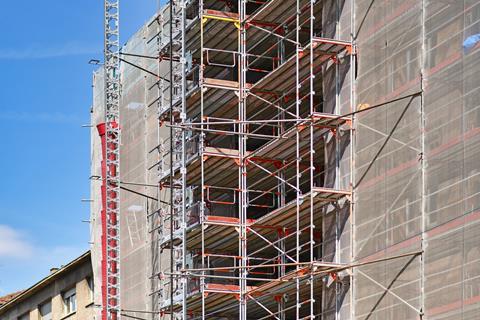
The proposed Remediation of Unsafe Cladding Bill, which aims to crack down on those responsible for unsafe cladding through tougher enforcement and penalties for non-compliance, has been broadly welcomed by the industry. However, several representatives have expressed scepticism about whether it goes far enough.
The bill would create a new legal duty for those responsible for the safety of their buildings, such as freeholders, to identify and fix issues without delay, while financial penalties could reach £500,000 for failure to comply with a remediation order.
Paul Woodhams, managing director for regeneration at McLaren Construction, welcomed the bill and said it introduced “meaningful incentives designed to prompt property owners to take decisive action” but warned against the “assumption that the slow pace of remediation to date is solely the result of inaction or obstruction on the part of property owners”.
“In our experience, the more common challenge is one of approach, where management teams are often tackling remediation on a project-by-project, transactional basis, rather than stepping back to assess their wider portfolio in a holistic way. This fragmented approach inevitably drives inefficiency, increases cost and extends timelines,” he added.
The bill would also allow third parties such as Homes England or local authorities to carry out remediation if those responsible continuously fail to act. Meanwhile, developers, contractors and other entities who have paid to make buildings safe would have a “simpler and more effective route” to pursue cladding manufacturers to recover remediation costs where their products have contributed to a building being unsafe.
Jaclyn Mangaroo, chief communications officer at The Property Institute, which represents managing agent firms and property managers responsible for around two million UK homes, warned that developers are “not subject to the same legal obligations, timelines and consequences as others”.
She said: “While the bill places new legal duties on building owners and responsible entities, developers signed up to the Developer Remediation Contract are exempt.
“According to our data, developer-led remediation continues to progress too slowly, with only 10% of projects complete and nearly 60% still awaiting agreed scopes of work.”
A new register of all medium residential buildings in England would be established under the proposals, with failure to register resulting in civil penalties of up to £7,000 and higher fines of up to £40,000 or prosecution.
A spokesperson for campaign group End Our Cladding Scandal, said it “cannot support [the bill] in its current form.”
“We are running out of time, running out of money and running out of patience. Minor legislative changes will not be enough to transform the practices of developers, freeholders, product manufacturers and insurers who continue to profiteer from our misery,” it added.
Following a meeting earlier this week with housing secretary Angela Rayner, during which there was reportedly recognition that “legislation alone will not resolve the many operational failures residents face on the ground”, the group called on the government to introduce “consistent standards across all remediation schemes, independent oversight, meaningful accountability and effective action to ensure every affected home is made fully safe”.
The government expects every building over 11 metres with unsafe cladding to have been remediated or have a clear date for completion by the end of 2029.
The introduction of the new bill follows the publication of the 2024 remediation acceleration plan, framed as the first phase of the government’s response to Grenfell Inquiry phase two.
Judith Blake, building safety minister said: “It’s unacceptable that so many people have been left living in homes with dangerous cladding, anxiously waiting for those responsible to take action.
“This bill is a milestone in our mission to right these wrongs and ensure everyone feels confident in the safety of their home.
“Crucially, it will ensure all residents have a route to remediation, regulators have the powers they need to take action and that for all residents currently waiting, an end is in sight.”




No comments yet