



















Construction has embraced digital transformation at almost every level - except the contracts. Rekha Thawrani OBE, Global Director of NEC Contracts, argues that this gap between ambition and practice is where commercial risk accumulates, and explains what the industry can do about it.
Consider for a moment the paradox at the centre of modern construction. We use sophisticated project management software to schedule works across global supply chains.
We deploy BIM to coordinate complex, multi-discipline designs in real time. We track carbon emissions, manage risk registers digitally, and collaborate across continents through cloud platforms.

And then we draft the contract in Word, email it to three different stakeholders for separate edits, and hope nobody selected two clauses that turn out to be incompatible.
This is not a fringe problem. It is routine. And in an industry where contracts govern how risk is allocated, how change is managed, how disputes are resolved - and ultimately how projects are delivered and paid for - it represents a material commercial vulnerability that most organisations have simply normalised.
NEC Contracts’ own research, Transforming Construction: Smarter, Greener, Together (2025), found that 40% of organisations have a clear digital roadmap, and 26% consider digital transformation core to their business.
The same research found that construction professionals broadly support the shift to collaborative contracting - 82% feel positively about wider adoption. Yet the contracts themselves remain largely paper-based. The ambition is there. The follow-through, at the point of procurement, is not.
The gap between where the industry knows it needs to go and where current processes sit is not a knowledge gap. It’s an implementation gap.
What collaborative contracting actually delivers
NEC Contracts has been the UK’s leading collaborative contracting framework for over three decades. Built on the principles of clarity, simplicity, and genuine collaboration - rather than the adversarial dynamic that still characterises much of the industry’s contractual culture - NEC4 contracts don’t just permit collaboration, they require it. Mutual trust and co-operation is a contractual obligation, not a preference.
The commercial case is well established. NEC contracts have supported delivery of over £100bn worth of works globally. The London 2012 Olympic and Paralympic Games, Crossrail, and major Highways England frameworks were all delivered under NEC contracts.

The UK Government’s Construction Playbook mandates NEC4 for public sector procurement. Developers and private sector clients operating alongside public sector bodies are increasingly expected to demonstrate compatible contracting approaches.
For commercial teams, the benefits are concrete: a clear compensation event mechanism that manages change fairly and promptly, early warning obligations that surface problems before they become disputes, and a programme-based approach that keeps all parties aligned on delivery expectations. Less time in claims. More time delivering.
The barrier to wider adoption has never been a lack of evidence. It has been implementation. Our research found that 43% of professionals cite training and perceived complexity as the primary obstacles. That barrier is now being removed directly at the point of drafting.
NEC Digital: digital contracting for the whole industry
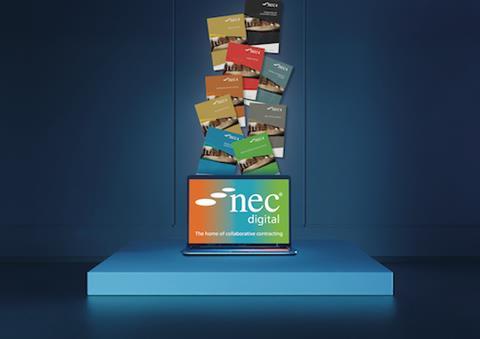
In November 2025, NEC Contracts launched NEC Digital - a subscription-based online contract drafting platform built from the ground up around the NEC4 suite. This is the industry’s first genuinely digital approach to NEC contract creation, and it addresses the practical barriers that have historically slowed adoption.
The platform guides users through drafting with contextual support throughout. Its Clause Navigator provides a live, side-by-side view of options and relevant clauses, making contract navigation intuitive rather than reference-dependent.

Intelligent compatibility checking automatically prevents the selection of incompatible clauses - eliminating a category of error that currently must be caught manually, or surfaces in dispute.
The full NEC4 contract suite is available, including the Engineering and Construction Contract (ECC), Term Service Contract (TSC), Professional Services Contract (PSC), and Facilities Management Contract (FMC), alongside a personalised Z clause library that organisations build from their own previously drafted contracts.
For commercial teams managing procurement across multiple projects, the efficiency case is clear. Drafting is faster. Errors are caught during drafting rather than in execution.
All stakeholders; clients, consultants, contractors, and subcontractors, work from a single platform with full version integrity and permission controls. During tender, bidders access a secure environment with the same guided experience, ensuring Contract Data 2 submissions are complete and consistent.
The broader strategic value is organisational. NEC Digital removes the expertise bottleneck that has historically limited collaborative contracting adoption in organisations without deep NEC knowledge embedded at every level.
Because guidance is available at the point of need, less experienced team members can contribute effectively while they build capability. Supply chain partners, who are often the weakest link in NEC implementation, can now engage with the same quality drafting environment without requiring specialist training before they start.
The cost of staying where you are
The risk of inaction is worth naming clearly.
The Construction Playbook is explicit about digital contract management expectations.
Public sector clients are increasingly scrutinising their supply chain’s digital contracting maturity.
Organisations that cannot demonstrate a credible approach to digital procurement will find themselves at a competitive disadvantage on public frameworks - and increasingly on private sector projects where sophisticated clients are applying the same lens.
Beyond compliance, there is a straightforward commercial argument. Every compensation event raised too late is a risk. Every incompatible clause that reaches contract execution is a risk. Every version control failure in a multi-stakeholder drafting process is a risk. These are not remote possibilities - they are the predictable outputs of processes that haven’t changed in decades applied to projects that have.
Organisations that build digital contracting capability now will be better positioned on every programme that follows. The competitive gap is opening.
Building the team capability to match
NEC Digital accelerates adoption and reduces drafting risk. The other half of the equation is people. NEC Training, delivered by recognised NEC experts, provides structured capability development across the full NEC4 suite, with a clear progression from introductory courses to advanced accreditation.
Courses are available for all roles: clients, project managers, commercial managers, quantity surveyors, contractors, and supply chain teams, in open and bespoke in-house formats. For organisations deploying NEC Digital, NEC Training provides the contextual knowledge that makes platform-guided drafting genuinely effective rather than just faster. The combination of well-trained people and the right digital tools is where real commercial performance gains lie.
The industry’s direction is clear. Collaborative contracting is mandated. Digital transformation is expected. The organisations that close the gap between their digital ambitions and their contracting processes - not just their design and project management tools, but the contracts themselves - will be the ones best positioned for what comes next.
Request a demonstration of NEC Digital here
Rekha Thawrani OBE is Global Director at NEC Contracts. NEC Contracts’ industry research report, Transforming Construction: Smarter, Greener, Together, is available to download at neccontract.com/research