











Structural engineer Webb Yates has completed its first structural stone building for a commercial developer and launched a demonstration project showcasing standardised stone structural elements. Thomas Lane reports on the firm’s 20-year mission to establish stone as a sustainable alternative to concrete
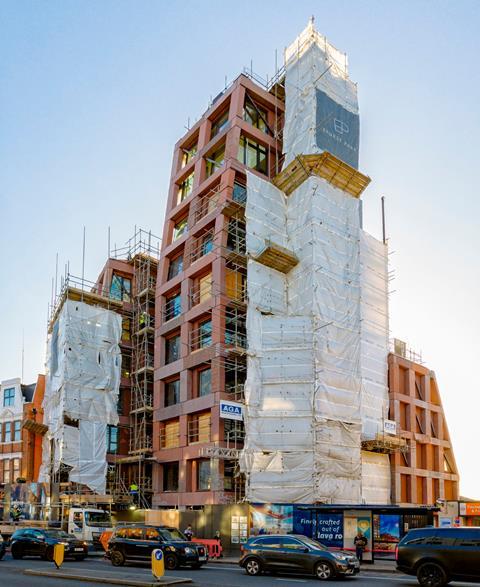
2025 was a good year for the engineer Webb Yates. The firm celebrated its 20th anniversary, during which time it has been on a mission to position stone as a significantly more sustainable structural material than concrete.
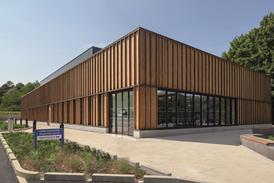
The year finished with a nine-storey residential building on London’s Finchley Road close to completion, the firm’s first structural stone building for a commercial developer. And, over in Earls Court, it launched a structural stone demonstration project in partnership with the Design Museum that uses standardised stone structural elements. The idea is that this will make adopting structural stone elements much easier and therefore more appealing for the mainstream industry.
The reason for promoting stone rather than concrete for structural work is the complexity and carbon cost of making cement. To make cement limestone is quarried, crushed and ground into a powder and fed into a kiln with clay and heated in a kiln to 1500°C, prompting a chemical reaction that releases large quantities of carbon dioxide. This produces a clinker, which is ground up ready for mixing with aggregate and water to produce concrete, a weaker material than stone and a carbon cost two thirds greater.
And, unlike timber, the alternative low-carbon structural material, stone is inherently fire resistant. With 20 years of experience under its belt, has Webb Yates finally managed to position stone as a serious alternative to concrete and timber?
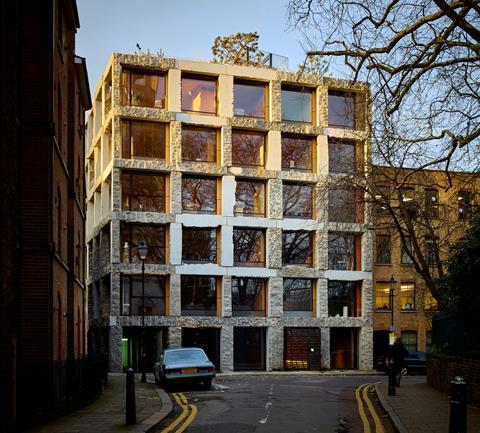
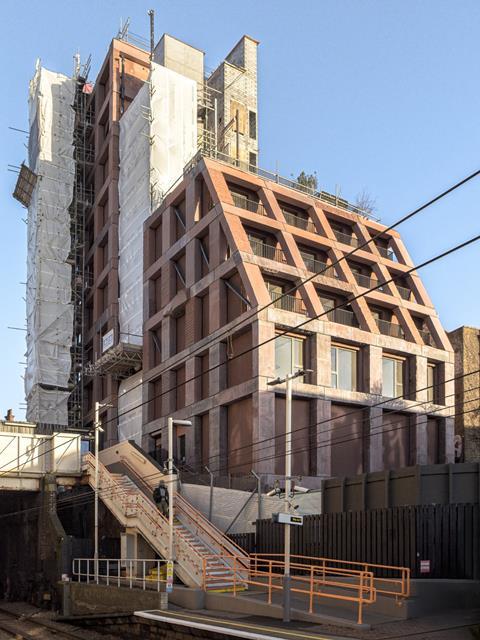
317 Finchley Road is an evolution of an earlier project in Clerkenwell Close designed by the same architect, Amin Taha. The difference is that Clerkenwell Close was developed by Taha for his practice Groupwork and as a home for himself. Finchley Road has been developed by a private developer and is residential except for the ground floor. At nine storeys, it is also three storeys higher.
Both buildings feature an external stone exoskeleton with two key differences. The Clerkenwell Close structure was built from limestone with a muscular, rough, unfinished face whereas a much more urbane, smoother granite was used for much of Finchley Road. This has been treated with a red wash to even out natural colour differences between the stones.
The second key difference is the Finchley Road structure is working harder as it provides lateral stability as well as taking vertical loads. This has the advantage of eliminating the need for a central core, which saves space.
“The client wanted to utilise the facades to get more flats in by not having a central core,” explains Alex Lynes, associate director at Webb Yates and the person responsible for the project. “In order to do that, we’ve made the exoskeleton a sway frame, which we could do, because it’s a slightly denser and harder stone [than Clerkenwell Close].”
Finchley Road splits into three volumes above ground floor level to soften the building’s mass. The stairs and lift are housed between these blocks.
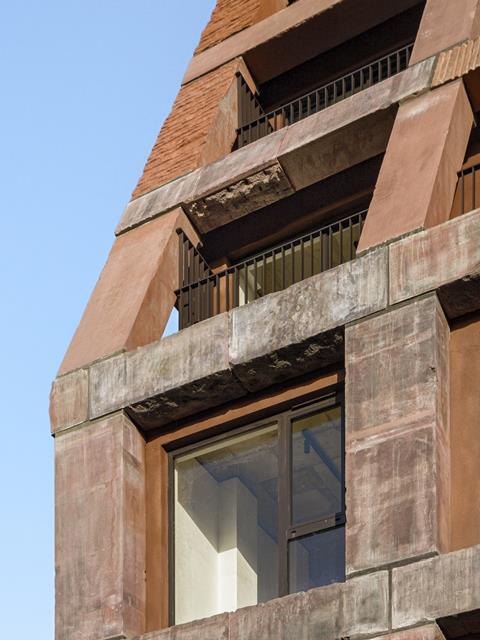
Initially the stone was an Italian basalt supplied by Ateliers Romeo, but supply constraints prompted the team to switch to a Norwegian granite supplied by specialist Lundhs. This features three surface treatments – naturally split, drilled and split and sawn. Granite splits more cleanly than limestone, which means the surface texture is more subtle than the limestone of Clerkenwell Close.
The beams and columns are typically 800mm wide and 400mm deep and up to 3.5m long. Some of the beams are longer than this so have been supplied in two pieces, thanks to the lifting capacity of the crane, and have been spliced together on site using steel dowels.
Construction was similar to a precast concrete frame with the beams and columns craned into position. Dan Crane, the site manager for contractor Ernest Park, says the stone was lifted from the top with a coat-hanger type frame. Unlike precast it had to be strapped too.
“It was wrapped in straps as a secondary precaution because – unlike concrete – it doesn’t have any rebar holding it together,” he explains. “If we were just relying on lifting it from the top and it cracked while lifting, it would be very disruptive.”

The stone blocks were supplied with holes drilled at each end as steel dowels and resin have been used to lock the beams and columns together to give the frame the necessary lateral stability. The frame is connected to the concrete slabs with brackets.
The blocks feature generous tolerances between the adjoining beams and columns, partly to allow space for the steel brackets tying the frame back to the slabs and because the team were not sure how accurately the blocks would be cut. Shuttering was needed to grout the gaps between some of the blocks.
“It was a case of weighing up the benefits of tightening up the tolerances and increasing cost and the amount of time it takes to cut the blocks,” Lynes says. “We didn’t want them to be spending loads of time getting to within a couple of millimetres of tolerance, which they could do, because then it would just add cost and time to the programme.”
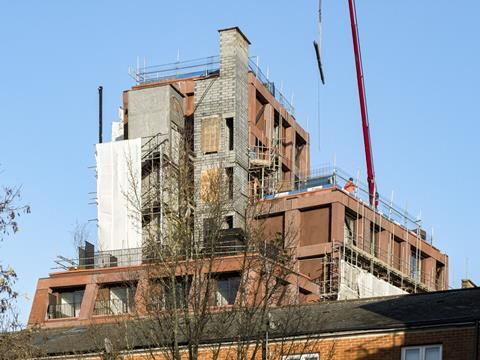
Stone panels were used to construct the lift shaft, with stone blocks used for the services riser. The riser was constructed at the same time as the frame as this helped the programme and required very little crane time.
“The crane is being used all day to install the exoskeleton, whereas using blocks for the riser just requires you to load up blocks at start of the day, and then the riser can be worked on at the same time as the exoskeleton,” Crane says.
The stone blocks were half the size of concrete blocks to keep the weight of each one below 20kg. Although this meant laying these was more involved, no post construction finishing such as painting was needed.
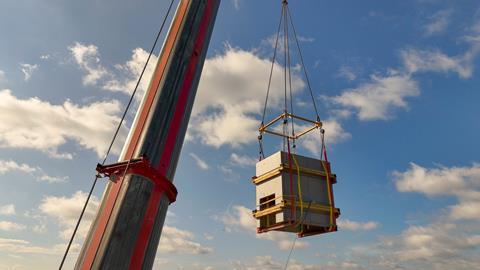
The tower crane was located in the vertical circulation area, which meant the lift shaft had to be constructed after the crane came out. “Because of the tight logistics of the site and the need to get that element of works going, we prefabricated the panels offsite over seven to eight weeks as that was the quickest method,” Crane explains. “As soon as the tower crane came out, over the following weekend, we put the whole lift shaft in in two days using a mobile crane in the road.”
Dowels were used to secure the panels together at the top of these to give the lift shaft the required fire rating. The stone panels were flame finished, which eliminated the need for any post-construction finishing other than grouting the joints between the panels.
Now that the project is almost finished, what does Crane think about stone as a structural construction material? “I can see the sustainability benefits of it,” he says, although he adds that opting for a sway frame added complexity as the floor slabs were built before the frame went up.
“This is a very bespoke structure, which is tied back to the slabs, so some temporary works were needed. The slabs went up as a normal frame, with temporary works holding these up before the stone was installed, one facade at a time.”
He says that it would be better to build the frame in tandem with the slabs as this would eliminate the need for expensive temporary works, and mean less swapping between lifting columns and beams. Ateliers Romeo were going to subcontract the installation to a UK specialist, which is why the frame was constructed independently of the slabs.
The switch to Lundhs meant Ernest Park’s team could do the installation themselve,s as Lundhs did all the shaping and cutting of the stone at the quarry rather than relying on an onsite specialist. Crane says he would build the slabs and frame conventionally next time.
The Earls Court structural stone demonstrator
While Crane was putting the finishing touches to his project, the next iteration of structural stone construction was being erected at Earl’s Court. “The stone demonstrator takes it a step further, where it’s all bolted together on site,” explains Lynes. All you need is a standard assembly team, rather than a stone specialist.
“It is better to get the stonemasons to do complicated stone masonry in their workshop, so you don’t need a specialist stone mason, apart from maybe in a consultant role or to check that the work has been done correctly.”
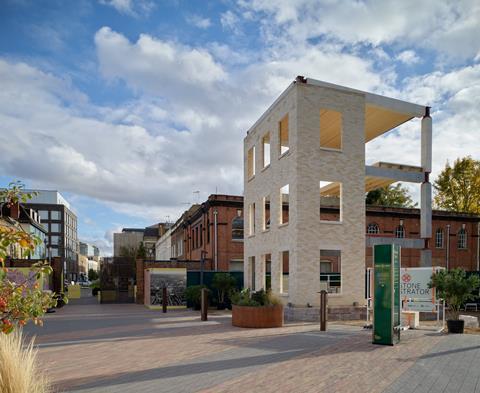
Unlike Finchley Road, the beams and columns at Earl’s Court are pre-tensioned. This has the advantage of enabling smaller section sizes – these are 300mm by 300mm for the columns and 500mm deep and 300mm wide for the beams. The beams are made up from 600 to 800mm-long stone sections, which are compressed together by the pre-tensioning. This means the beams can be much longer.
“The stone demonstrator grid is six and a half by six and a half metres. Obviously you wouldn’t be able to get a single piece of stone that large. And, in fact, the original proposal for the stone demonstrator was nine by nine, and then it got scaled back a bit to fit onto the actual plot that was available.”
The demonstrator was designed to be four storeys high. Lynes says the section sizes that have been used could support up to 10 storeys. A building could go higher still by using larger section columns at the lower levels.
Like Finchley Road, granite from Lundhs has been used for the demonstrator. Lynes says limestone has typically been used previously – as at Clerkenwell Close – because it is easier to work, but the superior strength of granite means section sizes can be smaller and the quality of Lundhs’ work has swung the dial in favour of granite.
The conventional, internal frame was designed to be quick and easy to erect onsite. “We’ve taken some cues from the precast and steel industry to make the end connection plates on the columns and beams standardised so that they can be slotted and bolted together really easily on site,” Lynes says.
“The idea is to keep the stone masons doing the specialist work in their workshop, where they can be the most efficient, and then making the assembly on site as quick and standardised so any contractor can do it.”
Testing the stone
Lynes says that the verification of structural stone performance has been built over the years that Webb Yates has been using the material. The firm has used a combination of masonry and concrete structural Eurocodes to define structural performance and has done its own testing. This means more recent testing focuses on the elements that are different from what has gone before; for example, the focus at Finchley Road was on the connections.
“Because this was a sway frame, the connections between the blocks was the key thing. So we built a test section and tested it for stiffness and strength to make sure that our calculations were correct.”
Because the frame at Finchley Road is external, the stone had to be tested for durability including freeze-thaw tests, permeability and porosity testing. Lynes says Lundhs did most of the tests because they see the market potential for structural stone and want to be able to demonstrate their stone’s properties to potential clients.
Arup worked with Webb Yates on the Earls Court demonstrator. Lynes says Arup has also worked with structural stone and it was good to see whether they had been working on the same basis.
“They have gone through the same process as us of going through the Eurocodes and figuring out how it can be applied to stone structures,” he says. “So it is quite nice to compare notes with them and have them check our work with the stone demonstrator and confirm that they are happy with what we have done.”
The Earl’s Court demonstrator showcases three different floor options. The lower floor features 150mm-deep stone planks spanning the full 6.5m grid. The middle floor demonstrates glutam beams spanning between the primary stone beams. These are topped with stone slabs, which are fixed to the beams enabling them to be supplied as modules for faster erection.
“Again, the idea is to make it quick to build onsite for larger scale buildings,” Lynes says. The top floor utilises CLT with a waterproof membrane. Unusually, the timber sections making up the slab are held together by dowels rather than glue.
“CLT has a lot of glue in it, which can lead to fire problems, because you need a really high spec glue so that it doesn’t delaminate in fire.Dowel laminated timber doesn’t have any glue, so it performs a bit better and it’s more sustainable,” Lynes says.
The idea is to demonstrate site-specific floor options. Lynes reckons the timber stone composite has the lowest embodied carbon but has the disadvantage of being deeper. The all-stone option is the slimmest but heavy, necessitating bigger foundations and potentially larger section columns. The CLT is the lightest with a flat finish, but isn’t viewed as favourably by insurers. “It’s what you want from the structure,” Lynes says.
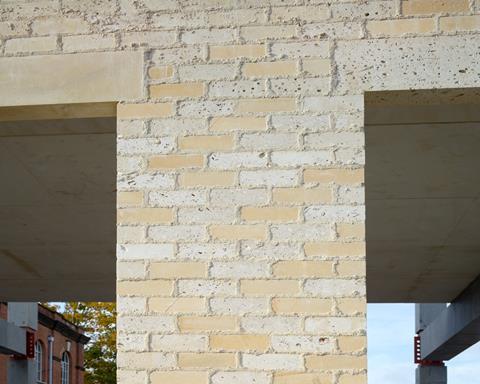
The self-supporting facade is constructed from stone bricks, which are 90% lower in embodied carbon than a typical London clay brick as no firing is needed. Lynes says the idea of stone bricks was pitched to a couple of quarries who jumped on the idea as it creates a revenue stream for offcuts that otherwise could not be used.
He adds that Albion Stone, which specialises in Portland stone, has recently invested in a new machine to cut stone bricks more quickly and efficiently.
An equivalent, all steel-framed structure with a standard brick facade would emit around 40,000kg of carbon; one built from concrete would emit 32,000kg of CO2. The embodied carbon footprint of the stone demonstrator with the low carbon floor options is just 3,000kg.
Webb Yates has worked hard to simplify structural stone construction but this is unlikely to take off unless it is price competitive with the alternatives. Lynes says a key driver was to match the price of a mass timber structure, which he says they got reasonably close to. Stone would have the advantage of smaller sections which would be more space efficient but timber would be lighter.
He adds that the connections were expensive as this was the first time these had been made. Mass timber is about 10% more expensive than traditional construction, but has the advantage of speed and savings on the finishes – similar advantages offered by stone.
Lynes says any medium to high-rise building would be well suited to the structural stone system. Stone structures would address residential fire concerns on tall buildings and the easy to build, prefabricated system, including the ability to create long spans is ideal for the commercial market.
He says a couple of commercial clients are interested in using the system on a project. If all goes well, 2026 could turn out to be an even better year for Webb Yates than the one just gone.
Project team (317 Finchley Road)
Client: 317 Finchley Road Ltd
Architect: Groupwork
Civil, services and structural engineer: Webb Yates
Cost consultant: Havard Knight
Project manager: Pantelli
Planning consultant: DP9
Main contractor: Ernest Park
Specialist stone contractors: Ateliers Romeo/Lundhs
Project team (Earls Court demonstrator)
Client: Future Observatory at the Design Museum
Site partner: The Earls Court Development Company
Funder: The UKRI Arts and Humanities Research Council
Architect: Groupwork
Structural engineers: Webb Yates/Arup
Principal contractor: Ernest Park
Stone structure: The Stonemasonry Company
Hybrid stone and timber floorplate: Bamberger Natursteinwerk Hermann Graser
Dowel-laminated timber floorplate: IQ Wood
Structural stone suppliers: Brachot, Carrière de Luget, Franken-Schotter, Lundhs, SigmaRoc
Stone brick supplier: Hutton Stone/ Albion Stone
Stone brick installation: Ryker Structures







No comments yet