














Robert Hopkins explains how trauma-informed design can move inclusive architecture beyond compliance to create spaces that feel safe for all
When we talk about inclusion in design, the conversation often starts with compliance. We think of accessibility standards, checklist targets and metrics to meet. Yet true inclusion goes further. It looks not only at who can enter a building, but how people feel once they are there.

When AHR began its collaboration with the University of Salford on the university’s new Thrive Health and Wellbeing Centre, we were introduced to the concept of trauma-informed care.
From the outset, the university encouraged us to look beyond the traditional measures of design success and ask a different question: how might the environment itself help people feel safe, supported and in control?
That challenge shaped how we approached the project. We were not designing a healthcare or education building in the conventional sense. We were being asked to bring empathy and evidence together to translate the principles of trauma-informed care into the fabric of a real place.
Trauma defined
We often associate the word “trauma” with something extreme, but in a technical, psychological context it has a specific meaning. It describes a broad spectrum of different difficult experiences that can influence how people feel, and how they interact with their environment.
These experiences include serious life events, such as the loss of a close family member in difficult circumstances; being involved in an abusive relationship; or being attacked. But everyday pressures, uncertainties or losses can all also leave a lasting impression and affect an individual’s sense of safety in the world.
Such experiences affect how people move through the world – and how they move through buildings, relate to others and respond to sensory factors, such as light, sound or space.
Research suggests that around half of adults have experienced at least one trauma-inducing event. For designers, that awareness opens up new possibilities – and brings new responsibilities.
Trauma-informed design
No two people experience space in exactly the same way. For example, for some, bright light feels energising, while for others it feels exposing. A busy corridor may create connection for one person, and anxiety for another. Trauma‑informed design (TID) encourages us to recognise these differences and create places that feel predictable, calm and supportive.
At its heart, TID is about psychological safety. It invites us to ask: does this environment help people feel grounded? Does it allow them to control how they move and interact? Does it bring comfort rather than confusion?
Small changes to how spaces are shaped and finished can make a big difference to how people engage with them.
Translating lived experience into space
The Thrive Health and Wellbeing Centre allowed us to put these ideas into practice at scale. From the first conversations about the project, our shared ambition was to create not just another teaching or clinical facility, but a building that actively promotes wellbeing.
We began by listening. Staff, students, clinicians and local community partners shared what mattered most to them – what worked, what caused frustration, and how they wanted to feel in the new environment. Their insights guided every decision that followed, from circulation layouts to material choices.
This engagement process mirrored the core values of trauma‑informed care: safety, trust, choice, collaboration, empowerment and cultural sensitivity. Each principle was explored and translated into design strategies that support emotional comfort as much as technical performance.
From principle to practice
Four key ideas underpinned our approach – and these form a structure that others can adapt when applying trauma‑informed thinking to design.
Safety and trust
Safety is more than a matter of compliance. It is about how secure people feel bodily and emotionally. Unpredictable layouts or sudden acoustic changes can cause anxiety. Clear sightlines, consistent lighting and straightforward routes help people stay oriented and calm.
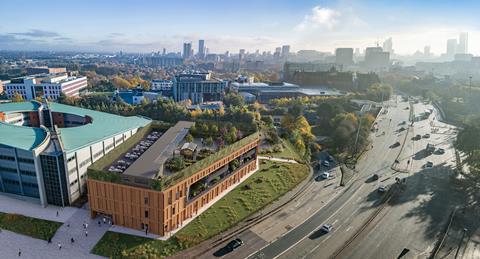
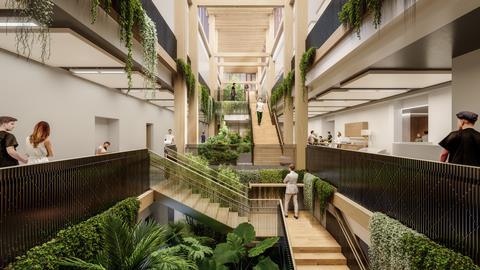
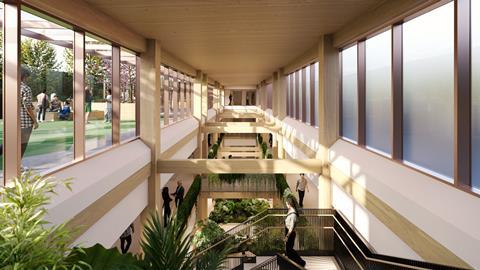
At Salford, the building is structured around a bright central atrium that acts as a constant point of reference. From any part of the building, people can see daylight or find their way back to this anchor, which reduces stress and restores confidence.
Choice and empowerment
Design can either limit or enable autonomy. Spaces that let people choose how and where they spend time help rebuild a sense of control. Moveable furniture, multiple routes and adjustable lighting all offer users tangible choice.
At Salford, open and enclosed spaces sit side by side, allowing people to select a setting that suits how they want to work, learn or wait.
Community and connection
Recovery and learning both depend on connection. TID encourages shared spaces where people can interact naturally while still finding privacy when needed.
At the Thrive Centre, the building’s forest atrium acts as a social heart linking teaching, clinical and public areas. It makes the university’s relationship with its community visible and tangible.
Beauty and joy
TID does not mean clinical neutrality. It embraces beauty as a form of care, and recognises that natural materials, colour and art can gently lift the spirits.
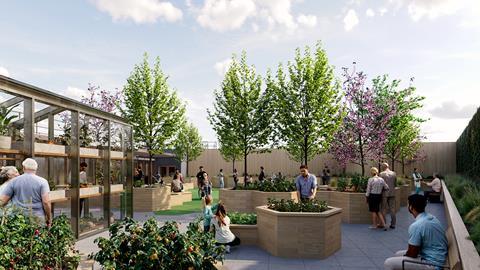
In Salford, warm brick tones, subtle references to the city’s heritage, and terraces filled with planting give the building a sense of belonging and optimism.
Beyond checklists
Like any high‑performing modern health facility, the Thrive Centre meets demanding standards for accessibility, sustainability and clinical function. What makes it distinctive is the way these requirements are complemented by a deeper commitment to sensory and psychological wellbeing.
Lighting is designed to avoid glare and flicker. Acoustics have been tuned to reduce echo. Textures are warm to the touch, and materials were chosen for their tactile comfort as much as for their durability. And all these details operate at a subconscious level, helping people feel settled, confident and at ease.
In many ways, TID aligns with neuroinclusive and dementia‑friendly design. The clarity, consistency and calm that support people who have experienced trauma can also help neurodivergent users, those living with anxiety – and anyone navigating a new or complex setting. The result is a universal design language that benefits everyone.
Designing for an evolving community
The new building also reflects the way healthcare education itself is changing. As the NHS and universities embrace integrated, community‑based care, there is a growing need for facilities that blur the boundaries between learning, research and service delivery.
At the Thrive Centre, students, staff and local residents share the building. Public‑facing clinics and therapy rooms sit alongside teaching environments, creating opportunities to learn through practice.
The surrounding terraces and gardens further extend this approach, providing spaces for informal wellbeing activities, reflection and social prescribing programmes in partnership with local organisations.
The organisational dimension
TID does not stop when construction ends. It also depends on the culture and everyday behaviour of the people who use the building. At Salford, that understanding influenced both the architecture and the operational model.
Staff training, governance and partnerships are grounded in inclusivity and empathy. Small choices reinforce this ethos: students and clinicians greet patients in person rather than from behind a desk; clear visual contrasts guide people through circulation routes; waiting areas offer multiple seating patterns so visitors can find the spot that feels most comfortable. These gestures may seem modest but, together, they create an atmosphere of care.
Evidence, learning and collaboration
As the project developed, we realised that our shared learning could go further so we set out our ideas in a white paper, Trauma‑informed Design in Practice, co-authored by AHR and the University of Salford. It sets out the research behind these ideas and offers a practical, evidence‑based framework for designers and clients.
Although this is an academic piece, grounded in clinical understanding, it is written to be accessible. Our aim was not just to share findings from Thrive but to create a practical guide that others could apply to their own projects, translating care into built form in ways that are measurable, sustainable and inclusive.
Rethinking professional responsibility
As architects, our responsibility goes beyond form and function. We design settings that can improve or undermine how people feel each day. Recognising that influence asks us to listen more closely; to question our assumptions; and to see comfort and psychological safety as essential components of good design.
Trauma‑informed projects begin with shared values rather than fixed solutions. They rely on early and open dialogue between designers, clients and users to understand operational, emotional and sensory needs. Embedding empathy and evidence from the start helps create buildings that are both imaginative and practical, spacious yet supportive.
Architecture as care
For me, this collaboration with the University of Salford has been a reminder of why we design. Buildings are never neutral. They influence behaviour, wellbeing and connection in ways we might not always see – but people always feel.
TID gives us a language for expressing care through architecture. It connects research with practice, linking sensory quality, technical integrity and social value. Most of all, it reminds us what truly inclusive environments can be: places that welcome individuality, create stability and offer people choice and dignity.
The next steps
As the Thrive Centre nears completion, a new phase of learning will begin. The university will gather feedback on how the building is experienced day to day, helping us refine and share insights across future projects.
Designing for psychological safety is not just possible; it is scalable. It humanises public buildings and provides a foundation for wellbeing in settings from schools and workplaces to civic and healthcare environments.
Our hope is that Thrive acts as a catalyst, encouraging others to explore this approach, to embed empathy and sensory awareness in their work and to see architecture as an agent of care. In doing so, we can move beyond compliance and create inclusive environments that allow people not just to function, but to flourish.
Postscript
Robert Hopkins is a director at AHR and co-author of the white paper Trauma‑informed Design in Practice
Article produced with insights from Professor Vicky Halliwell, Pro Vice Chancellor, Dean of the School of Health and Society, University of Salford, and co-author of the white paper






No comments yet