

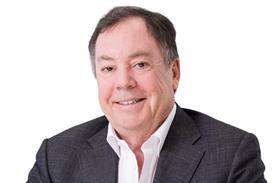
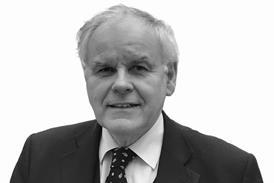



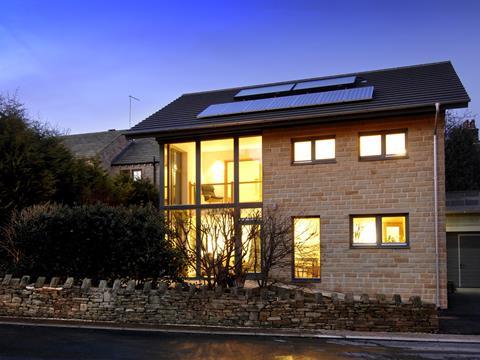
Sixteen years ago, Bill Butcher wrote a fortnightly blog charting the construction of the pioneering Denby Dale Passivhaus project, the UK’s first cavity wall Passivhaus. Now Butcher and his business partner Chris Herring are building a terrace of three timber frame Passivhaus Plus homes. Here, Bill and Chris share the lessons learned in the intervening years and what this latest project says about the evolution of the Passivhaus movement in the UK
After a long part of our careers working on Passivhaus projects, we are excited to have the opportunity to develop and live with our partners in a Passivhaus and experience the comfort and energy savings in our later years.
The vision
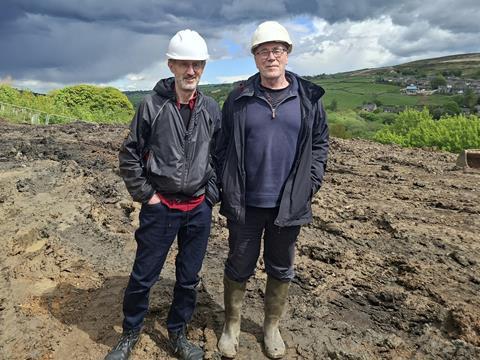
We acquired a green/grey belt site of just over an acre on a hillside in West Yorkshire’s Colne Valley. Our vision is of modest but exemplar homes – sufficient and efficient - set alongside a community food growing project to build resilience and inspire others in the face of the climate and ecological crises. We are, after all, old hippies at heart.
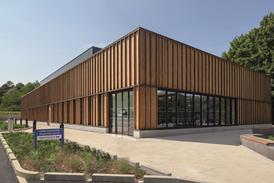
While our plans and material choices have been shaped by the stringent planning conditions, the timber frame, timber-clad construction will give us exactly what we wanted. We’ve decided to go to Passivhaus Plus standard which adds renewable energy generation to the Passivhaus fabric standard.
The dream team
From our early inexperienced Denby Dale days, the UK Passivhaus supply chain has evolved substantially, and we now also have an outstanding professional organisation, the UK Passivhaus Trust, which is at the leading edge in the global Passivhaus community.
Our long involvement with Passivhaus means we have the privilege of bringing together a true Passivhaus dream team: Nick Grant, the Trust’s technical director, is our Passivhaus consultant, Mike Whitfield, a master Passivhaus builder is co-designing and supplying the timber stick frame system.
Alan Clarke is designing the services, and Sarah Price is our certifier, both superstars in their fields. Our former site manager for Denby Dale and every project since is Jude Wilson, who will lead the construction with his Green Building Company team.
And the local architects, Hawdon Russell, will be working closely with us on the aesthetics and detailed design. As founders of 21 Degrees, we are using the company for key components, including triple glazed windows, MVHR, heat pump and solar PV.
One of the key lessons from the Denby Dale Passivhaus and ever since is the importance of having the whole team - from design to construction - on board, to understand the whole picture and communicate collaboratively.
Simplified details
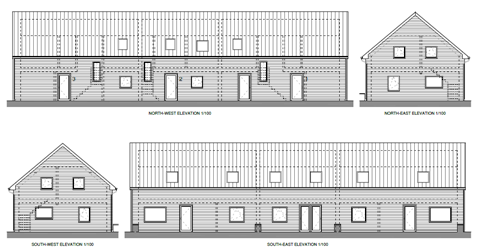
In retrospect, the detailing on the Denby Dale project was over-complicated. For example, the large overhang and detail at the eaves were unnecessary, there were simpler solutions we could have used.
Our current project benefits from Nick Grant’s pioneering approach of ‘radical simplicity’ or true value-engineering
Our current project benefits from Nick Grant’s pioneering approach of ‘radical simplicity’ or true value-engineering. We’ve been able to implement this from the get-go and Nick has worked closely with Mike Whitfield to develop some of the most pared down but efficient timber frame detailing available and alongside Alan Clarke, to design a heating system that minimises complexity and increases robustness.
Embodied carbon
We know a lot more about embodied carbon now. When we built Denby Dale we used cavity wall construction. Our project will be a stick-built timber frame system, insulated with recycled cellulose - keeping embodied carbon and whole life carbon as low as possible and incorporating as far as possible biologically derived materials. We have benefited from using PHRibbon, a plug-in to Passivhaus software tool, which calculates embodied carbon, whole life carbon (RICS whole life assessment methodology) and compliance with RIBA 2030 targets. And we thought very carefully about the use of concrete. Andrew Collinson, our structural engineer has designed our strip foundation and 100mm thick slab without the need for steel reinforcement or a screed.
Glazing
The Denby Dale project had an extensive two-storey glazed area that required good shading. Since then, the UK Passivhaus community has evolved its understanding of how to model for and prevent overheating, and our project has been able to use advanced overheating stress-test guidelines for designers using PHPP software developed by the Passivhaus Trust. As a result, we have fine-tuned and simplified the glazing requirement on our project which also reduced the cost.
Heating and services
There were several building services issues at Denby Dale relating mainly to over-specified systems. At the time, gas was the most obvious energy choice as heat pumps were a relative novelty. Our project will have an air source heat pump system for each house using ultra-low temperature water underfloor heating embedded directly in the slab, operating at only a degree or two above required ambient room temperature.
Keeping costs down
Major housebuilders like Barratt London are now adopting Passivhaus on a mass scale, demonstrating that the economics of Passivhaus now stack up. According to Passivhaus Trust research the cost uplift is 4%-8% more. We haven’t separated out the extra costs of building to Passivhaus standards for our project, but simplifying the form factor, glazing and heating systems is helping to make it as cost-effective as we can. What has happened since Denby Dale is the general increase in the cost of construction materials, largely due to Brexit, various conflicts and geopolitical events. Those are much bigger headaches for us, alongside the extensive groundworks needed for our project.
Hindsight is a wonderful thing
We remain inordinately proud of Denby Dale, grateful to our pioneering clients who trusted us on that journey and to Building magazine for helping share that journey. We learned so much from that experience and are pleased to know that the Denby Dale Passivhaus continues to provide a comfortable and pleasant home, as we know that ours will be. That is the beauty of the Passivhaus standard – it really does deliver consistently what it says on the tin.
Bill Butcher & Chris Herring are founders of 21 Degrees (formerly Green Building Store). Follow the progress of the project here





No comments yet