
















From mechanical scanning dogs to autonomous bricklaying machines, construction robotics is moving from novelty to necessity. But chaotic sites, fragmented supply chains and entrenched working practices mean the road to widespread adoption remains long and complicated
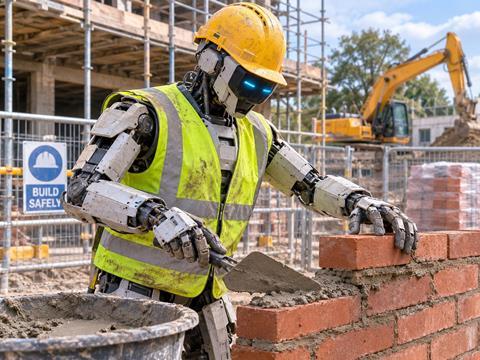
Throughout this year we have been wowed by videos of Chinese-made robots flawlessly performing carefully choreographed dance routines and beating humans at table-tennis. The abilities of these machines are extraordinary, yet a concern thanks to the potential impact on the future of work and more ominously the prospect of autonomous warfare between robot armies.
Given the speed with which artificial intelligence went from chatbot novelty to established workplace tool – with impacts on employment already being felt – could robots make similar inroads onto construction sites? In the case of construction, could robot workers help to solve the problem of how to cope with an ageing and declining skilled workforce?
What robots are on site now?
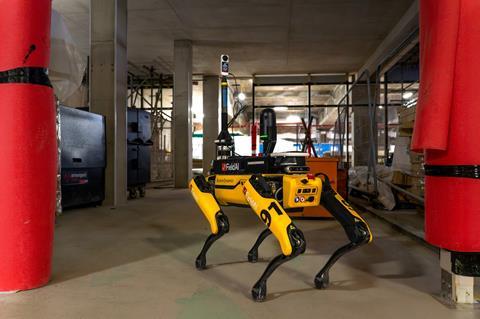
There are already robots working on sites. Contractor McLaren has two Boston Dynamics robotic dogs armed with scanners monitoring progress on site and reporting any discrepancies between the design and what has been built. These are already proving their worth by spotting elements being installed in the wrong place. The errors can then be rectified before follow-on trades arrive.
Tool manufacturer Hilti’s Jaibot, an automated drilling machine, is being used to drill up to 1,000 holes a day in concrete soffits ready for MEP installations. Similarly, lift manufacturer Schindler is using autonomous self-climbing robots to set out, drill and install anchor bolts in lift shafts ready for the elevator rail installation team.
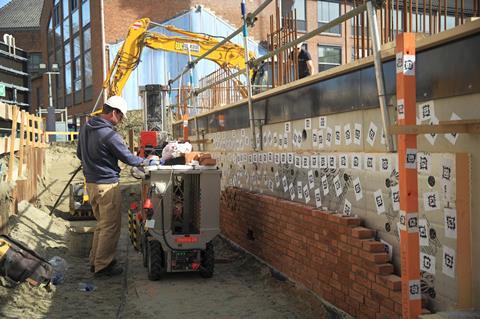
Dutch company Monumental has a fleet of 100 bricklaying machines capable of laying 800 bricks a day, double that of a traditional bricklayer. These are beginning to make an appearance on UK sites.
What are the benefits?
Robots really come into their own when performing highly repetitive tasks such as drilling holes or laying bricks. A prerequisite is an accurate BIM model, which the robot uses to position the hole or brick.
Getting figures for the return on investment in the technology is difficult as this depends on the cost of the robot and how it is procured. For robot purchasers, the utilisation rate for the machine is critical as it might perform the task very quickly then spend the rest of the time idle. The high costs of buying a machine mean other pricing models such as leasing or short-term hire are more cost effective.
Some charge by the task performed, for example Monumental charges per brick laid and aims to compete with local specialist contractor rates. McLaren has some initial return on investment data and reckons its robot scanning dog is worth almost 50% of a site manager’s salary because of the amount of time it takes to survey a big, complex project.
Direct comparisons are difficult because the dog is surveying a site three to four times a week, whereas a site manager might only do this once a week. Not only does more frequent scanning provide earlier warning of discrepancies, which could lead to bigger savings, but the scans provide a record of what was done when and by whom, which could be useful in case of a dispute.
And McLaren is considering using the dog to watch out for health and safety issues. “If it sees a blocked fire escape, loose cables hanging from ceilings or even members of the workforce not wearing PPE or not using the correct access to work at height equipment, it can start flagging those issues,” explains Tom Gothard, McLaren’s senior digital implementation manager.
In answer to the question of whether the workforce might see this as a Big Brother imposition, Gothard says communicating the reasons why the dog is watching is important. “You can argue it’s looking out for people’s safety – if it sees unsafe conditions, it’s flagging them so they get rectified.”
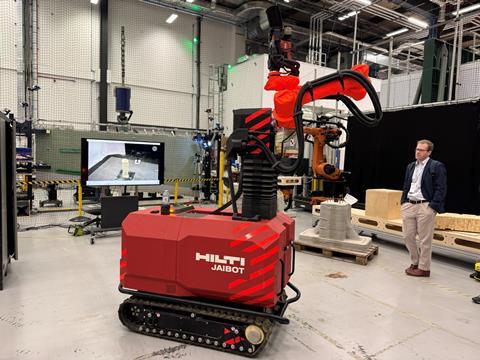
For Ben Wagenaar, senior innovation manager at HS2, a simple increase in productivity is not enough to justify investing in robotics. “The best performing innovations have two big wins, such as cost reduction and health and safety improvements, because the problem is a 20% improvement in productivity disappears by the time you have gone through procurement, training and the culture change,” he says. “For example, robotic drilling increases productivity and has health and safety benefits too.”
Barriers to implementation
According to Philip Reid, Vinci Construction’s head of innovation and transformation, very few robots that the company has tried make it to site. “Since January 2024, we have had about 54 demonstrations of robots, 24 trials, and one being purchased, and two bankruptcies of ones that we trialled and then couldn’t deploy,” he says.
The problem is that robots are fundamentally unsuited to the average construction site. Robots are widely used in manufacturing because products are mostly standardised and the processes used to make these highly repetitive. By contrast, construction is fundamentally bespoke, sites are chaotic and are constantly changing in unpredictable ways. And there is the human factor – people moving around unpredictably and performing tasks which cannot always be predicted.
Vinci trialled Monumental’s bricklaying machine. “It’s a great bit of kit, absolutely brilliant,” says Reid. “The challenges we had when we trialled it were not down to the machine. This was down to the fact that traditional bricklayers who, when they find something that’s not quite right, just fix it – and the site management team would never even necessarily know. When it’s a robot, it can’t just make it fit, and that becomes a challenge.”
This is where AI could make a difference. A robot equipped with a camera or sensor and AI software could make minor adaptions where it detected deviations from the BIM data. The power of McLaren’s robotic dog is provided by software specialist FieldAI. This enables the robot to adapt to its environment during scanning.
“The robots have a series of nodes, almost like target points that they need to capture,” explains Gothard. “The robot can adapt to its environment. If someone has put a whole load of materials on that node so it can’t easily get there, the robot doesn’t stop and panic and shut down. It will move on to the next node that it can reach.
“It is understanding its environment and knowing what it can and cannot get to. Also, if there are certain areas that we cannot have it going in on a certain day, we can manually set a keep-out zone.”
The plastering robot only operated for four hours a day because every day it caught up with the guys who were prepping the rooms ahead of it
Tom Gothard, senior digital implementation manager, McLaren
Another issue is that robots can get bogged down by the same productivity constraints which bedevil human workers. Human workers take breaks, spend time unloading and organising materials and negotiating their way around other trades who might be behind on their task and in the way of the follow on specialist. This wastes hours of their time and was also Vinci’s experience when it trialled a plastering machine on a hospital project in Shrewsbury.
“The plastering robot only operated for four hours a day because every day it caught up with the guys who were prepping the rooms ahead of it,” Reid explains. “It was so disappointing that we didn’t get full productivity out of it. But I’m now thinking that we did get full productivity out of that. We got four hours, which is probably what we would get from human workers.”
The problem is the upfront investment needed to buy the machine means that it needs to be working all day long to be cost effective.
Reid highlights other challenges such as cybersecurity risks and unexpected issues such as disruption to long-established relationships. He cites a successful trial of a plasterboard cutting machine that was popular on site because it was very accurate. Senior managers loved it because it meant workers didn’t need to wear dust masks. But a middle management tier wasn’t so enthusiastic.
“They weren’t keen because it was disrupting their business model,” Reid explains. “Their business model was based on employing people on hourly rates, keeping people they knew and had worked with for years employed. They were actually our biggest detractor from it.”
The most successful robots are those that take on very repetitive and unpleasant tasks – drilling robots seem to be the most widely deployed. “At the moment you need to find a specific use case rather than looking at it too broadly, and where a robot can help in a very repeatable manual and laborious processes,” Gothard says adding that the other benefit of the robotic dog is that it is unobtrusive and quietly gets on with its work without relying on – or disrupting – site workers.
What changes are needed to make implementation easier?
The challenges outlined by Reid, Gothard and others point to an obvious conclusion – current site process militates against robotics which means adoption is likely to be piecemeal at best. Site processes need rethinking to leverage the potential of robotics, as summarised by Mark Reynolds, executive chairman of Mace Construct.
“Firstly, how work is organised for automation. Secondly, how the supply chain is able to invest and adapt to deliver those changes, and thirdly, how employers can have the confidence as clients, tier ones, and everyone else in the supply chain, to build the capability that we need to make that change.”
For Reynolds the first point includes defining the construction process, including the inputs and outputs, in advance of work starting. This requires meticulous planning, including what components are needed, where these go, how they interface with other components including how materials flow through the site. And, during this, the site must remain safe.
Reynolds says the supply chain cannot be expected to invest in robots until they know what the revised construction process looks like. “We need to have those proven methods worked out upfront before we ask someone to commit and buy [robotics],” he says. “We must become an enabler in close partnership with our partners, so that they can invest and employ.”
As a co-chair of the Construction Leadership Council, Reynolds has an eye on bigger-picture adoption drivers. “This is why, through the Construction Leadership Council, we’ve also been looking at payments and payment terms, because without liquidity going into the sector, it’s going to make it challenging for people,” he says.
And, on his third point, the industry needs to embrace automation, digital process and robotics through training, updating guides such as the Construction Playbook to embed automation into site planning and process. Clients, particularly government, need clear pipelines of work which will give the industry confidence to invest.
What about the role of DfMA?
For decades the stock answer to poor construction productivity was to move construction processes into the factory. Tier one contractors including Mace and Laing O’Rourke have invested heavily in DfMA (design for manufacture and assembly) and many others utilise assemblies made offsite such as MEP modules, bathroom pods, utility cupboards and cladding panels. Many of these factories are relatively crude – using human workers to undertake onsite work offsite, unlike many other industries which are highly automated.
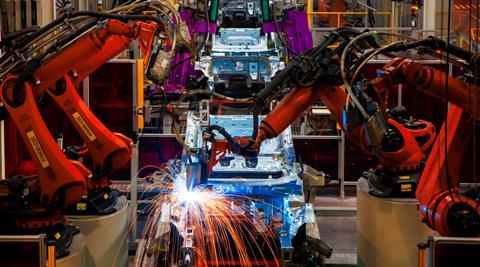
But similar constraints apply to offsite robotics as onsite; it is hard to justify a big investment in a machine that may only spend half a day being productive. Erratic and unpredictable pipelines of work make it hard to make the economics of automation investment stack up.
And what of the dichotomy between the same element made in a factory or made robotically on site – one example being brickwork? Factory-made, brick-faced concrete panels are widely used on some jobs. What is the difference between this and a site-based robotic bricklaying machine?
Gothard wants to try Monumental’s bricklaying machine to assess its productivity. He thinks a site-based bricklaying machine can undertake tasks that are not appropriate for large panels.
“We do a lot of refurbishment projects in central London, where we might be repairing a brick facade or stripping the brickwork back and reinstalling that brickwork. And sometimes a client is very particular about the arrangement of the bricks and there might be particular details they want on a column,” he says.
Mace and Laing O’Rourke have both learnt that the real benefits of offsite manufacture come from an integrated digital process, where architects design around the manufacturing process, logistics is managed through the same digital model and the site is organised around the offsite process. This is not so far from the robot-friendly process that Reynolds says is a precondition for onsite adoption.

What might the future look like?
Could those dancing humanoids come to construction’s rescue? In the short term this is unlikely as those robots are carefully programmed to move in a very choregraphed way, and the table-tennis robot is designed to react to a moving ball within a very specific environment. And there is another issue, as Reynolds explains: “At the moment a humanoid can’t even lift a bag of sugar, which isn’t very helpful. But, if it could lift 25kg or 50kg, then you start to move into a different world.”
Erik Sjödin, leader of engineering, construction and building materials practice at consultant McKinsey & Co, reckons there is a place onsite for humanoids for tasks which are not economic to perform in the factory or can only be completed on site – and that AI is the key. “The pace of learning is tremendous because of AI, he says. “Most sites don’t need to redesigned, as humanoids could integrate into teams.”
The tasks identified by Sjödin as suitable for humanoids include surveying – a task that is already proven to be worth automating – drilling, fetching materials and taking away waste and sorting it ready for recycling. Given the speed with which AI has become established in the workplace, it probably won’t be long before the first humanoids make a tentative appearance on site.







No comments yet