


















The promise of bringing the Manchester regeneration model nationwide has been welcomed by industry. But Joey Gardiner asks our Regen Connect advisers whether Burnham’s approach risks being undercut by a lack of local authority capacity and a disproportionate focus on council housebuilding


It is fair to say that the replacement of Sir Keir Starmer by former Manchester mayor Andy Burnham has sparked hope among some for a regeneration renaissance. “When Burnham became PM, there was a bit of a smile from those of us in the regeneration and placemaking space,” says Simon Marks, partner and city executive at consultant Arcadis. “A sense of, ‘that’s really interesting’.”
Burnham has, after all, come to power promising “growth in every postcode” – a veiled commitment to the renewal of left-behind places.
But Marks is not expressing a political preference. Rather, an enthusiasm about the prospect of the Manchester experience informing national policymaking.
“He [Burnham] really understands how important place is,” Marks says. “And he also understands the impact of local empowerment and local decision-making.”
And Burnham has wasted little time in getting to work on his agenda, proposing new powers for elected mayors, including over planning, setting up an arm of government based out of Manchester to oversee devolution, and allocating £10bn of spending for affordable housing.
However, no one expects the Burnham vibes to suddenly solve long-standing problems. And many in the sector are concerned by what they see as the Burnham team’s overly ideological focus on council housing. Likewise, there are fears that a lack of capacity in local government, allied to political gridlock in our age of multi-party politics, means that the promised devolution could struggle to deliver benefits.
As Building prepares to draw together eight months of work on its flagship Regen Connect campaign at the Building the Future Conference on 7 October, here it asks those on its advisory board and other industry experts to identify the opportunities and threats from the shifting political landscape under the new prime minister.

The promise of Manchesterism
The new PM has been rather quiet about Manchesterism of late, perhaps wary of the “King of the North” image grating on all the potential Labour voters who do not hail from the hallowed home of The Smiths, the Hacienda and Oasis.
But for the regeneration industry, the Manchesterism phrase really does mean something. While the rest of the country may have spent the past three years in something of an economic funk, Manchester has been booming – its economy growing at twice the rate of the rest of the economy for the past decade.
And this growth, while largely city-centre focused, has also been achieved while delivering some of the most successful genuine urban regeneration projects – the Hulme Estate, Ancoats, New Islington – in the country. It hasn’t been at the expense of quality.
This success has not been put down to the former Greater Manchester mayor alone – Burnham took up that job in 2017 after the city region had already been created as an effective entity by others. But he clearly recognised what worked, developed the model, and supported strong city-regional decision-making.
Mayors and combined authorities are going to have different ideas to Whitehall and Westminster
Lord Best
Phil Mayall, managing director of regeneration developer Muse, says Burnham’s first few months have already given the sector “a clear direction of travel” around “regional delivery, more power to mayors in all places, and a little bit more pragmatic approach, such as we saw in Greater Manchester on the social and affordable housing programme.”
One of Burnham’s summer announcements, for example, was a promise to give all elected mayors call-in powers for strategic planning applications in their area, equivalent to those in Greater London. The Treasury is also due to issue a white paper on fiscal devolution of income tax and business rate receipts, which will allow mayors to borrow against the expected revenues from future growth, money that could be used to fund major capital projects.
“I genuinely think devolution is a major opportunity, and we want more of it,” Marks adds.
Lord Best, former chair of housing association Hanover, says Burnham’s devolution focus will mean a “shift to regeneration”.
“Mayors and combined authorities are going to have different ideas to Whitehall and Westminster,” he says. “This will mean a greater emphasis on the existing condition of homes, on high streets, and on estate renewal.”
Best says that, in place of Starmer’s drive for 1.5 million new-build houses – largely out-of-town, greenfield and locally unpopular – a focus on regeneration will deliver “faster results, and visible change to local lives”.
Capacity in regional government
Devolution of control over funding has clearly worked in some cities. Manchester’s recently-expanded £2bn Good Growth Fund has shown how the power to allocate pots of government cash locally has allowed the city to create a long-term development plan, backed by a credible pipeline of cash.
Likewise, the West Midlands Combined Authority is to set up a £3.8bn “Futures Fund” for regen projects, combining cash from the West Midlands Pension Fund, Homes England, National Wealth Fund and other sources. In both cases, the ability to get long-term certainty over funding streams would not have been available without devolution.
Devolution can bring decision-making closer to the communities impacted, but greater powers need to be matched by the capacity and funding to turn ambition into delivery
John Wilkinson, BAM UK & Ireland
However, Building’s advisory panel fears the loss of skilled staff over the past 15 years across local government means that devolving further power will come with risks as well as opportunities. John Wilkinson, chief operating officer at contractor BAM UK & Ireland, says: “Devolution can bring decision-making closer to the communities impacted, but greater powers need to be matched by the capacity and funding to turn ambition into delivery.”
Arcadis’ Marks says: “The risks are around the capacity and capability of local partners to fully realise the opportunity.
“Money has been cut, people have been cut, people have taken early retirement. In the whole public sector – and some of the private sector – there is a significant shortage of capacity. And so the risk is that we can’t deliver at the pace that we need to.”
This risk is also, some point out, heightened by political instability in the current era of five-party politics. The local elections in May produced a record proportion of councils in no overall control, making long-term local decision-making about development harder.
Fully devolving this to unprepared authorities with little experience or capability could be problematic
David Lunts, board member at Clarion
Alex Notay, chief executive at industry group the Housing Forum, says devolution policies were not devised to cope with “the level of fragmentation in our politics that we have now”, in which 40% of councils are now under no overall control.
She says that investors’ ability to assess the likelihood and timeframe of achieving a planning consent in an area is impacted. “In an environment of no overall control, it is, you know, fingers in the air.”
So, while “Manchester has done some really good work”, this fragmentation means “that model isn’t going to work everywhere”, she says.
Likewise, advisory board member David Lunts, also board member at G15 housing association Clarion, says that devolution to both Manchester and London has made “an awful lot of sense” due to their consistent political messages and strong economies “over two decades or more”.
“But fully devolving this to unprepared authorities with little experience or capability could be problematic,” he says. “Yes, there needs to be a lot more decentralisation of power and authority and funding, but it can’t just be unconditional.”

Viability is the real problem
Elected mayors, after all, will be facing a very tricky inheritance. Housing development volumes have fallen sharply amid sticky and worsening viability issues. While starts have recovered from the lows seen in 2024, they are still more than a fifth below the volumes regularly seen at the end of the last decade, with London particularly moribund.
“Developers are really positive about devolution,” says the Housing Forum’s Notay. “But the bigger problem is viability. Viability is the crunch point.
“I’m not sure that the Burnham government has really picked up quite how fragile and how difficult things are in terms of viability for business just to keep going.”
I’m not sure that the Burnham government has really picked up quite how fragile and how difficult things are in terms of viability
Alex Notay, Housing Forum
The extent to which devolving powers and funding will be enough to overcome this is not at all clear. Particularly given that London – the original poster-child for city devolution – has some of England’s biggest challenges in getting schemes to stack up, following 10 years of stagnant house prices, low demand for apartments, and high build costs. Developer Ballymore’s chairperson Sean Mulryan recently described the city’s housing market as on the brink of an “extraordinary collapse”.
Building’s Regen Connect advisers say that the institutional architecture of agencies supporting regeneration has improved in recent years. Homes England has restructured to a decentralised model designed to support the priorities of local areas through a simplified single National Housing Delivery Fund, at the same time as agencies such as the National Wealth Fund and National Housing Bank have been created to put cash into projects.
Muse’s Mayall says: “The policy backdrop [and] the political backdrop is probably as strong as it has been for some considerable time. But we need the other factors to fall into place to really turbocharge things.”
The government has since acted on the demand side. On the eve of Labour’s conference in Liverpool, Burnham announced Your First Home, a new equity loan scheme for first-time buyers in England that appears set to work in a very similar way to the Conservatives’ Help to Buy scheme, which closed in 2023. Buyers purchasing a new-build home from a participating developer will need a deposit of just 2.5%, backed by a 20% government equity loan with an initial interest-free period. A household income cap and local property price caps will target support at those on lower incomes. Full details are expected in the Budget on 28 October.
Housebuilders have lobbied for this kind of stimulus for some time, and an independent evaluation for the Ministry of Housing, Communities and Local Government found that Help to Buy offered very high value for money and boosted housing supply beyond the homes sold through the scheme. Critics, however, argue the original scheme inflated house prices, with developers absorbing much of the subsidy through higher prices and bonuses. The share prices of listed builders rose 12-14% straight after the announcement.
Whether demand-side support will be enough to fix the industry’s viability problems is another matter. Mary Parsons at Lovell Partnerships says: “There’s no real sense of optimism that it’s going to change without the government doing something demand-side too. Your First Home is a welcome announcement but we need to understand how it will work across the country, including London.”
Council housing focus
One of the big fears of Building’s advisory group is that the new government’s apparent enthusiasm for council housing over affordable housing more broadly will come at the expense of delivery. Housing minister Matthew Pennycook has already admitted that some funding in the recent £10bn Social and Affordable Housing Programme allocation was held back from providers while councils ready themselves to get building.
Building’s advisers fear that this drive for council housing will just slow delivery, given the lack of local authority capacity to develop. In the 2025/26 financial year, just 1,090 homes were started by councils in England, according to government figures, compared with over 30,000 affordable homes by other providers.
The announcement that some of the strategic partnership funding has been held back to look at council housing, that’s displacing and potentially delaying investment
Mary Parsons, Lovell
Parsons says: “The announcement that some of the strategic partnership funding has been held back to look at council housing – that’s displacing and potentially delaying investment into delivery of affordable homes through registered providers. We need it as additionality.”
David Lunts says he finds the continual council housing rhetoric “depressing”. He adds: “What we need is affordable housing [and] social housing. I’m all in favour of councils building if they can build at scale and pace and at decent quality, but singling them out risks sending a negative message to the rest of the affordable housing world, that does have the capacity and track record of getting this stuff built.”
More broadly, the concern is that the simple desire to see numbers of council homes built takes over from a broader ambition to revitalise and regenerate communities by creating attractive places with jobs, amenities and quality affordable homes. “We just need to dig a little bit deeper than ‘devolve more, build more council housing’,” Lunts adds.
“There needs to be a bit more sophistication around it. It seems to be much more about ‘let me just get rid of all the barriers to development and let’s just build lots and lots of council homes’.”
Parsons recognises the same issue. She says regeneration has perhaps started to slip down the government’s core messaging, “because so much of the focus has been on affordable housing, [and] council housing.”
Like Lunts, she believes you can solve this with a more sophisticated approach. “I hope we get back to the kind of understanding that regeneration is multi-faceted, and you need to tackle it collectively to really make a difference,” she says. Whether this approach will return, is still, at this stage in the Burnham era, an open question.
Advisory panel members spoke in a personal capacity.
Regen Connect: turning regional ambition into delivery
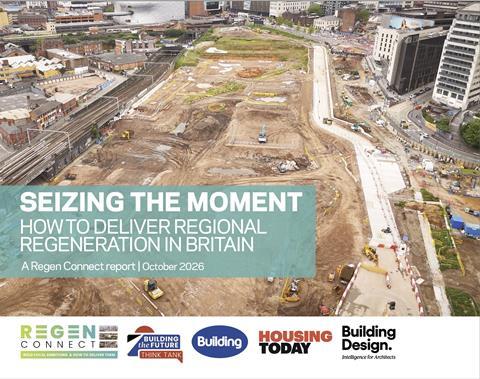
Building’s forthcoming Regen Connect report will examine how Britain can convert renewed political ambition for regional regeneration into viable, deliverable schemes.
Produced by the Building the Future Think Tank after eight months of reporting by Building, Building Design and Housing Today, the report will explore the barriers holding projects back, from fragile viability and fragmented funding to infrastructure constraints and shortages in local delivery capacity.
Drawing on insight from a 12-strong advisory panel, it will set out seven practical recommendations for government, mayors and the supply chain. Seizing the Moment: How to Deliver Regional Regeneration in Britain will launch at the Building the Future Conference on 7 October.

Through ongoing analysis and expert commentary, Regen Connect highlights the policies, funding streams and local priorities that matter most to the construction and development sector.
Click here for more on the campaign
Be part of the conversation – contact us to contribute or get involved by emailing our deputy editor at dave.rogers@building.co.uk and to find the campaign on social media follow #regenconnect







No comments yet