

















Despite the suitable location of the Bedfordshire site as a place for tens of thousands of new homes, the government has yet to formally declare its backing for the project. Joey Gardiner asks why so many questions remain unresolved about the plan for a new town in the area 18 months after Labour came to power
“It is a tremendous opportunity”, says Jas Bhalla, principal at architect Jas Bhalla Works. “You very, very, rarely see this scale of opportunity where different elements come together.”
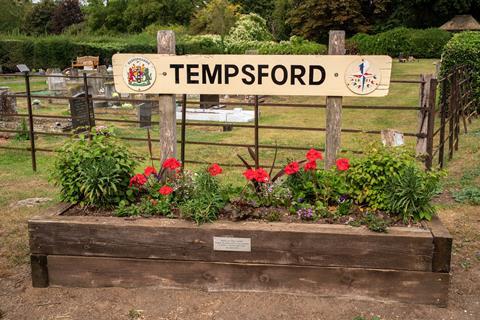
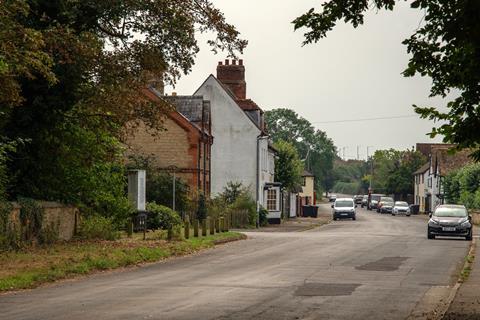
Bhalla is discussing the potential for building a new town at Tempsford in Bedfordshire, currently a one-road village of fewer than 600 people, surrounded by low-lying boggy fields draining into the nearby Great Ouse, and centred on the Wheatsheaf pub.
Bhalla’s practice drew up a masterplan for the 15,000-home development of the area prior to the covid-19 pandemic. Now, it has been named as a potential location for a 40,000-home new town, with the government already picking it as one of its three most “promising” sites.
But it could even go bigger. A report by think tank UK Day One in 2024 said there was scope to create a city “larger than Oxford or Cambridge” on the site, which it said could house 350,000 people and be a “major employment centre” for life sciences.
Tempsford is just one of 12 locations selected for major growth last September by the New Towns Task Force, with two others – Crews Hill in north London and Leeds South Bank – also earmarked as promising for early build out, meaning work could begin before the end of the parliament.
>> Also read: How to build 5,000 homes in Middle England – and keep the neighbours happy
Ellie de la Bedoyere, deputy director of the New Towns Unit within the Ministry of Housing Communities and Local Government (MHCLG), told delegates at a conference in Westminster last year that her team was working rapidly to push ahead on the programme. “The level of government enthusiasm for new towns [is] genuinely unparalleled from anything I have seen in my last 10 years in government”, she added.
Others, however, say that slow progress and siloed working mean opportunities at Tempsford to make the most of the site’s potential to create a great new community are already being missed. And, if Tempsford is the front runner in the programme, what does the progress at this site – or the lack of it – say about the wider new towns programme?
Why Tempsford?
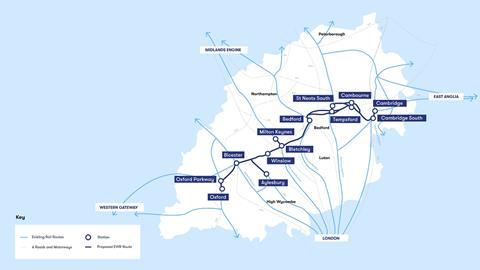
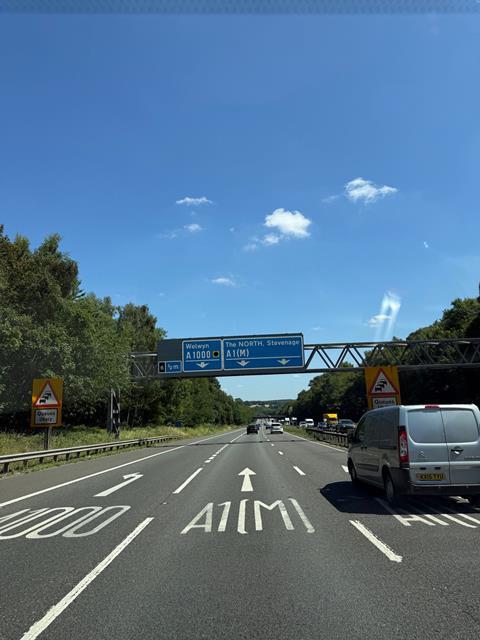
The reason for all this focus on an otherwise unpromisingly soggy stretch of land comes from its proximity to current and planned infrastructure. The site sits next to both the A1 motorway section and the East Coast Main Line railway running north-south down to London and up to Leeds and beyond. Currently under construction is an east-west dual carriageway, the A421, which will take drivers quickly across to Cambridge in one direction or Milton Keynes and Bedford in the other.
But most significant is the promise by the builders of East West Rail, which runs through the site, to put a station at Tempsford, opening it up to become a properly sustainable place in its own accord, not reliant on car journeys. Even groups that you might expect to be opposed, such as Bedfordshire’s branch of countryside charity the Campaign to Protect Rural England (CPRE), see the logic of focusing necessary growth in one location.
“We’re broadly supportive,” says Susan Lynch, a trustee of CPRE Bedfordshire. “There are potentially a lot of advantages to not spreading growth across the county.”
This potential was clear as far back as the end of the last decade, when Jason Longhurst, now UK head of sustainable investment and partnerships at logistics developer Prologis, was executive director for regeneration and business growth at Central Bedfordshire Council. As the official in charge of planning, he tried to persuade members to allocate the site to a 45-70,000 home new town in the local plan, but in the end the leader decided to oppose the idea.
The authority’s current 2015-2035 local plan, adopted in July 2021, ultimately put off any decision about it until after a promised future review – a review which has so far not happened. “We could have had a near perfect plan where close to 90% of the need was met with a sustainable strategic development,” Longhurst says. “But the leader resisted the housing numbers.”
Progress, what progress?
Now the scheme has the backing of the government-appointed taskforce set up to identify locations for new towns, which described it as a “unique opportunity with potential to provide over 40,000 homes in a standalone greenfield settlement”, hailing its “excellent connectivity” and the potential for an “infrastructure-first” approach. Large-scale developer Urban & Civic has an option on a large parcel of land that could form the basis of the scheme, making land assembly relatively straightforward.
However, while the government has described the recommendation as “promising”, it has not formally selected it or named it as a new town location, and for those in the area worried about the future, there is absolutely no clarity at all on what is being planned.
Adam Zerny has been the leader of the council since 2023, when his Independent Alliance grouping won control on an anti-development ticket. Personally representing the Potton ward, which actually covers Tempsford village, he said recently that he had met with ministry officials and that “the government doesn’t yet have a footprint” for the new town, but that it was “clear the government is pushing for as big a development as it can”.
John English, another trustee of CPRE Bedfordshire says: “There’s only 250 homes right now at Tempsford. To say that something like 40,000 might be built, for the people of Tempsford, it’s absolute devastation. They will just be hoping that the government will buy their homes from them.”
CPRE’s Lynch says she needs to know that any new-town homes built will count toward local housing numbers, and assurance that transport and flood defence infrastructure will be provided up front before offering support.
The ministry, for its part, says it cannot provide clarity now because there is due process to go through. Most significantly, that it needs to undertake a programme-wide strategic environmental assessment (SEA) before the government can kick off work in earnest – or leave itself open to judicial review.
So, while progress may not be visible to those outside the ministry and its agencies, officials maintain that work is happening nonetheless. The new towns unit’s De la Bedoyere says that alongside the “very important” SEA, the unit was also “working with delivery partners to really understand the opportunities, [and] the constraints. We’re considering the funding, the economic modelling, the infrastructure gaps, the potential governance, the potential delivery pathways and possible delivery vehicles [that we] need to support ministerial decisions on location selection.”
This work is being done ahead of a formal government consultation on its proposals for the new towns programme, and publication of the SEA, in February, she says. This is designed to then allow a final decision on allocations to be made and published in “spring” this year. The ambition, she says, is to bring forward development “with more ambition, built to last, [but] hopefully built fast”.
However, De la Bedoyere was unable to say when the areas involved might find out what exactly is planned. And where and when vehicles such as development corporations might be set up. “In terms of sort of confirming any timeline, I can’t do that,” she admits.
Missed opportunities
Nigel Moor, a former planning consultant at RPS and a Gloucestershire county councillor with responsibility for planning, is very concerned that slow progress and siloed thinking is already harming the potential for placemaking at Tempsford. He has conducted an in-depth study of the area with professor emeritus Doug Clelland, an architect and former academic at Liverpool John Moores University, and the pair recently gave evidence on the matter to the House of Lords’ built environment committee’s new towns inquiry.
Moor’s main concerns are threefold: Firstly, that the east-west A428 road is being built to go through Tempsford but without any junction or exit into it besides an existing A1 junction some distance to the west; secondly, that the “sclerotic” pace of the East West Rail scheme’s decision-making is hampering any progress on designing a non-car based scheme for the new town; and thirdly, that East West Rail is potentially leaving itself open to judicial review if it does not address up front the environmental impact of the whole development in its forthcoming planning application.
East West Rail has been consulting on a route and location for the station since 2021, and in January last year the government said it was bringing forward delivery of the part of the station which will sit on the East Coast Main Line. However, in the autumn East West Rail said it may no longer issue a final formal statutory consultation imminently, given the new Planning and Infrastructure Act has reduced its obligations to consult, leaving its plans less certain.
On this timescale a station at Tempsford and the rail link to Cambridge is unlikely before 2040
Nigel Moor, former planning consultant
Its autumn statement also made clear that its current preferred route alignment through the Tempsford area would take the proposed station further away from where the centre of the town is likely to be.
“On this timescale a station at Tempsford and the rail link to Cambridge is unlikely before 2040. This needs to be significantly advanced,” says Moor, adding that East West Rail gave “little or no consideration” to the new town at Tempsford in its 2021 consultation.
“Contrast this is the speed that the dualling of the A428 is taking,” he says. “This major road makes no allowance for a junction serving a Tempsford New Town. This can work – but is not ideal.”

Moor is clear what needs to happen. “To date all these agencies have been working in silos,” he says. “Ambition on this scale demands that government wastes no time setting up a specific team” involving existing agencies such as Homes England and the Highways Agency, which could then form the basis of a future development corporation set up to push the project forward.
He adds: “Action on Tempsford New Town now needs priority rather than consultation and process. Time wasted now on resolving issues of governance will only continue the lack of joined-up thinking unfortunately experienced so far.”
Scale of ambition
He is not alone. Others fear the current proposals risk missing the potential scale of growth that could be accommodated in such a uniquely located place. Samuel Hughes, a researcher and co-author of the UK Day One report which recommended building a city of 350,000 people on the site, says the opportunity is there to build something that “could be so much bigger” than the taskforce’s stated 40,000 home community.
However, Hughes says that such large-scale growth could only happen with expensive capacity upgrades to the mainline railway – albeit works which could be paid for out of value capture. “If you had a regular service to London from there, the demand would be almost bottomless. But rail services are already at capacity, so to make it work you have to spend money,” he says.
It requires a level of state organisation, bandwidth and joined-up thinking that I think we’re going to struggle to have
Samuel Hughes researcher and co-author of the UK Day One report
“I suspect this bigger opportunity is one we’re going to miss because it requires a level of state organisation, bandwidth and joined-up thinking that I think we’re going to struggle to have.”
Likewise, Prologis’ Longhurst says he is not convinced that those backing the new town have grasped the opportunity to make it a major employment centre in its right, rather than simply a dormitory suburb serving London, Cambridge or the forthcoming Universal Studios development outside Bedford. “I think they’ve understood the urgency of it, I’m just not sure they’ve got the economic connectivity point yet,” Longhurst says.
“We can’t only talk about housing, or this will just be a bloody dormitory town.”
Wider programme
“The risk,” says Nigel Hugill, chair of developer Urban & Civic which has options on the Tempsford site, “is the process becomes inadvertently extended.” But right now, he says, he remains optimistic about progress.
“I’m very supportive of what the government’s doing and very keen to be involved. We have to have development corporations as quickly as we can, whilst also being in a position to undertake early works in anticipation. That seems to be the intent. I’m not sure how we can go faster than we are.”
Others are less sure. Architect Jas Bhalla says the publication of the taskforce report has generated some momentum – but that will only continue as long as there is solid and evident political support. “We need cross party consensus to ensure an ongoing political mandate,” he says.
“Tomorrow we could have another government, and we need to ensure this project has a life beyond that.”
This links into criticisms of the wider programme made by the House of Lords’ built environment committee last autumn. The committee’s report found that ministers had failed to properly communicate a vision for the programme, leaving it instead to the taskforce. Furthermore, the government needed to set out its approach to funding new towns at the autumn Budget – something it did not do.
One source close to the taskforce told Building that they had definite concerns about a loss of momentum with the programme while the SEA process was being undertaken. In addition, the source said, there were fears that by only committing to get work started on site at three out of the 12 new towns by the time of the election, it might become a de facto three town programme – which wouldn’t be enough to make a transformative difference.
Lastly, the source said they were concerned about the lack of clarity on how new towns will be funded. The taskforce report called for significant up-front funding combined with long-term loans.
De la Bedoyere said last year that “all of the recommendations in the taskforce report around funding, including tax incremental financing, are being looked at” and that there was “lots of interest within number 10 and the Treasury and MHCLG” to come up with solutions. But no final position has so far been arrived at.

Asked if there is any chance of the bureaucracy around the new towns process actually delaying the development at Tempsford, and other locations, De la Bedoyere is adamant that this is being avoided. “There is no chance that they will be slowed down,” she says, “because me and the team are on it.”
She adds that she realises it is “frustrating” she cannot be more definitive about what is part of the programme at this stage. “But I also think the importance of getting this right and doing the proper environmental assessment will be critical to the longevity.”
Samuel Hughes is sympathetic to the ministry over the “frustrating” but genuine legal obligation to undertake an SEA, which is currently delaying progress. But if new towns are to happen at all, rapid progress from here remains vital.
“If Tempsford is well underway by the election, then you can imagine that it will carry on whatever the next government,” he says. “But, if is still at the assessment or the planning stage, then very likely it could just lose momentum and stall and not happen.”
That is something the scheme’s opponents will be all too well aware of.







No comments yet