













In a series celebrating the Building Awards finalists, we look at the Environmental Impact Award shortlist, in partnership with the Climate Group

Earlier this year Building announced the names of all the firms that made it onto the shortlists for our prestigious annual Building Awards.
Now we are shining the spotlight on each category in turn and publishing a selection of the images that impressed the judges.
Today’s shortlist is for the Environmental Impact Award, in partnership with the Climate Group.
Barker Associates (Essex) – for Great British Energy Solar Partnerships (GBESP) / Net Zero Accelerator Programme (NZAP)
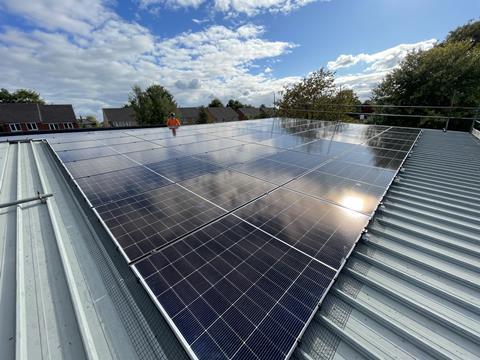
Barker’s work across the education estate demonstrates how data-driven decarbonisation can deliver measurable environmental, financial and social impact at scale. Through the Great British Energy Solar Partnerships and DfE Net Zero Accelerator Programme, its Energy360 methodology has delivered around 398 tCO₂e savings across 25 schools, while 9.5MW of solar PV has been installed across 79 education sites. Energy savings averaged 22.6%, with behavioural change and controls optimisation contributing significantly.
Batch procurement reduced solar capital costs by more than 22%, generating £2.1m in savings reinvested into teaching and learning. Beyond delivery, Barker is helping shape national practice through climate action plans, green skills academies, sector partnerships and knowledge-sharing. Engagement with more than 1,400 students and 269 staff ensures decarbonisation extends beyond infrastructure, embedding climate literacy and environmental stewardship within school communities while demonstrating a scalable model for public-sector net zero delivery.
Gilbert-Ash – for environmental responsibility

Gilbert-Ash has made environmental responsibility a core part of its purpose, with an ESG strategy built around measurable targets, internal accountability and action across its projects, people and supply chain. In 2025, 85% of ESG targets were achieved, while emissions fell 35% across scopes 1, 2 and 3 from the 2022 baseline and 95% of projects used HVO biofuel.
Its collaborative supply-chain approach has supported 180 partners in achieving ISO 14001 accreditation, with 40% providing environmental product declarations. Seven BREEAM-assessed projects achieved strong results, including Outstanding for the sensitive refurbishment of a grade II-listed former police station. Meanwhile, 77.2 tonnes of timber were diverted from waste, saving 38 tonnes of CO₂e. Through training, community partnerships, climate commitments and continual improvement, Gilbert-Ash is embedding sustainability into everyday decisions and raising environmental performance across construction.
HTA Design – for the Queen Elizabeth II Garden

HTA’s work on the Queen Elizabeth II Garden is a remarkable exemplar of climate resilience, transforming two acres of impermeable hardstanding in Regent’s Park into a biodiverse, accessible public landscape. An extraordinary 80% reduction in embodied carbon was achieved by recycling 670 tonnes of concrete on site and creating new growing mediums from construction materials, while 100% of non-contaminated waste avoided landfill.
The garden delivers a 184% biodiversity net gain, with 1.5 acres of habitat, more than 60 new trees and innovative drought-tolerant planting. A fully integrated SuDS network captures rainwater for reuse, reducing pressure on London’s sewers. Shaped by more than 880 public consultees and generating 1,300 volunteer hours, the project combines environmental innovation with meaningful community engagement. Its pioneering approach to soils, planting and adaptive landscape design provides a model for resilient public spaces and shares valuable lessons with the wider landscape sector.

Join us for the 2026 edition of the Building Awards
This year’s event will take place at the Grosvenor House Hotel on 3 November.
There are 19 awards being handed out, so make sure you are in the room for construction’s night of nights and to celebrate excellence.
Tickets are selling fast, so secure your place today.
Mott MacDonald – for the Zero Carbon Accelerator
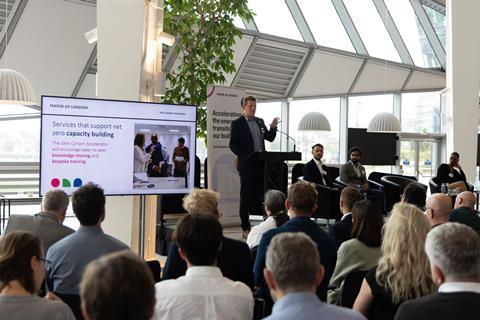
The mayor of London’s Zero Carbon Accelerator, managed by Mott MacDonald with the Greater London Authority and Energy Saving Trust, is helping public sector organisations turn net zero ambition into practical delivery. Its people-centred approach targets complex buildings where decarbonisation can also improve health, comfort and resilience.
In 2025, the programme delivered annual savings of 150,000MWh and 66,500 tonnes of CO₂e across 20 projects, while supporting a pipeline expected to reach 80 live projects. Its Prepare, Plan, Procure, Perform methodology combines technical expertise, commercial strategy, procurement and funding support, helping unlock investment and maximise value from limited public resources. The wider framework, worth up to £150m, reflects demand for its scalable approach.
Building on earlier programmes that attracted more than £250m in capital funding, the ZCA is creating a replicable model for public-sector decarbonisation, sharing knowledge and strengthening capability across London’s schools, hospitals, housing, civic and cultural buildings.
University of East London – for the Living Lab
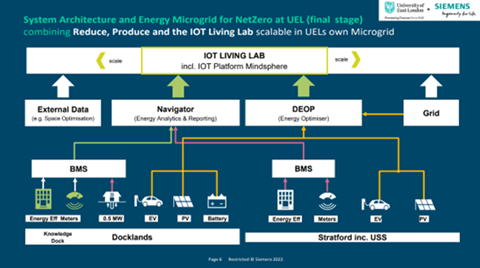
The University of East London’s Siemens Living Lab demonstrates how digital technology can turn a university campus into a testbed for sustainable action. Developed with Siemens, the programme integrates solar PV, EV charging and LED lighting with the Navigator Platform displaying live energy data at the Royal Docks Centre for Sustainability.
The initiative has delivered significant cost and carbon savings while creating a platform for education, applied research, behavioural change and industry collaboration. Its strength lies in connecting operational performance with cultural change, giving students and staff tangible insight into how energy is generated, consumed and managed.
By combining smart technology, real-time data and stakeholder engagement, the Living Lab provides a scalable and replicable model for campus decarbonisation. It demonstrates how universities can move beyond reducing their own environmental impact to actively educating and empowering the next generation to drive wider sustainable change.







No comments yet