

















Housebuilder bought land before lining up partners, leaving cash tied up in ‘balance sheet drag’ boss of partnerships business says
Vistry put growth before ensuring consistency and quality, leaving around a fifth of its sites underperforming, its chief executive of partnerships has admitted.
The housebuilder, which is now embarking on a restructure to become smaller, yesterday announced a pre-tax loss of £660m for the first half of the year.
The losses, which totalled £83.3m when adjusted for one-off writedowns and provisions, were due in part to its decision earlier this year to discount homes to generate cash, as it had £600m of unsold homes in-build at the start of the year.
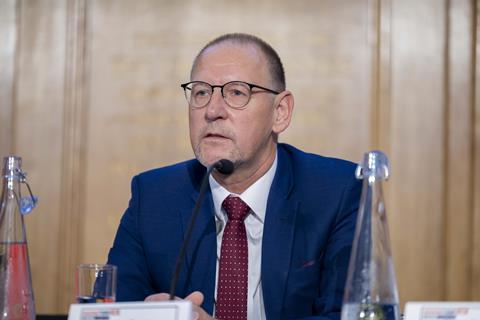
Stephen Teagle, speaking to Building, said 17% to 20% of its sites have been “underperforming” with the problems disproportionately in the south east of England.
Under Vistry’s new plan announced yesterday, it is reducing completions from 15,000 to 12,000 a year.
Teagle, who three years ago said Vistry was targeting 25,000 homes a year, said: “It is entirely fair to say that we have been focused on growth ahead of our focus on consistency.”
He said the firm now wants to prioritise “consistency in terms of quality of homes that are delivered, quality of sales, quality of partner delivery, ensuring quality of financial outcomes, ensuring that what we have is a consistently successful outcome on all of our sites”.
He said Vistry’s problems have tended to be where the firm “hadn’t bought land well” and had not identified its “partner solution” before buying land.
He said: “We may not have identified our registered provider and private rented sector. We may not have identified the right housing mix for those partners […] we may not have put the right transactional terms in place in the way that we work with those partners in order to help us achieve what we need to achieve when we buy the land.”
He said Vistry was left with then trying to find partners after acquiring land, leading to interest costs and what Teagle terms “balance sheet drag”.
He added that in the South-east, Vistry had inherited a large number of housebuilding sites from its predecessor organisations and sought to convert them to lower-margin partnerships sites – where a proportion of homes are pre-sold to housing associations or investors. “We haven’t done a great job of doing that, and that’s partly because the people involved have not had the necessary skills or knowledge of the partnership solution,” he said.
He added as an example that not having partners on board earlier meant Vistry would be left trying to sell larger, harder-to-sell four and five bedroom homes after their housing association and PRS partners coming on board late bought the smaller properties that are easier to sell. “This is how not to run a partnerships business,” he said.
Under chief executive Adam Daniels’ restructure, Vistry will operate in 12 regions instead of 25. It will reduce its land bank from 51,000 to 36,000 plots and ensure a “more selective approach to new land acquisition; increased discipline around capital allocation; and a sustainable management of margins”.
It will focus more on regions where the mixed-tenure model works best, with increased exposure in the North, Midlands and West. In the south east it will move to a fully partner-funded model to reduce open market exposure.
The group said it has identified overhead cost savings of £50m a year as a result of fewer regions, flatter structures and lower volumes.
Teagle said Vistry began a redundancy process with staff yesterday but could not give a figure for how many of its 4,500-strong workforce are likely to lose their jobs. He confirmed around 5% of the workforce has departed the company through its voluntary exit scheme announced earlier this year, under which staff were offered enhanced terms to leave. He said the voluntary exit scheme was a one-off and will not be repeated.
Teagle said lenders had given Vistry a waiver for a breach of its interest cover due to it recognising a £475m accounting write-down of value attributed to acquired businesses.
He said Vistry is fundamentally a strong business and expects to make an adjusted pre-tax profit of £165m this year. The firm was allocated £350m through the government’s Social and Affordable Homes Programme last month.
He said: “Vistry is a very, very good business with a clear differentiated business model from the rest of the sector, and these measures, these one-off adjustments, and the direction of travel will make us absolutely a business that will continue to be working with our partners.”







No comments yet