


















With an eye to the prospect of taking the reins of power, Reform UK has called on former Homes England chair Simon Dudley to help develop its answer to Britain’s housing crisis. He spoke to Daniel Gayne about navigating nimbyism, getting pension funds to invest in affordable housing and reassessing the post-Grenfell consensus on building regulation

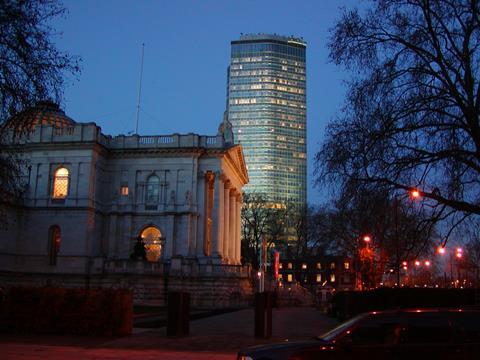
“Sorry about the view,” jokes Simon Dudley as he strolls into Reform UK’s ‘Westminster’ meeting room, so named for its position looking over the eponymous palaces. From the twenty-somethingth floor of Millbank Tower, the nation’s legislative chamber looks uncharacteristically small, practically begging to be conquered. If this is a rather on-the-nose metaphor for the party’s current position of strength, riding high in the polls with the government floundering, the symbolism doesn’t stop there.
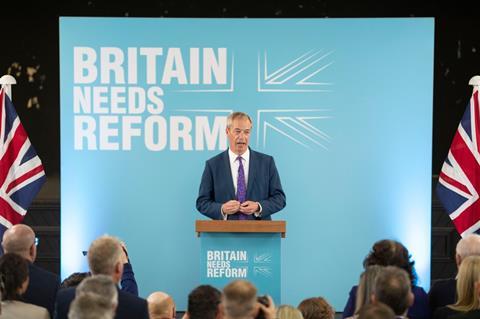
Millbank is as iconic in British politics as a drab, international style office tower can be, having at various times hosted both of the traditional parties of government. In moving here last year, Reform stuck one foot in the door of this rarefied club. Meanwhile the parade of big-name Tories that have joined the party’s ranks since then has only underlined the sense that it is trying to make the move from start-up mudslinger to natural party of government. It’s not for nothing that, following accusations of schoolboy antisemitism, Farage has of late been talking up Reform’s credentials as a “centre-right” party in an effort to shake off the less appealing “hard-” and “far-” intensifiers.
The man I’ve come to interview slots neatly into this phase of development. A long-time Conservative council leader, short-time chair of Homes England and for a number of years the chair of the Ebbsfleet Development Corporation, Simon Dudley is a creature of the right-wing establishment as well as a man with real credentials for the policy brief he has been handed as housing and infrastructure spokesperson. Disillusioned with his former party since 2019, Dudley explains his switch as being about “the future of the centre right politics”, describing a “gravitational shift” after the defection of Robert Jenrick, a close friend whom he had campaigned for in his 2024 leadership bid.
In his new role, Dudley will work with Reform business spokesperson Richard Tice in crafting a policy platform for the party around housing and infrastructure. There is a strong argument that a clear programme on this topic is due. Anyone could tell you what Reform stands for on immigration, but even the party itself has seemed reticent to do the same on housing. Scroll through the ‘what we stand for’ section on Reform’s website and you’ll find 19 policies without a single mention of the subject.
So what does Reform stand for as far as this sector is concerned? Would a Farage-led government rip-up the rule book, or is this really the Tories mark 2?
Same diagnosis, different medicine: How Reform sets itself apart as a ‘pro-development’ party
Straight out of the gate, Dudley is clear about one thing. This is a pro-development party. “This country has got to a point where, for various reasons, it struggles to build things, be it housing, infrastructure, reservoirs, data centres,” he says, blasting the “anaemic growth” and linking it to the country’s “mounting debt crisis”. The YIMBY rhetoric comes naturally to Dudley. Flick through the archives of an outlet like Conservative Home and you can find him railing against spiders apparently halting development and the need to stop invoking the green belt as “sacred scripture”.
But while the rhetoric is strong, it wouldn’t mark him out much from the current crop of Labour party ministers. Indeed, the prime minister himself seems to have cribbed Dudley’s spider anecdote last year for a speech on planning (though the claim in question much-criticised by nature groups).
When I put this to him, Dudley responds that Labour “diagnose” the problem right, but “then apply medicine that actually makes the country sicker”. So what’s Reform’s prescription? In the past, Dudley has described the 1947 Town and Country Planning Act as “one of the greatest handbrakes on growth in the developed world” and praised Jenrick’s tenure as housing secretary, perhaps the most ideologically radical in recent memory with its doomed white paper advocating a switch to a rules-based and zonal system.
We need to be building far more in our cities and our towns around transport nodes
You might imagine then that he will push Reform to rip up the rule book and completely overhaul the British planning system. And perhaps he will – but he won’t commit to it, or indeed much at all, today. “We’re developing the policy position at the moment,” he says, adding vaguely that the party wants “to have a reset that is driven by industry expertise”.
Previous comments give us some idea of what this might involve. Back in February, Dudley wrote in Conservative Home that the next government should “focus on expanding and densifying successful towns and cities, especially in the South-east, through muscular planning reform, including Statutory National Development Management Policies and tougher compliance with local plan-making”.
If this sounds like music to developers’ ears, they should take a look at forecasted election maps before getting too excited. Many of the first seats to flip Reform’s way have been slightly run-down towns whose main struggle as far as development is concerned has been to attract investment in the first place. But if Reform replaces the Conservatives as the primary party of the right, it will also inherit the latter’s rural, and often NIMBY-ish, constituency.
One wonders how much this will weigh on Reform’s approach to this issue, and there’s a slight hint of drift even in Dudley’s comments to Housing Today. “We need to be building far more in our cities and our towns around transport nodes and the like. This isn’t about going and carving up beautiful parts of the green belt,” Dudley tells me. This, I point out, is a bit of a change of tone from the man who, only last July, wrote that much of the green belt was “neither green nor pleasant,” but rather “disused scrubland, fenced-off car parks, and muddy wasteland behind a B&Q”.
[The Tories] thought by getting rid of mandatory housing targets they were going to save themselves in the last general election
In response, Dudley acknowledges that “some of it is not green” and may indeed be suitable for development, while maintaining that “there should be far more [development] in cities and towns”. He says he backs a plan-led system and holding councils to their housing targets and that “allocation of where those houses are is where there is an error”. When I suggest that this would put Reform into the age-old tradition of putting the burden of development on the opposition’s voters, Dudley strikes a firmer tone. “I wouldn’t be in Reform if I thought Reform was not going to be pro-development,” he says.
Drawing on his experience as a councillor, he says that many of those who opposed schemes were homeowners who had time to campaign against new homes. “The voices of people who are anti-development were amplified, and the true picture of what the community thought was not clear,” he says, arguing that what is needed is a more representative process. NIMBYism, he says, is “not where the votes are” and that this is something the Conservatives got wrong. “They thought by getting rid of mandatory housing targets they were going to save themselves in the last general election,” he says. “There are an awful lot of people who want to see change and want an opportunity to buy a home, and you’ve got to take the argument to the community. I’ve always done that, and I would take that argument to any reform candidate. “
A return to deregulation: But how far back would Reform move the pendulum on Building safety?
But planning isn’t the world, no matter how much developers think about it, and Reform’s policies for unlocking development are clearer once you look beyond it. Builders, Dudley says, are being constrained by an “excessively high tax burden” and over-regulation. “If the private sector cannot make money by doing things […] then it’s not going to happen no matter what the planning system is,” he says. Dudley points to the Building Safety Regulator, created as part of a wider policy response to the Grenfell Tower disaster, as something that was “brought in with the best of intention”, but which is holding up development.
While he acknowledges that the fire at Grenfell was “an absolute tragedy” and a “failure of various stakeholders”, his remarks on the topic are much less cautious than politicians in the established parties. “People die on the roads because people drive cars, but we’re not stopping people driving cars. So why are we stopping houses being built because of previous tragic deaths?”
It has been exceedingly rare in the years since 2017 to hear people, whether in politics or industry, talk in this manner publicly and flies in the face of the pro-regulatory consensus that has existed on building safety for nearly a decade. Whether this rhetoric will fly among the general public remains to be seen. It’s worth remembering the Grenfell inquiry’s conclusion that the government’s deregulatory agenda in the years after the Lakanal House fire “dominated [its] thinking to such an extent that even matters affecting the safety of life were ignored, delayed or disregarded”.
Dudley’s analogy itself is a little flimsy. We don’t stop people driving cars due to road deaths, but we do make them wear seatbelts, stop at traffic lights, and abstain from drinking – nor for that matter, is it true that we have stopped building homes entirely. The goal of finding the right balance between maintaining safety while avoiding paralysis is so agreeable as to be meaningless. The political question has always concerned where exactly that balance could be found.
So if, as Dudley argues, “the pendulum has swung too far” on building safety regulations, how far exactly must it shift the other way? This, it seems, is another question that remains to be answered. “In the case of the building safety regulator, can you modify it so it both performs faster, does its job properly, protects people, but doesn’t stop development? Or is the solution which has been arrived at there so incorrect that you need to do something more dramatic with the building safety regulator?”.
People die on the roads because people drive cars, but we’re not stopping people driving cars. So why are we stopping houses being built because of previous tragic deaths?
I ask directly whether “something more dramatic” would mean stripping back post-Grenfell safety regulations, but again Dudley won’t quite go that far, offering only that this is “a policy decision we will arrive at”, before adding: “Clearly we’re very aware of the emotional and political sensitivity around that, given the Grenfell backdrop.”
Another piece of red tape that Dudley is keen to snip is the requirement for developers to build a certain proportion of affordable housing. “At the moment, there is far too high a requirement for affordable housing as part of a development which feeds into viability, which is just stopping all development, so you’re achieving nothing,” he says. “It’s counterproductive”. He also questions whether the £39bn Social and Affordable Homes Programme is “the most cost effective way to achieve affordable housing”.
But if developers shouldn’t be expected to build as much and grant isn’t the answer, how should affordable housing be paid for and built? Dudley’s emerging answer is that for-profits registered providers should build and pension funds should provide the funds. “Something we’re definitely looking at is an amalgamation of the local government pension schemes into a sovereign wealth fund and those investing in affordable housing,” he explains. As the former chair of Square Roots, a for-profit owned by developer London Square, Dudley says he saw that the “major impediments” to his organisation’s business plan was access institutional capital. “If a home cost £250,000 to build and there was an element of grant funding which had to come in for it to be affordable, the net of grant had to be funded through institutional capital. The limiting factor was access to that institutional capital in the affordable housing space”.
Its an answer that rhymes with another of the party’s – its promise in its last election manifesto to launch a new model to bring 50% of each utility into public ownership, with the other half to be owned by UK pension funds. On their face, these kinds of policies sound good. But Dudley might want to take note of the current chancellor’s struggles to get pension funds to bend to her will.
Dealing with demand as well as supply: Reform’s plan to link housing and migration policy
Ultimately, though, supply is only one half of the story for Reform. They also want to reduce demand for housing, specifically by cutting the number of new people entering the country. “If you’re bringing in three quarters of a million net legal migrants in a year, you can never build enough homes to deal with that turbo charge demand,” he says. Dudley seems to be conscious of the chicken and egg problem here, given the UK’s reliance on migrant labour in order to build things in the first place. He says a Reform government’s housing policy would have to be linked to the retraining of unemployed people in order to fill construction roles so that the industry is “not reliant on overseas labour”.
This might raise some weary eyebrows within the industry. Training and improving domestic skills capacity is something the UK has been failing to do for years, and even a successful policy would not take effect overnight. So how do you get from A to B? Here one wonders how far Dudley’s answer would satisfy Reform’s core voters. “There may have to be transition arrangements for certain skills,” he says. “This is something which Reform will be looking at”.
The link between immigration and housing is not just core to its plans for building, but also for allocation. Reform’s ‘Contract With You’ contained the promise to change social housing law in order to “prioritise local people and those who have paid into the system”. Foreign nationals, it said “must go to the back of the queue, not the front”.
Simon Dudley’s CV
2025-2026 | Senior fellow, Onward
2021-2025 | Chair, Ebbsfleet Development Corporation
2021-2024 | Chair, Square Roots Registered Provider Limited
2019-2020 | Interim chair, Homes England
2016-2019 | Leader of council, Royal Borough of Windsor and Maidenhead
2007-2016 | Cabniet member, Royal Borough of Windsor and Maidenhead
2009-2013 | Executive director, Arcapita
2001-2009 | Managing director, fixed income, Citi
1991-2001 | Director, Atlas Capital Finance Limited
1987-1991 | Assistant general manager, Handelsbanken
1985-1987 | Assistant manager, HSBC
It’s the kind of eye-catching populism that has put the party where it is today, and when I ask Dudley if he agrees with it his answer is emphatic: “Totally”. But what, I am curious, does the promise actually amount to? Some foreign nationals, for instance those with settled status or indefinite leave to remain, have the same rights to access social housing as British citizens, while others – temporary visa holders, undocumented immigrants and EU nationals without settled status – do not.
Presumably, then, Reform’s policy of putting foreign nationals “to the back of the queue” would mean giving those with settled status or indefinite leave to remain some kind of negative weighting on the social housing weighting list? Not according to Dudley. With the proviso once again that “this is a policy area that is being worked on”, he says the policy is about how the country deals with the so-called Boriswave of legal migrants who have yet to get indefinite leave to remain. “It should be far harder to get settled status in this country, and therefore far harder to be falling back on the resources that there are in this country,” he says, while stating that those who already have the status should not be deprioritised.

This line may be slightly reassuring to those who have achieved such status, as well as the more liberal end of the British political spectrum, but I wonder (aloud) whether this is really how Reform’s voters, particularly those who might be on a social housing waiting list, would interpret that promise? Dudley says he “can’t speak for all Reform voters”, but that it is “quite a different thing to remove your legal status as opposed to not giving that legal status to a very significant incremental number of people”.
These comments – and arguably Dudley’s appointment itself – fit into the pattern of a party in the process of moderating its message, but its difficult to know how far to take this at face value. Talking right to the electorate and centre-ish to business leaders is a game the Conservative Party has been playing for years, and its ultimate failure to do so successively is arguably what has led to the disillusionment of people like Dudley. But when people like David Cameron and Theresa May do it, the sense is always that their more natural allegiance is to the businesslike centrism.
With Reform, one senses the opposite is true. This characteristics makes the party, along with its peer group of pragmatic right-wing populists across Europe, hard to predict. Political analysts have struggled to categorise Italy’s Giorgia Meloni even after four years in government. So it is with Reform. Everybody expects that they will initiate a sharp break from traditional British politics, but it is harder to say exactly what form this will take, particularly in an area such as housing where they are clearly still working on the detailed policy.
It’s by no means certain Dudley, who plans to run for parliament at the soonest opportunity, will be in Steve Reed’s seat in four years time (“I’ll do what I’m asked to do,” he says when asked if he’d like to be housing secretary). But if he, or a likeminded colleague, does find themselves in that position, it seems that we can expect an emphasis on low taxes, minimal regulation and the primacy of the private sector - which sounds a lot like a return of Thatcherism to British housing policy.
Since the article first appeared, Simon Dudley has been sacked for comments he made about the Grenfell fire







1 Readers' comment