












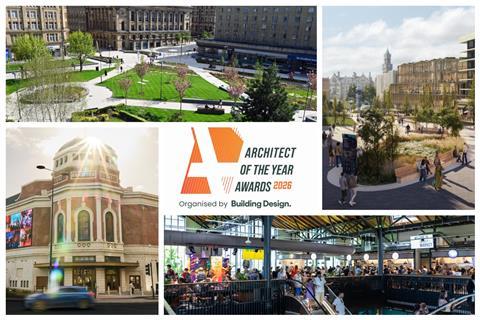
The UK Design Capital of the Year Award recognises and celebrates outstanding leadership in architecture, placemaking and regeneration. Launched in 2025, as part of the Architect of the Year Awards this accolade looks beyond individual projects and buildings to acknolwedge cities showing strategic ambition in shaping their built environment, from long-term masterplans to bold urban experiments.
Across the four cities shortlisted for this year – Bradford, Cardiff, York and Plymouth – architects, planners and civic leaders are testing ideas that could set benchmarks for urban growth across the UK. In the first of this year’s series, Alex Funk takes a closer look at her home city and explores the projects, policies and partnerships driving its transformation
“Bradford’s role in life is to make every place else in the world look better in comparison,” the American travel writer Bill Bryson declared in his 1995 book Notes from a Small Island. Then he added a sting: “And it does this very well.”
For Bradfordians (I count myself among them) the line hurts because it taps into a wider British habit of looking at the city through the lens of decline. But 30 years on, the city’s current regeneration push could be seen as an attempt to rewrite that sentence and shed its down-at-heel reputation.
Backed by its City of Culture 2025 title and record levels of investment in city centre regeneration, Bradford is reasserting itself as a thriving, multicultural metropolis. That ambition has earned it a place on the shortlist for UK Design Capital of the Year 2026 – part of the Architect of the Year Awards, run by Building’s sister title Building Design.
This sense of renewal is reflected in a series of bold projects recently completed in the city, from the reopening of a historic music venue to the creation of a landmark public realm scheme celebrating the city centre.
Building’s sistr title Building Design visited the city to see first-hand how Bradford has evolved and to hear more about the council’s vision for the future.
Identity, heritage and history
Bradford has the fifth largest population of all metropolitan borough councils in England and 30 electoral wards. While some areas are relatively prosperous, 2021 census data shows the district as the 13th most deprived local authority in England and Wales.
“This is a place that deserves – and can show – that it’s got huge opportunities and massive potential, and if we continue to use Bradford as the poster child for poverty and deprivation, it will stick, and that’s not fair on the next generation,” says Jamie Saunders, enabling officer at Bradford council. “It makes some people leave Bradford and never come back.”
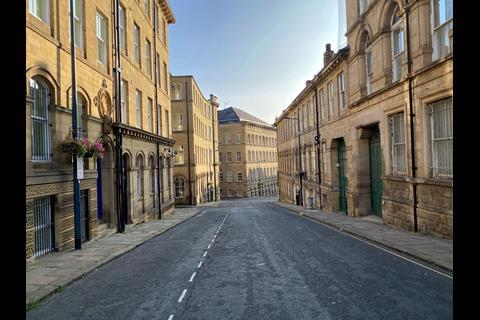
Although the city’s image in recent decades has been linked to high rates of crime, rough sleeping and poverty, many will also know that Bradford was once revered as one of the most prosperous areas in Britain – the remains of its industrial success still visible in its distinctive architecture. Little Germany, an enclave of 85 neo-classical buildings with 55 listed, appears as the backdrop for films and series such as the Peaky Blinders movie The Immortal Man, Downton Abbey, Gentleman Jack and Narnia: The Magician’s Nephew.
During the 19th century industrial revolution, Bradford enjoyed a thriving textile industry and was considered to be the wool capital of the world. By the 1850s, it produced around two‑thirds of the UK’s woollen textiles, creating a class of extremely wealthy mill owners.
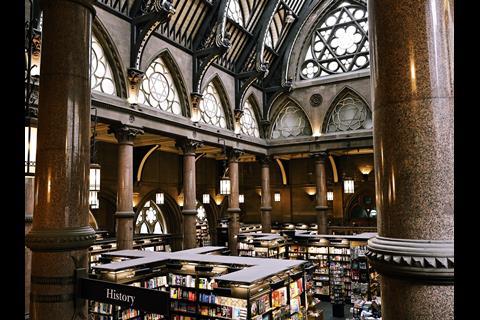
Most notably, the Wool Exchange, completed in 1867, stands as a symbol of Bradford’s success before the industrial decline. The grade I-listed Victorian gothic building, designed by Lockwood and Mawson, reopened as a Waterstones bookshop and cafe in 2013. Its cathedral-like interior means it is often referred to in the media as the UK’s most beautiful bookshop.
As Saunders puts it, Bradford is on a mission to “come out of the shadow of Leeds” – a goal that does not seem too far out of reach. Last year, it was named one of the UK’s 15 “ most talked-about cities” in a study by consultancy ING Media, largely due to its status as the government’s City of Culture 2025.
Bradford took over the Mumtaz Leeds restaurant at the highly-anticipated UKREiiF conference in May this year, hosting a non-stop series of events and lunches across the three days, showcasing its growth and setting out its vision to potential investors. One speaker was Alexandra Depledge, Bradfordian and first ever entrepreneurship adviser to the Treasury, who described Bradford as “a phoenix that rises from the ashes”. This metaphor seems to encapsulate Bradford’s ability to regenerate itself, overcome adversity and emerge even stronger.
Bradford Live: a culture hotspot
With a planning application imminent for a Brit School-inspired college, an up-and-running ballet school, a £6m investment to upgrade the National Science and Media museum alongside the continued success of the iconic Alhambra Theatre, the city centre is looking to attract culture vultures from afar and keep Bradford-born artists close.
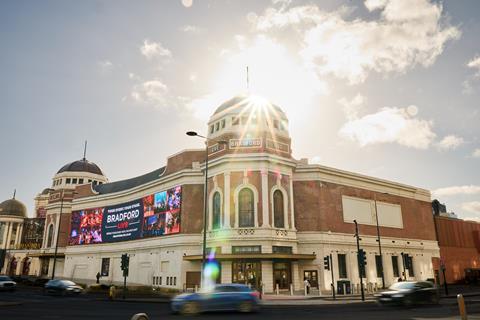
As the city aims to establish itself as a cultural hotspot, the opening of Bradford Live – a 1930s art deco former cinema and concert hall known as Bradford Odeon – may help Bradford to build on its City of Culture legacy.
The 4,000-capacity venue closed in 2000 after opening in the 1930s, hosting performers such as Tom Jones and the Beatles. Tim Ronalds, founding director of Tim Ronalds Architects, the team behind its refurbishment, describes how it was earmarked for demolition after being bought by the council for just £1 to make way for offices.
“The building just stood empty, but there was a growing campaign to save it in the city, which had great, great support,” he says, referencing the campaign led by the Bradford Odeon Rescue Group.
“When we started work on it, we found that they had stripped the inside completely, so the auditorium was made out of the shell of the existing building, which turned out to be incredibly dramatic. So it’s very beautiful brick and steel and timber inside, which has a surprisingly warm feel to it.”
The £50.5m hub opened in 2025, in time for the second half of the year of culture.
Bradford city centre
Arguably the most dramatic transformation in Bradford in the past 15 years is Gillespies’ award-winning City Park scheme. The vision for the city centre landmark was originally set out in 2003 by the late architect Will Alsop in his proposed masterplan to help Bradford recover from decades of socio-economic decline and attract investment.
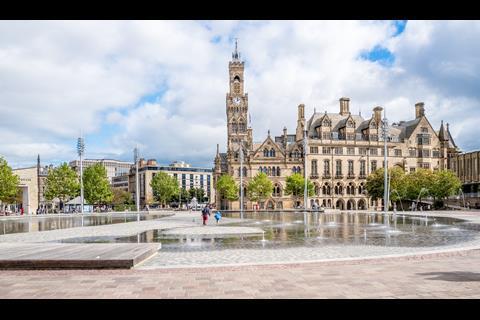
His initial suggestion to remove the 1960s concrete infrastructure near the City Hall and replace it with a large body of water to serve as both an attraction and events venue evolved into City Park, also known as Centenary Square, completed in 2012.
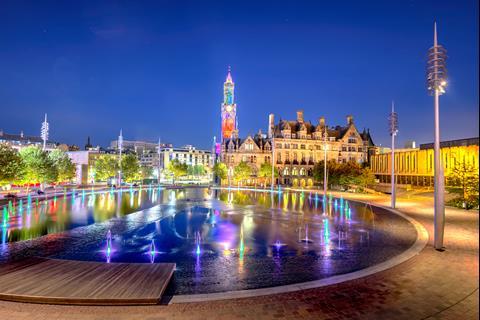
As it now stands, City Park boasts a six-acre Mirror Pool – the UK’s largest urban water feature – which, when Building Design visited during the May heatwave was being enjoyed by children paddling in and around the feature’s 100 fountains and groups of adults lounging at its edges.
At set times, the water recedes to reveal a pedestrian walkway, or drains completely to make space for 10,000 visitors during events. One such event was Rise, which marked the launch of Bradford’s year of culture. It saw 200 performers, including the Bradford-born magician formerly known as Dynamo, and 23,000 attendees over the two nights.
But delivering this public space has been challenging. The city administration was put under severe pressure by 14 years of austerity under previous Conservative governments, resulting in competing priorities and question marks around what to do with the £25m that Bradford gained after selling its stake in Leeds Bradford International Airport in 2006. The conversation that followed, Saunders says, was a “very tough political meeting”.
With need rising rapidly, many politicians wanted the money to go towards frontline social services, but ultimately, Saunders says, the council decided “we need to show that we turn visions into reality”.
This decision encapsulates the city’s approach to “incremental, pragmatic urbanism” which strives to keep up momentum, funding and delivery, despite push-back from members of the public and other councillors.
Even today, some remain sceptical about the city’s transformation, which has been labelled a “vanity project” by its critics. “Elements of Bradford have aesthetically improved without doubt, but it is largely a veneer,” says one sceptic on Linkedin.
“If you drove around more, I am sure you would see some areas have declined. It is a good start and a work in progress, but it will be a marathon not a sprint.”
Saunders gestures to a handful of tents set up by the Bradford court. “We know we’ve got rough sleeping. We know we’ve got extremely vulnerable people in the city centre,” he adds. “You can’t shy away from it.”
Standing next to these tents are two black pipes, serving as the “only evidence” of a £75m private sector investment in a city-wide heat network led by 1Energy and currently under way to connect major buildings in the city centre. It should be operational from autumn 2027.
Meanwhile, Bradford’s planned low carbon hydrogen production facility and the government-backed local industrial decarbonisation plan seek to cement the district’s reputation as a champion of green energy. Earlier this year, the LNER-owned Beryl scheme brought e-bikes to Bradford for the first time – another sign of a city on the up.
Bradford City Village
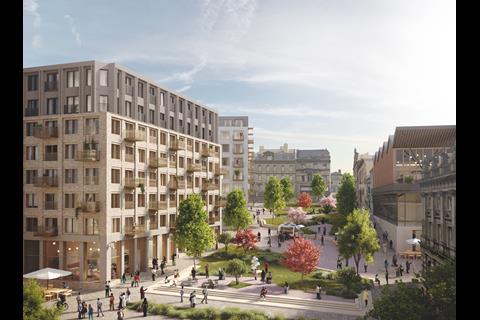
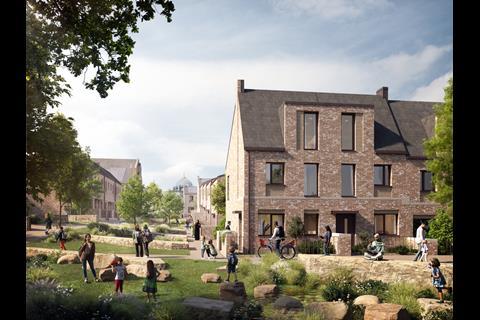
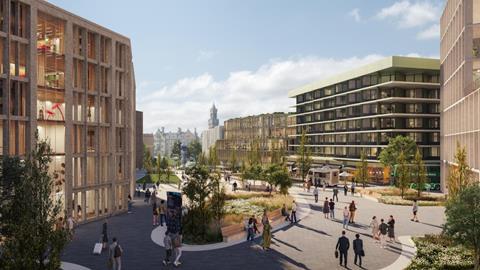
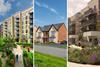
The standout scheme – widely regarded as the most ambitious in the city’s pipeline – is the 1,000-home Bradford City Village, which is being delivered by the council alongside joint venture partnership the English Cities Fund (ECF).
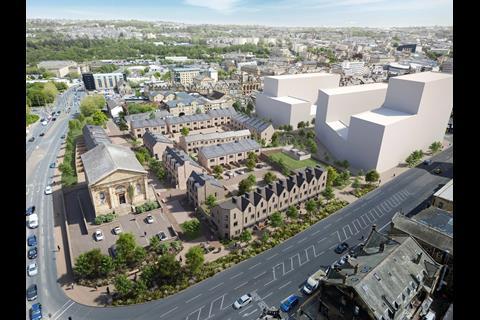
With plans approved in February this year, the 5plus Architects-designed project promises to transform the area that has been home to the brutalist Kirkgate market, Chain Street and another 1970s market – Oastler – into a mixed-tenure neighbourhood.
The scheme’s first phase will see 97 two and three-bedroom townhouses for shared ownership (24 units) and affordable rent (73) delivered by Bradford-based affordable housing provider Incommunities.
“Bradford is a city with a long history of dense and innovative housing layouts, including back-to-back housing in square blocks around yards, or in long rows,” explains 5plus director Paul Norbury. “Back-to-backs accounted for a majority of Bradford’s housing in the late 19th century, but terraced housing prevailed in the 20th century.”
Rather than attempt to replicate the city’s “historic fabric”, Norbury adds that the scheme seeks to “make a positive contribution to the evolving character of the area, reinforcing a sense of place by engaging with the architectural language that defines Bradford’s vernacular heritage.”
Saunders notes that the council is in the process of securing an institutional investor for the subsequent phase “who has never invested in Bradford before”.
Timeline: 60 years of design highs and lows in Bradford
1964: Forster Square redevelopment begins
Post‑war modernisation sweeps away Victorian streets around Forster Square, ushering in an era of large‑scale restructuring that will shape the city for decades.
1974: The Kirkgate Centre opens
A concrete retail block became one of the city’s most controversial buildings.
1983: National Museum of Photography, Film & Television opens
Austin‑Smith:Lord’s landmark cultural building signals Bradford’s ambition to reinvent itself through media, creativity and national‑level institutions.
1986: The Alhambra Theatre reopens
After years of decline and a period of closure, Bradford’s 1914 Edwardian theatre undergoes a major restoration led by Bradford council. Its reopening marks a turning point in the city’s cultural confidence, bringing West End touring productions to Bradford and cementing the Alhambra as one of the North’s premier theatres.
1990: Centenary Square reimagined
Early public‑realm improvements reshape the civic heart of the city, setting the stage for later, more ambitious interventions.
2003: Alsop Architects’ regeneration masterplan
Will Alsop is appointed to produce a bold vision for reshaping the city centre – a sweeping plan that imagines new neighbourhoods, bridges and cultural anchors. Though only partially realised, it becomes a touchstone for Bradford’s regeneration. Some critics branded the proposals, which included flooding parts of the city centre, as unrealistic and overly optimistic.
2001-15: The Broadway saga
A major retail scheme clears a vast site in 2001, then stalls for years, leaving a fenced‑off void that becomes a symbol of frustrated ambition. Chapman Taylor’s Broadway finally opens in 2015, reconnecting long‑severed parts of the centre.
2009: Bradford becomes first UNESCO City of Film
A cultural milestone that reinforces Bradford’s identity and helps to justify investment in public realm and heritage.
2012: City Park completes
Inspired by Will Alsop, Gillespies’award‑winning public space opens, instantly becoming Bradford’s most successful piece of contemporary urban design and a catalyst for renewed civic pride.
2013: Wool Exchange reopens as Waterstones
The grade I‑listed Victorian gothic building is reborn as a bookshop and cafe, becoming widely known as “the UK’s most beautiful bookshop”.
2025: Norfolk Gardens opens
A £45m pedestrianisation project replaces one of West Yorkshire’s busiest dual carriageways with a peaceful 10,000sq m park, winning multiple design awards.
2025: Bradford Live reopens
The 1930s art deco former cinema (Bradford Odeon) reopens as a 4,000‑capacity venue after a £50.5m refurbishment
2025: Darley Street Market opens
A £32.3m, three‑storey market designed by Greig and Stephenson Architects replaces two ageing markets, bringing traders into a modern civic building and revitalising the top‑of‑town area.
2026: Bradford City Village approved
The 1,000‑home regeneration of Kirkgate Market, Chain Street and Oastler Market receives planning approval, with demolition works being carried out this year. Phase one (97 homes) begins, backed by WYCA and Homes England.
2027: City-wide heat network due to become operational
1Energy’s £75m low‑carbon heat network set to start operating, connecting major buildings across the city centre.
He explains how the demolition of Kirkgate Market and the project’s design seeks to “heal the city centre” and reintroduce old street patterns that will create visibility and engagement, sewing together modern flats with the alleyways and ginnels, or passageways, typically seen in Victorian cities.
James Dinsley, senior development manager at Muse Places, part of ECF, alongside Homes England and Legal & General, describes the scheme as a “model for economic regeneration”.
He explains how the project aims to respond to shifting consumer patterns catalysed by the introduction of The Broadway shopping centre in 2015, which caters for most retail needs and also includes a cinema. This, in turn, caused footfall around the markets at the top of town to taper off.
The Broadway was used by some critics as an example of Bradford’s poor track record with development. The site currently occupied by the mall was an infamous “hole in the ground” for the best part of a decade, with delays resulting from the financial recession.
Sceptics of the new City Village have expressed concerns around timelines and practical issues, such as parking and the impact of development on local businesses, when Kirkgate hits the ground.
“Bradford has had to manage low opportunity,” says Dinsley. “There is visible antisocial behaviour in areas of Bradford and, through economic regeneration in the form of putting a critical mass of new people and new residents into the city centre, it gives people a sense of pride in their city again, which I think is massive.”
These new city centre dwellers, ranging from families and young professionals to older people who want to be on the doorstep of Bradford’s amenities, would – so the theory goes – boost the daytime and night-time economies.
Dinsley also points to the knock-on regeneration that may come from instilling confidence in private investors, which could then spill into the rest of the city’s “fantastic heritage buildings”, as “one of the biggest positives”.
The next phases of the scheme will provide build-to-rent flats, placing residents looking for a “high quality couple of years living in the city centre” alongside homeowning families, to “provide opportunities for people to be part of the city centre”.
Meanwhile, space at ground-floor level could be used to meet the usual community needs through a nursery or GP practice, and could also encourage Bradford’s “young, vibrant demographic who are entrepreneurial in spirit” to open hospitality venues of their own.
However, a major development like this was bound to evoke some concern. Dinsley describes how the public took time to warm to the ideas presented through each stage of consultation as the developer amended plans in light of feedback.
Many residents felt attached to the Kirkgate Centre and its history, so Muse’s design and planning team and the council are aiming to preserve and restore the medieval Market Cross in the new scheme to honour the symbol of Bradford’s trade heritage alongside large-scale concrete murals created by renowned sculptor William Mitchell.
The project is supported by major inward investment, including £13.1m funding in principle from the West Yorkshire Combined Authority (WYCA) and £30m of government cash via Homes England.
Darley Street Market
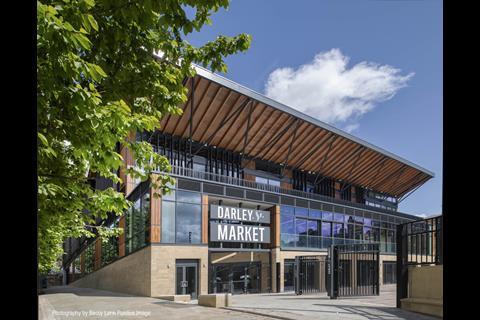
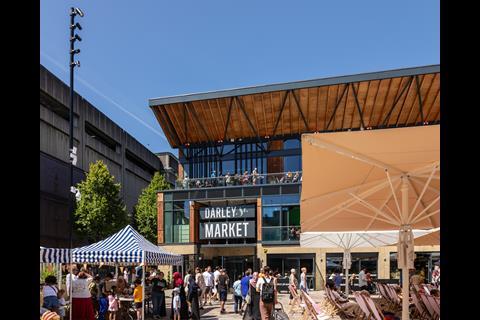
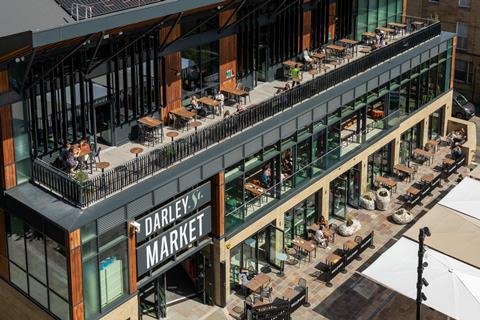
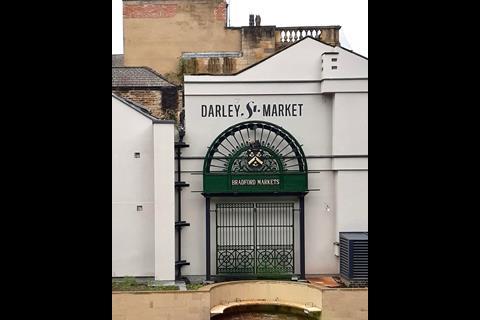
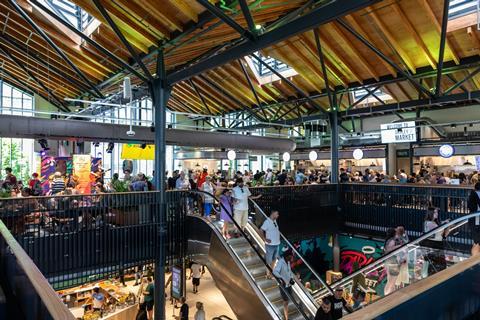
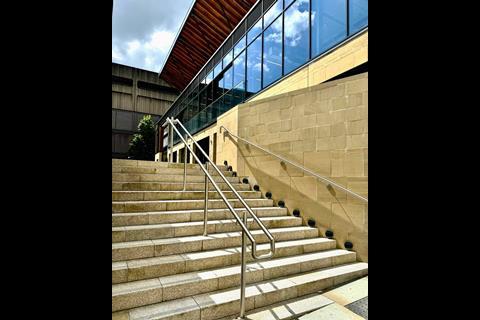
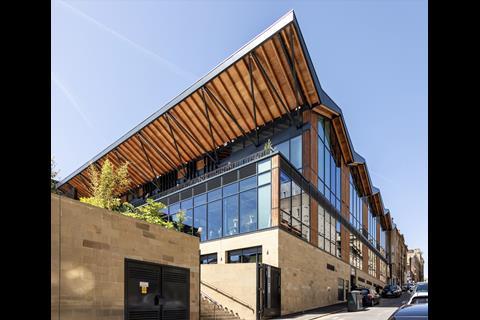
Darley Street Market, which opened in July 2025, will be one of the fixtures serving the future residents of Bradford City Village. The £32.3m project, designed by food market specialist Greig and Stephenson Architects, was a strategic move to bring life back to the top-of-town area and find a new home for traders from the two soon-to-be-demolished markets.
Across the three floors, visitors can find bling, fresh fruit and veg, butchers, coffees, pastries, wine, cheese and everything in between. The venue also plays host to conferences and events in its courtyard, which can be enjoyed from the viewing platform on the rooftop.
“It’s not just what you think of as a traditional market, it’s this marketplace of activity as well,” says Adam Parker, director at Greig and Stephenson Architects.
Parker credits the council with having a long-term vision for a civic building that promotes “investment, job creation and social cohesion. Not many local authority projects around the country set that level of ambition for a public market building,” he adds.
He notes that the market attracts a “cross-generation mix” and that a number of traders report that “business is booming”.
However, the demolition of Oastler and Kirkgate markets caused quite a stir, with local media widely reporting that traders and shoppers alike were put out by the closure of buildings that many considered to be an important part of Bradford’s identity. While many business-owners ended up making the move to the modern market, some described the new space as too congested and raised concerns over higher rents. Consumers said they would miss the affordability of products sold in the original markets.
The opening of the new hospitality venue was delayed by around 18 months, which some traders complained further exacerbated problems in the disused markets. The council also received criticism from the public and opposition councillors for not disclosing the £7m overspend on the market until after it opened. The council said the figure was commercially sensitive and sharing it earlier could have damaged ongoing contractor negotiations.
Public realm and transport
Bradford’s transformation extends beyond specific buildings and schemes. It can be seen in the public realm which connects the city to itself and the vision for new transport that will connect it to elsewhere.
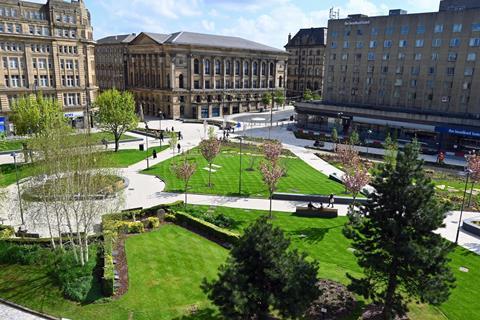
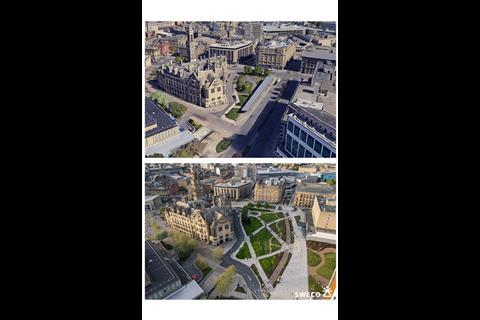
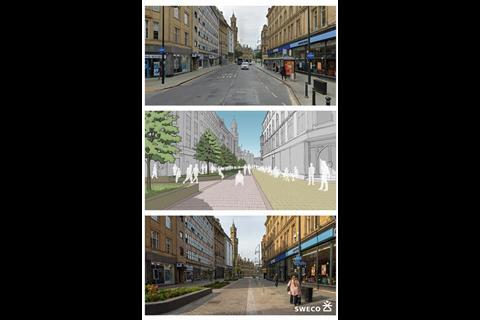
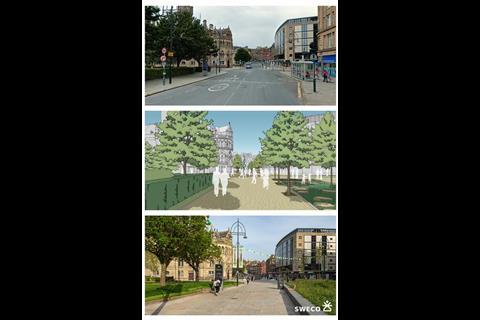
The Norfolk Gardens project has replaced what was once a dual carriageway, described by Saunders as “one of the busiest, most dangerous roads in West Yorkshire” with “one of the quietest, most peaceful places to have a picnic”.
Its 2025 opening marked the completion of a £45m city centre pedestrianisation project, delivered by the council and WYCA with funding from the government’s transforming cities fund.
The 10,000sq m park delivered by Balfour Beatty is decorated with a wide variety of trees, shrubs and plants with a sustainable urban drainage system alongside benches, new cycle and walking routes and green space for children to play. It has won several accolades, including the healthy city design award at the international Healthy City Design Congress and national infrastructure project of the year at the Constructing Excellence awards.
An unintended benefit of the scheme is the reports of improved sound quality for audiences watching performances at St George’s Hall – the 1853 Italianate-styled Victorian concert venue.
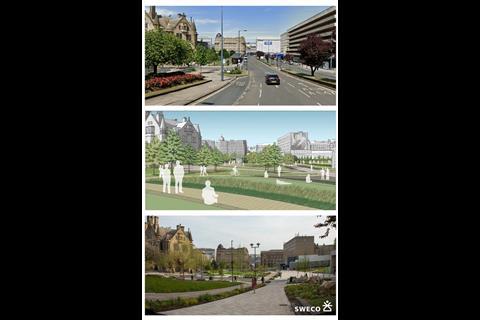
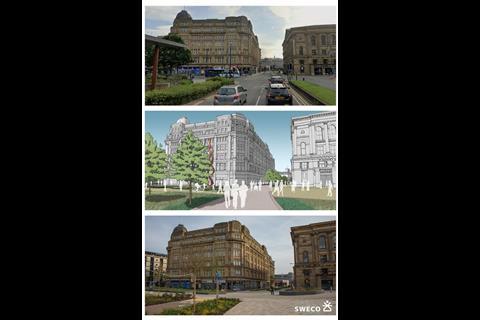
Meanwhile, the council has worked with Bradford Civic Society and Keighley designer Jimmy Smith to replace many of the city centre’s street signs, including all those that are part of the heritage action zone, with a new black “heritage” design created by the foundry that produces the City of Westminster street signs. Small details like this, says Saunders, show that the city is “taking care of itself”.
Opposite Norfolk Gardens is the public transport interchange and the area involved in proposals to double the size of Bradford city centre through the 5,000-home Southern Gateway scheme.
The plans, developed by the council, the government and Arup, would see around 126ha of industrial and brownfield land turned into mixed-use neighbourhood and new public realm.
This major regeneration project is underpinned by the creation of a new train station, new bus station and a Leeds to Bradford tram line that would connect the cities in a 12-minute journey. This tram line would form the first phase of a wider mass transit system that could also connect Bradford to Manchester within 30 minutes.
The government is due to make a decision on the business case for a new rail station this summer as part of the £45bn Northern Powerhouse Rail programme.
With WYCA bankrolling Bradford’s new bus station, the aim is to “bring the district back together again” because progress “isn’t just about Bradford city centre,” Saunders emphasises.
The vision for a well-connected city is part of the Bradford Built Different initiative – a regeneration and growth plan covering 2025-35 aiming to transform Bradford into a leading UK core city through culture, infrastructure, skills and sustainable development.
Bryson’s passage about Bradford ends: “In any case, the mills went, the offices grew dark, the once-bustling Wool Exchange dwindled to a dusty nothingness, and now you would never guess that Bradford had ever known greatness.”
If Bryson once saw a city that made everywhere else look better, Bradford is now trying to prove the opposite: that a place synonymous with decline can become a test case for civic repair. The question now is whether the pipeline of new development and regenerative efforts around education, social cohesion, transport and affordable housing will reawaken the district’s former greatness.
Other key players
Re‑form Landscape Architecture
Landscape designers for City Village and contributors to wider public‑realm improvements.
West Yorkshire Combined Authority
A crucial funding and policy partner, supporting transport, public realm and economic regeneration projects across Bradford. Saunders says devolution has been vital for Bradford’s revival.
Sweco UK
The engineering, design and environmental consultancy which helped to bring Norfolk Gardens to life by leading the production of the outline and full business cases. It advised on urban development to help enhance connectivity and infrastructure, encouraging walking, cycling and bus travel as the preferred options for local journeys.
Balfour Beatty
The main contractor delivering Bradford’s flagship City Centre Walking and Cycling Improvements Scheme, including the transformation of Hall Ings, Market Street, Bridge Street and the creation of Norfolk Gardens.
Kier Construction
The main contractor behind the delivery of Darley Street Market.
About the UK Design Capital of the Year
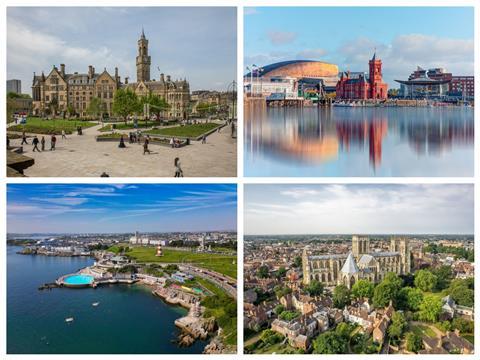
UK Design Capital of the Year is an award run by Building’s sister title Building Design as part of the Architect of the Year Awards. Now in its second year, it recognises cities leading the way in architecture, placemaking and regeneration - looking beyond individual buildings to celebrate places where strategic ambition is reshaping the built environment.
Bradford, Cardiff, Plymouth and York have been shortlisted for the title this year. Over the coming months, our editorial team will visit and profile each city in depth, speaking to civic leaders, clients and designers to assess the strength of their urban strategies.
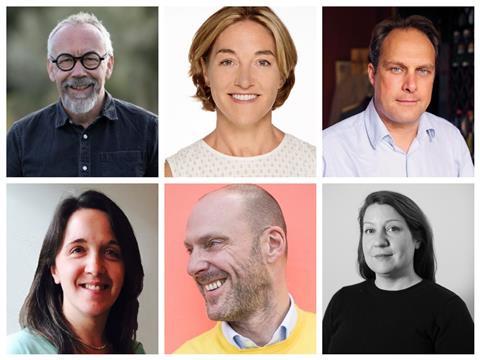
A high-profile panel of built environment experts first helped identify the shortlist; they will reconvene later in the year as final judges. Cities are assessed against five criteria: strategic vision and leadership; quality of design and placemaking; delivery and momentum; innovation and experimentation; and regeneration and economic transformation.
The winner will be announced at the Architect of the Year Awards ceremony on 7 October. Last year’s inaugural title was awarded to Manchester.


No comments yet