


















Schemes in London already subject to rules but new guidelines to extend requirement outside capital from 2029
Evacuation lift cores will be required in all high-rise residential buildings in England from 2029 under the government’s latest proposed amendments to fire safety rules.
A consultation published yesterday on revisions to Approved Document B, the main guidance document for fire safety in buildings, has outlined a series of planned changes which strengthen existing rules.
Currently, at least two common stairs are required in all buildings in England taller than 18m which contain at least two dwellings.
However, full evacuation cores in addition to a building’s main lift core are only compulsory in London under revisions to the London Plan made in 2021.
The latest tweaks to Approved Document B would extend the requirement across England, potentially impacting high-rise residential developments in northern cities including Manchester and Liverpool.
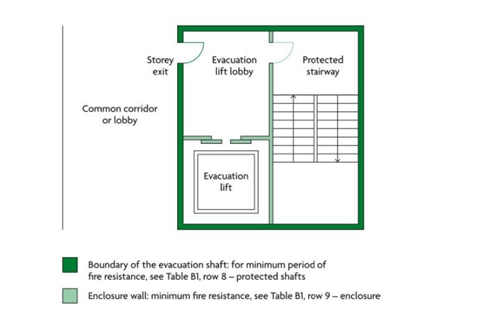
A compliant evacuation core would need to contain an evacuation lift, an evacuation stairway and a secure evacuation lobby on each floor which provides access to the lift in the event of a fire.
Under the proposed changes, each evacuation lobby would need to provide a “protected area for those waiting for the evacuation lift, have direct access to a protected stairway and not be directly accessible from any flat, maisonette, storage room or electrical equipment room”.
An evacuation lift lobby could serve multiple lifts within the same evacuation shaft, according to the consultation, although an escape route could not pass through an evacuation core to another evacuation shaft unless the two are adjacent.
Both the evacuation lobbies and evacuation lifts would also need to contain an emergency voice communication system which is separate from the building’s intercom system.
The lifts themselves could be no smaller than other passenger lifts serving the building, and contain enough space for at least one wheelchair user and an accompanying person.
Evacuation lifts in buildings designed with a stay-put strategy could also serve a dual purpose as firefighting lifts, provided they meet the minimum design and installation provisions for both functions.
Other proposed changes include smoke control systems within buildings above 18m to keep protected stairways remain safe and usable, and to ensure smoke entering the area is “removed rapidly”.
Smoke control systems would also need to keep common corridors and lobbies free of smoke, and should be designed to draw smoke away from evacuation shafts and stair enclosures.
It is understood the changes could have a significant impact on MEP firms due to the need to add new smoke egress systems to each floor of a building.
The consultation also proposes consolidating guidance on extensions to existing buildings, with duty holders required to assess the broader implications to an existing structure if an extension is added.
This includes considering whether upgrades are needed to the existing building in the event that an extension, or even small changes, has changed the fire risk of the entire structure.
“What may appear to be a minor modification can introduce new risks and significantly affect the level of safety in the building. Dutyholders should therefore assess the broader implications of the work, including its interaction with existing fire safety measures,” the consultation says.
The consultation is set to run for 12 weeks until 17 June, with any new rules proposed scheduled to come into force in September 2029 following a transition period.







No comments yet