











A recent roundtable, hosted in partnership with Siniat, tackled the complexities of fire damper specifying – and explored how fire protection specifying needs to change in the light of the Building Safety Act. Mary Richardson reports
Fire safety remains one of the most scrutinised aspects of building design – yet when it comes to the specification and co-ordination of fire dampers and firewalls, confusion and inconsistency continue to put compliance, project timelines and, ultimately, lives at risk.
With the Building Safety Act placing clear legal duties on those responsible for design, getting this right has never been more critical – making it an ideal moment for the industry to take a hard look at current practice and how it must evolve.
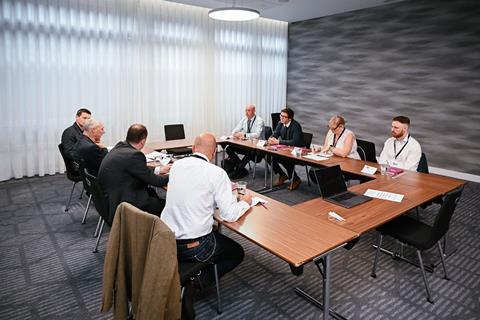
Recently, key voices from the fire-protection world came together for a discussion, chaired by Building’s Thomas Lane, to discuss how fire damper and firewall specification can best be co-ordinated to achieve true compliance.
Inadequate specification of fire dampers, and misunderstandings about how they fit into firewalls, is an ongoing issue that often creates delays – and, more importantly, has the potential to compromise fire protection.
“The biggest thing to remember under the new regime is that if you’re legally responsible for design, you’re legally responsible. You can’t contract that away.”
Paul McSoley, PMCSTech Consult
It’s an area where improvements in practice are needed, particularly in the light of the new responsibilities introduced by the Building Safety Act. Our expert panel looked at what can go wrong and what best practice ought to look like.
Paul McSoley, director of PMCSTech Consult, said: “The biggest thing to remember under the new regime is that if you’re legally responsible for design, you’re legally responsible. You can’t contract that away.”
Choosing the right damper
First the group discussed the complexities of choosing the right fire damper. They agreed that specification must be performance-driven and start early.
“Fire dampers don’t all come in the same shape and form,” said McSoley. “They each come with inherent performance… and what you need depends on what risks you’ve got in your building.”
He warned that relying on generic requests such as “a fire damper” when specifying is inadequate.
“If you’re going to change something, have you got the competency to say, ‘if I make that change, it’s not going to fundamentally affect the building’?”
Steve Warriner, Siniat
Product choices must be made with reference to risk and performance, adding: “And don’t forget about damper cycling: a 300-cycle damper would be no good in a 25-year build where the dampers are tested every week.”
Liam Nevins, product technical manager at Trox UK, added, “As well as how many minutes it needs to be, whether it should be insulated, its integrity and smoke leakage, you need to know whether it should be a fusible link, motorised…what type of accessories… if it is in an ATEX-rated environment where there’s an ignition risk.”
Good practice
McSoley recommended BESA’s DW145 Installation and Maintenance of Fire Dampers: A Guide to Good Practice, which he helped to develop.
He said, “It covers all the damper frame types and gives a prescriptive process to look at all the different risks you may come up against. You need to look at what damper performance is required in each specific situation in the building. Also, if a risk condition changes, you’ve got to recheck the performance. If a room changes in purpose during the design stage from a storeroom to a kitchen, say, then you’ve got to check again that you’ve still got the right damper.”
Early engagement and accountability The panel agreed that communication between engineers, architects and manufacturers is crucial.
“The building services engineer is probably the chief accountable protagonist,” said McSoley. “Ask the manufacturer what they have that meets your performance requirements – and it could be as many as 30 different things you need to declare in performance, whether that’s a classification, atmospheric, blast… What you can’t say is just ‘give me a fire damper’.”

Craig Abbott, technical director at FSi Promat, said: “Look for manufacturers that are going to work together, and look for manufacturers that are going to take responsibility for what they do.”
James McNay, divisional director for fire safety at Stantec, also emphasised the importance of collaboration: “As fire engineers, what we care about is: What kind of fire do we anticipate here? What will the outcome of that fire be? What’s your fire load? How can that spread? Where are your safety-critical areas of the building? Where are the areas where it’s simply unacceptable for fire and smoke to get to? Then we come up with a specification of what we need the system to do. But we don’t know the specification of individual products, so there needs to be an early discussion.”
Leaving it too late
Steve Warriner, head of specification at Siniat, said the biggest challenge comes when “none of these elements are talking to each other early enough. You’ll get to RIBA stage 4 or 5, then when they bring the elements together, they find they needed a double-boarded system for this damper, not a single-boarded.
Meanwhile, even though designers might have put a design in place, you’ve got a subcontractor going, ‘Let’s see if I can get that damper cheaper,’ or ‘I want to change the wall out.’ You need that earlier engagement to stop all that.”
“The Passive Fire Knowledge Group… was set up by the tier 1 contractors so they could get in a room together and discuss all these challenges collectively.”
Alex Double, AD Design Consultants
McSoley said: “If you’re going to set the wall and say everything else – flues, glass screens, fire doors, pipes, busbars, fire dampers, smoke control dampers – all has to work with it, then you’ve got that sequence the wrong way round. What we should be doing is considering all the different walls that this stuff needs, then going to the wall supplier and saying, ‘We’ve got all these different requirements for walls, what is the sweet spot?’”
McNay stressed the importance of early design engagement: “If it’s late in stage 4, there is very little a fire engineer can do… If it’s stage 2, we can design around it.”

And he reminded the group that all these decisions must be recorded: “You have to justify it… document it and put it in the digital record.”
Alex Double, managing director at AD Design Consultants, said: “If we’re talking about collaboration, I want to give a plug to the Passive Fire Knowledge Group. It is an organisation that was set up by the tier 1 contractors so they could get in a room together and discuss all these challenges collectively. They have a lot of good knowledge-shares on their website. It’s free information as well.”
The perils of value engineering
McSoley warned, “If you don’t go through that performance loop and do that bit of early engagement, then you get into value engineering… There’s a belief still in the quantity surveying world that the value’s in the market. So, if you want to get value, you keep going out to tender to get the best price. But you can’t do that if you don’t actually know what performance it’s based on.”
Warriner said: “If you’re going to change something, have you got the competency to say, ‘if I make that change, it’s not going to fundamentally affect the building’? I don’t think enough people in the design process understand that if you swap something out based on price, you are taking on that responsibility.”
He added: “You have made a design decision, and that could come back to bite you. If you draw it out and say ‘do this’, you’ve become a designer – an unintentional designer.
“If you get a design that isn’t quite good enough and the guy with the pouch on and the screw gun does what he thinks is right, he’s now become the unintentional designer. Don’t fall into that trap. It should be somebody on CAD drawing up exactly what needs to be built, then the subcontractors should build exactly what’s been detailed.”
Interface issues
Interfaces between dampers and walls remain a major complication. Alex Double, managing director at AD Design Consultants, said: “The interfaces are an issue with dampers, because the detailing needs to be very specific – because you have maybe a flange fitted and, if you put multiple layers of board in the opening, your flange maybe can’t then fit into the metal of the design.”
McSoley added: “The screws have got to hit the metal track. If you put too many layers in, you end up with the screws in the plasterboard.”
“If it’s late in stage 4, there is very little a fire engineer can do… If it’s stage 2, we can design around it.”
James McNay, Stantec
Abbott noted: “As soon as you throw fire stopping into the mix, you’ve got infinitely more possibilities. For us at FSi, we refer back to the damper manufacturer – because it’s a system test that looks back to the contribution of the interface materials for the air leakage in conjunction with the damper.”
On this point Nevins agreed, syaing: “At that point our test as damper manufacturers would take precedence. We’d specify everything from the fire bat, the mortar, whatever seal we’re using, to how we line the opening out. That would come from our data.”
Standards and classification
The discussion turned to the role of standards and classification. Abbott noted how long standardisation has taken: “To develop BS EN 1366-3, the penetration sealing European Standard, took us 10 years. It was a battle of attrition, and it has ended up about 270 pages long.”
McSoley added: “Meanwhile, UK construction is racing off at 100 miles an hour developing new methods of construction. That’s one of the big issues: it takes so long to get these standards written.”
Warriner highlighted the value of classification: “Partitions in the UK always worked to BS 476. Now we’ve moved over to EN 1364-1… What helps link everything together is getting all our partitions classified.”
The panel agreed that classification reports provide clearer assurance than raw test data. “We’re still stuck in a world where everyone asks for the test report,” said Warriner. “But actually the test report puts a lot of responsibility on you as an individual. The advantage of a classification report is experts have done the work, and that derisks it for you as an individual. The classification protects everyone – the consultant, architect, main contractor, manufacturer.”
Abbott noted: “Test reports in isolation don’t paint the picture… it’s the classification, the European Technical Assessment, the third-party certification document, that’s what you should be asking for.”
Digital tools and progress on co-ordination
Lane asked whether digital tools could simplify co-ordination. McSoley replied: “With BIM, the issue is the level of detail… It’s very hard to represent the level of detail required.” Double said BIM is currently most useful for clash detection.
Despite the limitations of digital modelling, there are signs of progress. Nevins observed: “With little contractors, you’re still seeing ‘give me a fire damper’ and ‘here’s a size’. If we had collaboration at design stage, they’d be able to say with confidence, ‘this is what I need’.”
Double was cautiously optimistic: “The situation is getting better. The improvement is starting at the top with the tier 1 firms. I’m seeing that earlier engagement an awful lot more. I’m sitting down with architects reviewing elevations of walls with penetrations. That never happened years ago.”
While challenges remain around detail, consistency and collaboration, the growing focus on early engagement, accountability and information-sharing suggests the industry is finally moving towards a more joined-up approach to fire safety design and specification.
Around the table
Chair: Thomas Lane, technical editor, Assemble Media Group
Craig Abbott, technical director at FSi Promat
Alex Double, managing director of AD Design Consultants (ADDC)
Paul McSoley, director of PMCSTech Consult
James McNay, divisional director for fire safety at Stantec
Liam Nevins, product technical manager at Trox UK
Steve Warriner, head of specification at Siniat