














With construction regulations tightening, Tobermore is evolving its structure, creating senior roles, and building on its existing technical expertise to deliver effective and compliant solutions for customers. Sales director Anna McAleer explains how the company is adapting operations, supporting housebuilders, and embedding a culture of internal growth to stay ahead in a changing industry.
As pressure to deliver projects to a higher standard increases and projects themselves grow more complex, manufacturers are increasingly expected to support specifiers, contractors, and housebuilders — not just with products, but with technical and design guidance and compliant solutions.
For Tobermore, making this support more accessible has been central to its recent organisational evolution.
Anna McAleer, recently appointed sales director, discusses her career journey, the company’s Create & Construct platform, and how it is helping customers achieve compliance in a shifting regulatory landscape.

Tell me a bit about yourself and your career journey so far.
Anna McAleer: I joined Tobermore in 2014 after coming back from Australia, and if I’m honest, I didn’t really know what I wanted to do at that point. I wasn’t sure about the sector, but I decided to give it a go and quickly found I loved it.
At the time, Tobermore had a very flat management structure, which worked extremely well. Because of that structure , I didn’t really think about progression. Ten years on, the business has grown and evolved and I’m incredibly proud that my career has grown alongside it.
I’ve gained invaluable experience in different roles in the specification team, which has helped me to really understand our customer journey, before moving into more strategic sales roles, which has culminated in me becoming sales director alongside Lee Blackburn .
Tobermore has undergone a significant organisational restructure in recent years. What’s driving that change?
McAleer: We’ve gone from thinking of ourselves as a small company to recognising that we are now a large business, with many more people and divisions operating across the organisation. With that scale comes the need to manage teams more effectively and most importantly, make sure the business remains ready to listen and align to market needs.
The restructure is a positive reflection of that growth. It’s about putting the right leadership and support structures in place to match not only where the business is today, but also where it plans to go in the future.
You’ve recently been appointed as one of Tobermore’s first sales directors. Why is now the right time to introduce roles like this?
McAleer: As the business grows, clear leadership across functions becomes essential. We now have so many more people and so many more divisions working together that having defined roles like sales director helps ensure consistency, accountability and focus. That in turn means we can continue to support our customers as they design, build, and supply the materials for their projects.
It’s also a really positive signal internally. It shows employees that there are genuine opportunities to progress as the company grows, which is hugely important for engagement, retention and our culture as a business.
The restructure has involved a high level of internal promotion. What does that say about Tobermore’s culture?
McAleer: It shows how invested we are in our people. Developing from within has always been important to us, and promoting internally helps protect our culture as we grow.
People stepping into new roles already understand how we work, how important our customers are and what Tobermore stands for. That continuity is incredibly valuable and helps ensure the standards we are known for don’t slip as the business scales up.
How is the sales function evolving to support expansion, including the opening of a new production facility?
McAleer: Growth at this scale is about balance. It’s the classic question of whether you build the manufacturing capacity first or put more people on the ground to deliver the product. In reality, you have to do both.
We’re also very conscious that we don’t just sell products – we provide solutions. If you look at something like our Secura retaining wall system, that’s much more than a block. It requires technical expertise, consultative sales and specialist support, which is why the creation of new roles is happening alongside investment in production.
Housebuilders are a key customer group. How has the restructure strengthened Tobermore’s offer to them?
McAleer: Housebuilders are absolutely central to our strategy. Previously, they sat within our wider commercial team alongside main contractors and groundworkers. But given the pressures they’re under – including government housing targets – they need more dedicated support.
We’ve now established a dedicated housebuilder team operating across Great Britain, supporting both regional and national housebuilders. That allows us to respond more effectively to their specific challenges and requirements.
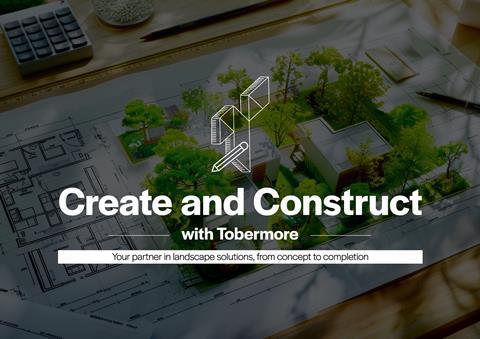
Create & Construct has been described as a major customer service initiative. What gap was it designed to address?
McAleer: Construction projects are incredibly complex, from early concept and planning through to construction and post-completion support. In my previous specification role, I saw how much support specifiers needed just at the early stages, and how many services we were offering in response to customer requests.
What became clear was that if I felt overwhelmed by how the different services we provided mapped against the specification journey, then customers working across multiple product categories must feel the same. Create & Construct brings everything together in one place, allowing customers to see clearly what support is available at each stage of a project and choose what they need.
Ease of use was clearly a priority in the platform’s design. Why was that so important?
McAleer: People are time-poor. We hear weekly from customers who say, “I wish I’d known about that service earlier.” Sometimes they don’t even know what support they need until they see it.
By allowing users to identify what stage they’re at in a project and immediately see what services are available, we make that support visible and accessible. It’s far more efficient than trying to talk someone through everything on a call, and it allows customers to engage with us when it suits them.
Which services are proving most valuable to specifiers?
McAleer: Our hard landscaping proposals in both 2D and 3D stand out. They allow us to work with a specifier’s design intent rather than replace it, mapping Tobermore products onto their drawings.
From there, customers can explore mood boards, samples, costings and sub-base requirements. It’s a strong starting point that helps move projects forward quickly and confidently.
Value engineering is often seen as a compromise. How does your approach help maintain quality and design intent?
McAleer: The key is that quality isn’t compromised across our product ranges. That gives specifiers reassurance that if a project can’t accommodate one product, we can provide alternatives that still meet the design intent and performance requirements.
Specifiers often over-specify initially to give themselves flexibility later. By engaging early, we can work with realistic budgets upfront, saving time and avoiding unnecessary redesign later in the process.
With SuDS requirements tightening, what challenges are customers facing most often?
McAleer: One of the biggest challenges is misconceptions around SuDS, particularly around cost and maintenance. There’s still a belief that anything other than traditional solutions is prohibitively expensive, which can limit design development.
By reviewing site conditions, investigation reports and CBR values, we can help landscape architects, civil engineers and housebuilders to identify solutions that are both compliant and realistic in terms of cost.

If Schedule 3 becomes law, how prepared do you think the industry is – and how does Create & Construct help customers stay ahead of compliance?
McAleer: Given that implementation in England has been repeatedly delayed since it was enacted in Wales in 2019, I don’t think the industry is fully prepared. There are multiple stakeholders involved in delivering compliant SuDS solutions, and coordination is critical.
We are definitely seeing a significant increase in enquiries and have appointed a permeable paving specialist to support customers in navigating these changes . Through Create & Construct, we provide site-specific designs showing appropriate sub-base requirements. Early engagement is key – the sooner customers involve us, the more effectively we can help them achieve compliant and cost-effective designs.
Looking ahead, what excites you most about this next phase of the business?
McAleer: What excites me is the opportunity to support more customers more effectively. When I joined, I was the only specification person covering Scotland, and it was frustrating knowing how limited my reach was.
This restructure allows us to focus our efforts properly and offer deeper support rather than spreading ourselves too thin. There are still many specifiers, contractors and groundworkers we don’t yet work with, and this growth gives us the ability to reach them and add real value through the support that we can provide to them.
As manufacturers respond to housing demand, regulatory change and increasing project complexity, McAleer argues that structure and early engagement are becoming just as important as capacity.
For Tobermore, investment in people, design support and technical expertise is intended to ensure growth only enhances its focus on customers - by enabling the company to be better able to respond to the sector’s changing needs.