















In the latest instalment of the series, the foundation, floor and walls of the house get attention
We cannot live in pure insulated boxes without windows and doors; nor can we ignore the fact of gravity. So, thermal bridges in buildings are inevitable. As standards for thermal performance become increasingly stringent, particularly at Passivhaus levels of performance, understanding and accurately modelling thermal bridging is becoming absolutely critical to accurately predicting the heat loss of a building. The current UK methodology - the Standard Assessment Procedure (SAP) - uses, in my opinion, a crude generalised assessment of thermal bridging, given as the “y” value.
Conversely, the Passivhaus planning package (PHPP) requires far more detail, including the entry of a linear thermal bridge heat loss coefficient (the PSI value) for every junction. Although this approach can be more laborious, it ensures a far more accurate prediction of building heat loss than with the normal SAP-based approach.

At Denby Dale we are using a combination of details to minimise thermal bridging within the foundations and floor, illustrated in the sections we supplied with the last blog. The cavity wall goes right the way down to the foundation strip, which inevitably results in a thermal bridge where heat is transferred from the solid concrete groundfloor slab through the internal leaf of the cavity wall into the ground and strip foundations below. To minimise the effect of this we are undertaking two key measures.
Below the slab level we are using a lightweight aerated 7N/mm² block, which doesn't transfer heat as readily as the standard concrete block.
Unlike typical foundation wall details, we are also ensuring that the 300mm insulation in the cavity goes right down to the strip foundation, so that any heat lost from the concrete floor slab will have a lot further to go.
Thresholds
Doorways and windows are inevitably going to be weaker spots in terms of thermal bridging. Walls in the Denby Dale House have a U value of 0.1 W/m²K and windows and doors are 0.8 W/m²K. It is important therefore that we pay particular attention to where the windows and doors are placed within the walls - in this case the threshold on the floor slab. We've decided, for the sake of adequate support for the sunspace windows and entrance doors, to take the floor slab through the cavity for a further 150mm to be able to hold a substantial Passivhaus-style door or window. We felt that it was worth sacrificing some of the insulation in order to have the structural stability for the doors and sunspace windows. This has been worked through on PHPP and has been deemed within acceptable parameters. In response to the suggestion about an insulated threshold fitted into a rebate in the slab, this is definitely something that would be helpful here but we haven't been able to find a product suitable for this - any suggestions welcome or perhaps we need to invent it!
On site
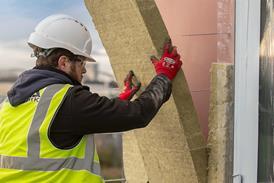
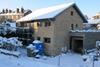
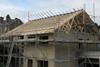
Progress is relatively slow because some of the team are finishing off other jobs elsewhere. To be honest I'm not worried, as it means we can pay particular attention to the detailing - Jude, Andrew and Callum have been doing a wonderfully neat job. We're building the walls from foundation strip up to the floor level. We've taken delivery of wonderful looking polystyrene slabs (300mm thick). The polystyrene is being cut in as big as slabs as we can manage, so that the airflow in the cavity will be an absolute minimum.At this point of the build, we need to take into consideration all the services coming into the building. To minimise thermal bridging and airtightness problems, we need to bring drains and services such as gas, water, electricity into the building in a careful manner. Our aim is to interrupt the thermal envelope as little as possible and to have services going into the building in positions which are easy to make airtight. To help minimise thermal bridging, we are bringing the drains in under the slab, rather than having exposed soil vent pipes outside coming through the wall. The gas and electric supply will have to come through the cavity into meter boxes, but they will be in such a position that we can maximise airtightness by using grommets bedded into the wet plaster.
Even the most minor aspect of the build has to be rethought in terms of airtightness and thermal bridging. For example, when bringing the drain into the bathroom, we want to make sure that it's far enough away from the wall to be able to see behind it so we can seal the joint. It would be difficult to seal around a 4 inch drainpipe that is right in the corner. This is where teamwork is vitally important in the build. Everyone within the construction team needs to understand what each subsequent trade is going to have to do, especially where airtightness and thermal bridging is concerned.




7 Readers' comments