












With the viability crunch causing housing numbers to crash, some developers are starting to look for different ways to reimagine projects. Joey Gardiner looks at some of the new – and old – forms being tried to get projects moving forward
Housing starts in London collapsed to just 4,170 in the year to April, according to government data, the lowest figure on record and just a quarter of the average for the last five years. Starts across the country are also sharply down. While some northern markets remain strong, it is no exaggeration to say that much of the residential development industry is in something of a crisis.
Increasing regulatory requirements, compounded by soaring materials costs, mean that in parts of the country the homes developers have traditionally produced now simply cost more to build than buyers are willing to pay.
The problem is particularly acute for sites purchased several years ago on the basis of disconfirmed assumptions, with one in six London sites now on hold, according to data from Molior last autumn.
Andrew Matthews, co-founder of housing architect Proctor & Matthews Architects, says his practice’s situation is shared by others in the industry “We have got projects, but they’re all on hold,” he says. “If you look at our order book, it looks very healthy, but actually, most of those projects are waiting for instruction.”
With build prices set to rise further in the wake of the Iran war, the problem is only going to worsen.
In the face of this, much of the industry focus to date has been on persuading the government to cut regulations or bring back support for first-time buyers.
Meanwhile some clients and designers are not passively waiting for government to ride to the rescue, but instead trying to tackle the crisis with a more radical reassessment of what they’re building. Designers are experimenting with forms, such as terraced back-to-back housing, that haven’t been used at scale in this country for many years, in order to make high-quality, high-density homes deliverable.
Doing so means moving away from the suburban houses and high-rise flats that have predominated in recent decades, and slaying some holy cows beloved by planners, funders and developers alike. So, what options are being looked at, and how do they change the viability equation?
What is the problem?
The two predominant development forms of recent times are both challenged financially in different ways. For traditional housebuilders building suburban homes at 30 dwellings per hectare, the simultaneous increases in build costs and regulation have made the relatively low site efficiency of this traditional style increasingly financially unsustainable. The Home Builders Federation says the combined impact has added £76,000 to the price of a home in the last six years.
Large areas of these schemes are given over to tarmac – roads and other infrastructure – for which the builder gets no return but pays a very high cost. Carl Venn, managing partner at architect Pollard Thomas Edwards, said that one typical suburban scheme it worked on had 39% of the site tarmacked, prior to redesigning it down to 9%, which “massively reduced the cost”.
“Housing data firm Zoopla reported last autumn that traditional housing sites were effectively unviable across half of the country”
David Birkbeck, chief executive of consultant Design for Homes
David Birkbeck, chief executive of consultant Design for Homes, says: “Redrow or Barratt house types will deliver homes at around 15,000ft² of development to the acre, whereas a [back-to-back terraced] scheme like Great Kneighton in Cambridge has 44,000ft² of development per acre.” Unsurprisingly, perhaps, housing data firm Zoopla reported last autumn that traditional housing sites were effectively unviable across half of the country.
Four ways to do housing differently
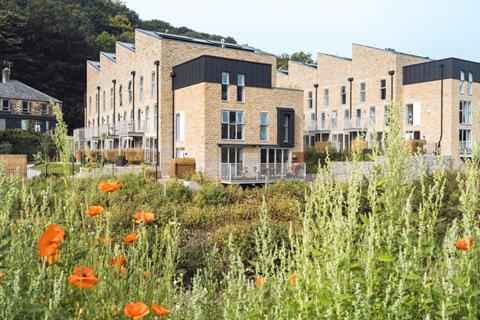
Concept/developer: Sky-House Co
Type: Back-to-back-four storey terrace
Density: 70-100 dwellings per hectare (dph)
Outdoor space: First-floor balcony and roof garden
Parking: Neighbourhood car parks close to homes
What they say about it: Usual street widths are squeezed to just 12m between house fronts, by the removal of cars, with shops built at the end of streets. “The system has broken. We’re doing something completely different” – David Cross, chief executive of Sky-House Co
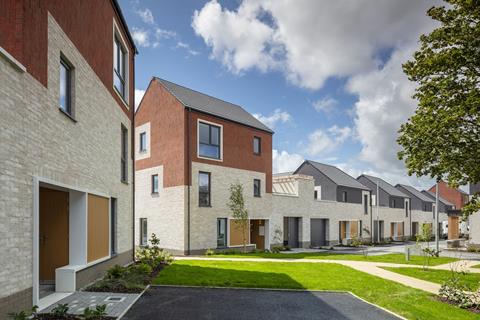
Name: Wilkinson Brook scheme for Glenveagh, by Proctor & Matthews Architects
Type: Two- and three-storey courtyard houses
Density: Circa 50dph
Outdoor space: Courtyard gardens and roof terraces
Parking: Carport integrated into ground-floor house
How it works: Courtyard garden set to the side of rear extensions. Usual street widths are squeezed to just 9m between house fronts by taking cars into the building. “A lot of our work is looking at much more sort of humane street widths … they start to get a sense of enclosure. And there’s a big cost reduction in infrastructure in that” – Stephen Proctor, co-founder, Proctor & Matthews Architects
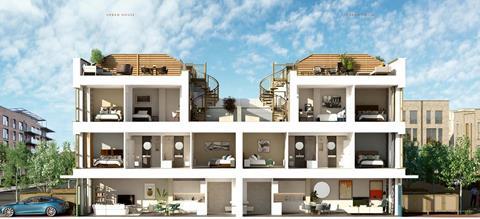
Name: Skyview, developed from Berkeley Urban House
Type: Three-storey back-to-back terrace
Density: 87dph
Outdoor space: Front-facing first-floor balcony and second-floor roof terrace
Parking: Off street in front of house
How it works: Back-to-back homes in which a first-floor back bedroom gets light only from a rooflight, but the second floor boasts a penthouse room and roof garden. “Barratt told me this doesn’t work. Well, I can take you to Kidbrooke, and I can show you 20 houses that have been built and sold in excess of £1m. If you had these in Surrey, they would fly out the door” – Peter Nesbitt, CEO of Evolving House
![NEIGHBOURHOOD NH 3 Bed B2B [HIGH-RES]](https://d3sux4fmh2nu8u.cloudfront.net/Pictures/480xany/6/1/8/2030618_neighbourhoodnh3bedb2bhighres_296231.jpg)
Name: Neighbourhood, by developer Capital & Centric
Type: Variety of back-to-back houses, including semi-detached and terraced forms
Density: Around 70dph
Outdoor space: Shared clustered gardens
Parking: Shared “car barns” away from house
How it works: Homes clustered around shared communal outdoor spaces maintained by the developer, making up for the lack of outdoor space on all but the largest properties. “This came about through frustration with the lack of innovation for such a long time in the housing market. No has asked, ‘is housing right in the first place?’” – Richard Spackman, development manager at Capital & Centric
The situation is more severe for apartment blocks. Not only do they face the regulatory challenges that houses do, but high-rises have also had to negotiate the issues with the new Building Safety Regulator. High-rise buildings reliant on lifts, cores and frames are inherently much more expensive than homes to build, so have been hit harder by price rises, while the need for additional means of escape, circulation room, lift space and M&E plant all eat into the sellable area.
In addition, the financing of the development is expensive and risky, requiring huge volumes of cash, while demand has collapsed due to weak investor appetite and concerns from occupiers about high service charges. Stephen Proctor, co-founder of Proctor & Matthews Architects, says: “Developers are telling us apartments are just not cost-effective at the moment. Even at medium density.
“A lift adds significant sums to costs. Then you’ve got to add circulation space to get to the apartments. All of the common areas need cleaning, maintaining and will have fire escape requirements. The initial cost and the service charges are really very significant. And it’s an ongoing management challenge.”
What is the answer?
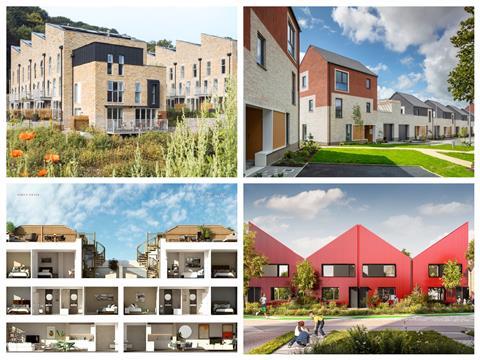
Several developers and designers are now reaching the conclusion, in different places and in different ways, that a compact, low-rise urbanism is the way forward (see “Four ideas for doing housing differently” panel above). While the responses to this challenge are multifarious, they share common features: they are based around tightly packed houses or maisonettes, avoiding the space inefficiencies and high build costs inherent in apartment blocks; they hit much higher densities than traditional suburban house types, often two or three times what would normally be expected; and they are no more than four storeys in height, so as not to require a lift.
David Cross, chief executive of Sheffield-based developer Sky-House Co, which is promoting exactly this kind of product, says the result is viable sites. “Our response is perfect for today. We’re not proposing some 50-storey tower where the cash flow is horrendous. We’re winning bids for land and we’re still buying and we’re still building.”
The Sky-House concept is terraced four-storey back-to-back properties, in which the lack of a garden and the single aspect is compensated for by not only floor-to-ceiling front windows, but also a balcony and a roof garden. Cross says his approach is modelled on the great Victorian terraces of his native Sheffield, and his firm is now delivering its seventh scheme.
Other examples of a similar approach include the Neighbourhood product being promoted on several sites by Manchester-based regeneration developer Capital & Centric. This also uses back-to-back house types but, for the most part, it doesn’t offer roof gardens, instead creating clustered shared gardens with a variety of facilities that are looked after for residents.
As well as harking back to Victorian terraces, the schemes also have an eye to more recent successes, such as Countryside’s Great Kneighton scheme in Cambridge, developed in the teeth of the 2008 financial crisis, which pioneered the modern use of back-to-back forms. Design for Homes’ Birkbeck says: “What Countryside did was go back to the drawing board. Tony Travers, who was the regional MD, he literally said, ‘Come on, back to the drawing board; we need to design in viability’. In the end it became their most successful ever scheme.”
It is not only compact terraces that are being trialled. Andrew Matthews says his firm, one of the original designers at Great Kneighton, is also working on back-to-back stacked maisonettes – essentially, four-storey buildings in which you put one two-storey house on top of another. Both have their own front doors, meaning there are no common parts generating a big service charge, and no lift requirement.
“There were maisonettes of this type historically. This is not a new typology. Clients are starting to realise there are mansion blocks across London that function perfectly successfully, where people walk up,” he says, adding that recent accessibility standards requiring lifts for home entrances above ground floor should be eased.
How does it impact viability?
These solutions are designed to help viability in two ways. Compared with traditional suburban products, the increase in coverage – sellable area – means that sites can generate higher sales. Compared with apartment blocks, these forms reduce build costs and financing costs while retaining reasonable density, benefiting the viability equation.
Richard Spackman, development manager at Capital & Centric, says its schemes are typically built at 70 dwellings per hectare, while Sky-House’s Cross says his projects can deliver anything up to 100 dwellings per hectare. “We’ve got a variety of typologies, which improves densities and makes the schemes more viable,” says Spackman.
According to David Birkbeck: “Apartment builders can’t create any land value. They’ve got build costs of £4,500/m², compared to £2,250/m² for traditional housing,” he says. “Essentially, you’re halving your build cost, and your net to gross ratio of sellable area is going back up to 100% And you can see how it works economically. It’s just a question of having the guts to do it.
“Nothing’s coming out of the ground; we have to do something radical.”
Richard Abbott, project director at consultant Stace, says a number of clients are asking how to reprofile sites allocated for apartments in the current market, including one 1,000-home apartment site he is working on. “Tall schemes are being challenged. If you’re building houses at much higher space efficiency, you might get 600 homes on that site that people actually want and you can sell.”
“Nothing’s coming out of the ground; we have to do something radical”
David Birkbeck, chief executive, Design for Homes
It is not just the density – while the build costs of such schemes are comparable to traditional suburban build, there are also savings to be made from the fact that only one wall in a back-to-back requires an external build-up.
Peter Nesbitt, a former long-time divisional MD at Berkeley Group, is another who is promoting such ideas. He says the density of his Skyview back-to-back terrace is equivalent to a six-storey block of flats – but at a fraction of the build costs and without generating high service charges. “With all the issues of common parts with apartments, this is a no-brainer,” he says. “It’s got to be a no-brainer.”
Radical change
But doing this requires a radical break from preconceptions of what buyers like. Back-to-back homes are associated with the worst of slum Victorian housing, with many cleared after the Second World War. And many also go against the grain of recent regulation – such as recommended street widths and the Greater London Authority’s prohibition of single-aspect homes.
The products designed by Proctor & Matthews and Sky-House, for example, not only squeeze space by making properties back-to-back – they also squeeze the distances between the frontages of homes facing each other across a street, from the more than 20m typically seen on housebuilder sites, to as little as 9m in the case of the Proctor & Matthews design. This requires alternative arrangements being made for cars – such as car parks at a distance from homes – but the designers say this makes the neighbourhoods more attractive and walkable.
Peter Nesbitt’s Skyview product is based on the Berkeley Urban House he worked on that the listed developer sold on its Kidbrooke scheme. While Berkeley has since stopped production of the house, due to pulling out of the modular factory it set up to build it, Nesbitt says the failure of the factory says nothing about the design.
Another back-to-back with a roof garden, Nesbitt’s concept extends the idea even further by putting a bedroom at the back of the house, where the only natural light comes in via a rooflight – something his colleagues told him buyers wouldn’t accept. Discussing the 22-home Kidbrooke phase, he says: “People loved it. We made £5m more profit by just doing that small part of the site. It went down a storm. The combination of the rooflight and the roof garden really made this a very very saleable product.”
The suspicion of many in the industry is that these kinds of products remain exceptions that can work in certain conditions, but would never be appropriate for the mass market – which prioritises a traditional rear garden and off-street parking over fine urban forms and walkable neighbourhoods. Matthews admits: “The criticism of Great Kneighton was always ‘of course you can do this in wealthy Cambridge, that’s well and good, but it won’t work anywhere else’.”
But then the practice repeated the exercise for Irish volume housebuilder Glenveagh in Dublin at its Wilkinson Brook development. “We were really pleased when Glenveagh came to us from Ireland, said, ‘Look, we want to have the same aspiration as Great Kneighton, but we’re in the flight path of Dublin City Airport, and it’s pretty low value.’
“We took it on to the next stage, really, to demonstrate that you can do the same things, but at lower cost.”
Likewise, Sky-House’s Cross says his company has had “all sorts” of different buyers. “We’ve sold to the young, the old, families, divorcees – there’s no pattern.”
Jonathan Gimblett, development consultant at HLME and, as a former executive at Countryside, one of the people involved in Great Kneighton, says he sees a sad lack of product innovation among volume housebuilders. “I think the mainstream industry, with everything else happening, has forgotten product,” he says, pointing out that Countryside founder Alan Cherry used to see the product as a key to motivating buyers in a tough market. “Previously, great schemes came out of a recession. But the industry is massively de-skilled from where it was. No one is doing anything particularly different. Where’s the incentive to buy?”
Clearly, these are ideas that may not work – or be needed – on every site. But there could be a chance for this kind of innovation to be given more opportunity.







No comments yet