















A roundtable hosted by Building at UKREiiF in Leeds last month explored how the government’s devolution initiatives are reshaping regeneration and what still needs to happen for the sector to deliver at scale
Regional regeneration in the UK is entering a new phase – one shaped by devolution, shifting governance structures, and a renewed focus on collaboration. But while the tools available to local and regional authorities have expanded, so too has the complexity of the landscape.
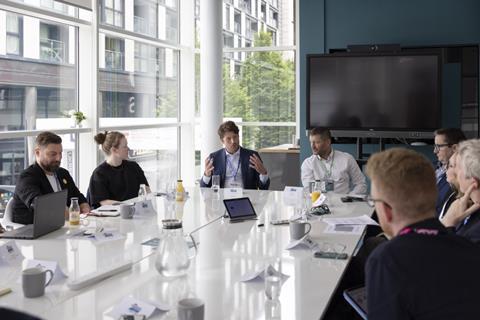
At a roundtable run by Building magazine at UKREiiF last month, senior figures from across the sector explored how the government’s devolution initiatives are reshaping regeneration, and what still needs to happen for the sector to deliver at scale.
What emerged was a predictable cautious optimism: a sense that the UK may finally have the ingredients for meaningful, sustained regeneration, but also a recognition that political instability, fragmented governance, viability challenges and infrastructure delays continue to hold some places back.
Looking out from the first floor of P+HS Architects’ distinctively colourful dockside office in Leeds, the view of thousands of delegates weaving between venues was a reminder that successful regeneration must make meaningful improvements for people. As if to underline the point, music from a local community flash mob played out beneath the meeting room as the panellists began talking about how authorities can now raise their game in line with their powers.
Devolution as a game‑changer
Devolution has fundamentally altered the trajectory of regeneration, particularly in regions with established combined authorities.
Lee Arnell, head of place and regeneration programmes at Leeds City Council, described devolution as “game‑changing for Leeds and West Yorkshire”. He pointed to the South Bank, where around 4,000 to 4,500 homes have been delivered since UKREiiF first launched in 2022. Without devolution, he argued, the majority of those homes simply would not have been built.
For Arnell, the contrast of the current funding landscape against the 2010 UK quango reforms is stark. “It really felt like there was a death of funding for regeneration. From a local authority perspective, you were almost like pigeons competing for crumbs.” Devolution, he said, has replaced that scarcity mindset with a more strategic, long‑term approach. While he acknowledged public-private partnerships as “clearly critical” to this strategy, he spotlighted public-public partnerships across public financial institutions as the main catalysts for growth.
But devolution is not just about funding powers. As Nicola Rigby, principal at Avison Young, put it: “We fall into the trap of thinking it’s just about funding. Funding is huge, but devolution is a way of working, a long‑term commitment to how we operate at a local level.”
It really felt like there was a death of funding for regeneration. From a local authority perspective, you were almost like pigeons competing for crumbs
Lee Arnell, head of place and regeneration programmes, Leeds City Council
Rigby argued that the most successful devolved regions, notably Greater Manchester, have benefited from years of “steadfast” voluntary collaboration before formal devolution. In the case of Greater Manchester, this was facilitated through the Association of Greater Manchester Authorities agreement – a voluntary partnership formed in 1986 by the 10 Greater Manchester councils after the abolition of the metropolitan county councils.
However, unlike Manchester, some other combined authorities are only just forming, with regions undergoing local government reform facing an even steeper climb.
Rigby cautioned that “local government reform is fantastic, but it’s not a short‑term solution. It’s a long‑term commitment to place.” The risk, she said, is assuming that structural change automatically delivers clarity.
Matt Woolgar, development director at Igloo Regeneration, echoed this concern. With local government reorganisation under way in Hampshire, he noted that “the idea of removing some of the hierarchy of that decision-making seems like a really positive thing but, equally, I hear quite a lot about how it doesn’t always work out like that in practice.”
Peter McDermott, professor of construction procurement at the University of Salford, agreed, noting that devolution is helping to rebuild the strategic capacity lost during the “bonfire of the quangos”. But he also warned that the term itself can be misleading. “The problem with the word ‘devolution’ is that it implies breaking things down, yet everything we’re talking about is bringing things back together again.”
The academic also described the delay between political commitment and on‑the‑ground action as “a well‑documented gap between the original investment decision and getting on delivering”, and suggested that a governance restructure can help bridge it, but only if regions maintain the stability and collective discipline needed to make decisions stick.
But Gavin Mason, operations director at Pick Everard, warned that devolution does not necessarily remedy the viability challenge. He described schemes being slowed down by “conflicting interests within the LPA [local planning authority], within the GLA [Greater London Authority] … all the stakeholders feeding into the process”. The result, he said, is that projects spend years trying to “derogate away from a whole range of policy” just to reach an acceptable solution.
Mason argued that devolution will accelerate delivery only if it brings greater policy alignment, noting that “you cannot build these buildings asking for absolutely everything”. With local and regional standards often in conflict, particularly around affordability and design requirements, he advocated for “harmonised policy” so developers can work within a framework that is “reliable and effective,” rather than one that leaves schemes stuck in viability limbo for years on end.
Avison Young’s Rigby argued for a pragmatic approach to affordable housing and viability, saying that while affordable housing is important, requiring too much too soon can stall development altogether. She contrasted London – where strong affordable housing requirements are said to be holding back development – with Manchester, where the council initially prioritised growing the city-centre residential population and attracting private investment first. She said: “You can’t always deliver everything that people need right now… It can stop development happening. And actually, development happening is one of the most important things because it creates momentum; it creates value.”
Mayoral development zones
One of the clearest signs of how devolution is being translated into delivery came with Leeds’ announcement – made just a day before the roundtable discussion – of a new mayoral development zone (MDZ) covering the city centre.
Arnell described the move as a direct response to an increasingly “congested” policy and funding environment. The MDZ model, he explained, will create a “single front door for investors” by co‑locating Leeds City Council, the West Yorkshire Combined Authority, and support from Homes England and the Ministry of Housing, Communities and Local Government into a single Leeds Growth Team.

However, Phil Bentley, director at P+HS Architects, asked if investment concentrated in core cities like Leeds, Manchester and Newcastle will “naturally” trickle down to smaller places like Wakefield, Calderdale and Halifax, or leave them behind.
For Rigby, MDZs represent a shift in mindset as much as a shift in structure. “What that signifies is we need to work differently to unlock regeneration investment. It’s about how we make it easier for the private sector to invest in the places where we need them to invest.” She noted that several regions, including Newcastle and Gateshead, are exploring similar models as a way of aligning planning, infrastructure, land assembly and funding decisions.
We fall into the trap of thinking it’s just about funding. Funding is huge, but devolution is a way of working, a long‑term commitment to how we operate at a local level
Nicola Rigby, principal, Avison Young
Brian McArdle, chief operating officer at Gleeds, argued that national agencies are also adapting to the devolved landscape. Homes England, he said, has shifted from a centralised model to one that reflects regional priorities. “They’ve had to create local teams to liaise with local government and combined authorities,” he noted.
Simon Marks, chief executive for the Midlands at Arcadis, argued that MDZs help tackle one of the most persistent barriers to regeneration: fragmentation. “The opportunity to simplify, join up, and expand out to other stakeholders is a real bonus of the devolution process.”
He explained that the new Birmingham East Mayoral Development Corporation (DC) will operate within a wider MDZ and represents “£10bn worth of regeneration opportunity” across areas such as Digbeth, the Knowledge Quarter and the Sports Quarter. The announcement, made by mayor Richard Parker during UKREiiF, was described as a major step forward. “We will see the powers go in, we will see the funding go in [and] a way of working established around that DC that will see Birmingham turbocharged over the next 10 to 15 years.”
But the ambition goes beyond city‑centre growth. Estate renewal schemes such as Druids Heath and Ladywood – delivering thousands of new homes – were highlighted as examples where devolution must support both the “big towers” and the neighbourhoods that surround them. “You have to take a holistic approach across a place,” Marks concluded.
Social value
This big-picture approach to regeneration was championed by the panellists, who agreed that the real measure of success is whether communities feel the benefit in their daily lives, particularly through affordable housing and healthier communities.
Rigby captured the shift in the sector’s priorities over the past two decades, noting that regeneration has moved beyond design‑led masterplans and delivery targets. “For the last 15 years it’s been very much delivery focused,” she said, “but now… regeneration has to have a really profound social impact… delivering benefits for people on the ground.” That evolution, she argued, is reshaping how partnerships are formed and how funding is deployed.
Arnell echoed this, emphasising that affordable housing and community outcomes sit at the heart of Leeds’ regeneration strategy. He said his team works extensively with registered providers to increase affordable housing, with the city’s devolution deal enabling new partnership models to accelerate delivery.

Meanwhile, Hans Jansen, lead concept designer at Permasteelisa Group, added that devolution can deliver the type of housing that communities actually want by bringing public and private sector interests together. “I don’t think you can leave it to the private sector… there always needs to be a big public‑sector part of it.”
Bentley brought a health‑led perspective, arguing that regeneration must be rooted in wellbeing. His work on hospitals and coastal communities has shown how “healthy living with healthy communities” can underpin wider economic and social renewal.
The problem with the word ‘devolution’ is that it implies breaking things down, yet everything we’re talking about is bringing things back together again
Peter McDermott, professor of construction procurement, University of Salford
Pete Stead, technical director at P+HS Architects, reinforced this, noting that the technical side of regeneration – refurbishment, repurposing, cladding remediation – is increasingly central to creating safe, sustainable homes.
He also highlighted how the supporting infrastructure around schemes, such as mass transit, can help tackle the skills and recruitment challenges. “One of the blockers to the talent recruitment process is people being able to access places to work through public transport.”
While pointing to Manchester and London as exemplifying efficient integrated transport systems, he said: “Until other parts catch up with that, we’re always going to struggle in terms of how we recruit, retain talent and also attract people to live in different places.”
Transport is the ‘icing on the cake’
But how can those responsible for delivering regeneration answer the chicken-and-egg question posed by mass transit infrastructure that takes time to deliver but on which peripheral development also relies?
Arnell responded that good strategic planning can mitigate this. “Sometimes you see infrastructure as the cake, [but] I see it as the icing or the cherry on the cake.” He pointed to the South Bank, where regeneration continued despite the infamous HS2 delays and cancellation. “We built around it… we’re not sat going ‘HS2 ruined the South Bank’.”
Rigby argued that the public sector having a “really robust vision and sticking to it” can boost private sector confidence. She said that, from a private investor perspective: “If you really, really believe it’s coming, you will invest on the back of it.” Development and infrastructure, she noted, now tend to progress in parallel rather than sequentially.
Marks added that devolution helps align transport and housing strategies. In two‑tier systems, he pointed out, “you’ve got transport at county level and housing at district level”, making co-ordination difficult. Devolution simplifies this, enabling regions to “get the housing in the right place, get the growth in the right place, get the infrastructure in the right place”.
A moment of opportunity
The UK stands at a pivotal moment for regeneration. While devolution may offer new powers, new funding tools and new ways of working, those levers only matter if they translate into better lives for those on the ground.
Amid the celebrations and visions of the progress that devolution could bring, authorities must now focus on turning plans into places by bringing coherence to a crowded policy landscape, aligning public and private ambition and holding a steady course through political cycles long enough for residents to feel the benefit.
As Arnell put it, regeneration is like “flavours of ice cream – each place has its own strengths.” Devolution gives regions the chance to choose their own flavour. The challenge now is to serve this to communities.
Around the table:

- Lee Arnell, head of place and regeneration programmes, Leeds City Council
- Phil Bentley, director, P+HS Architects
- Hans Jansen, lead concept designer, Permasteelisa Group
- Simon Marks, chief executive for the Midlands, Arcadis
- Gavin Mason, operations director, Pick Everard
- Brian McArdle, chief operating officer, Gleeds
- Chloë McCulloch, editorial director, Building (chair)
- Peter McDermott, professor of construction procurement, University of Salford
- Nicola Rigby, principal, Avison Young
- Pete Stead, technical director, P+HS Architects
- Matt Woolgar, development director, Igloo Regeneration






No comments yet