














Levitate’s refurbishment of Trevor Dannatt’s 1959 Vaughan College demonstrates how careful retrofitting and minimal interventions can deliver a modern museum without compromising an important piece of Leicester’s mild brutalist architecture. Owen Hatherley reports
Many British cities – including anywhere with a “chester” or a “cester” in its name – are former Roman colonial towns, but they fall into two distinct types. There are those which obsessively conserve every trace of the past, and bitterly refuse the new, bar for chain stores and cars – think York, Bath, Chester – and there are those which are every bit as old, every bit as full of antiquities if you know where to look, but are also constantly constructing and rebuilding.
London is the most obvious of these, but Leicester is another.
Founded as Ratae Corieltauvorum in the 1st century, Leicester is a city with an almost complete medieval street plan largely lined with big, flamboyant Edwardian buildings, all enclosed by a ruthless 1960s ring road; its monuments include an Anglo-Saxon church, a dramatic Lutyens war memorial and James Stirling’s peerless Engineering Building; it is surely the only place in Britain with both a space museum (a goofy, fittingly Buckminster Fuller-esque design by Grimshaw), a museum dedicated to Richard III, and a Roman museum.
The latter is made possible by the fact that Leicester has, as Pevsner wrote in the 1960s, more conspicuous Roman remains than any other British city. It is at once one of the youngest of cities, in terms of the age of its population, one of the most multicultural (a decade or so ago, it was the first British city to become majority-minority), and one of the most obviously ancient. Everything has happened here, and you can see all of it at once.
The Jewry Wall Roman site
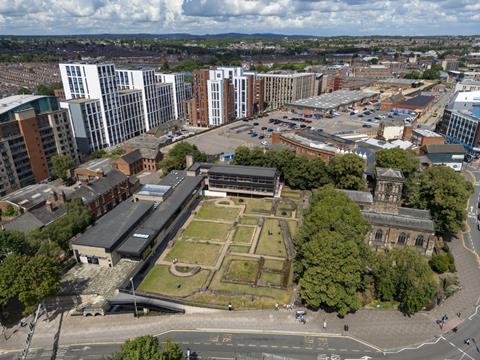
The city’s major Roman site is Jewry Wall, a large brick, stone and tile complex which stands to much of its original height, in front of the excavated foundations of the Roman town’s public baths. In an example of the sort of historical symmetry that seems to happen here a lot, the baths were excavated in the 1930s by Kathleen Kenyon – better known for her work in the Middle East – when the city planned a new public swimming pool on the site.
The Jewry Wall itself did not need to be dug out of the ground. It had long been a monument in the city, preserved through use as a retaining wall for the Anglo-Saxon St Nicholas Church. In its height and mass, it is probably the largest Roman monument surviving in urban Britain. But nobody quite knows what it actually is.
Kenyon wrongly thought it was part of the town’s forum (which was then discovered elsewhere, a few decades later); the current thinking is that it is one wall of a palaestra that was attached to the baths complex, and the rest of the building was recycled into materials for the adjacent church. Its name, in use since the Middle Ages, is also wholly unexplained – theories have ranged from a reference to the Jewish community of the city, to jurors and judges, and to the Roman god Janus, all of them wholly unproven.
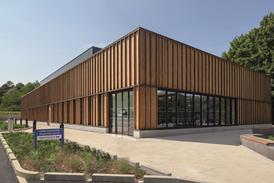
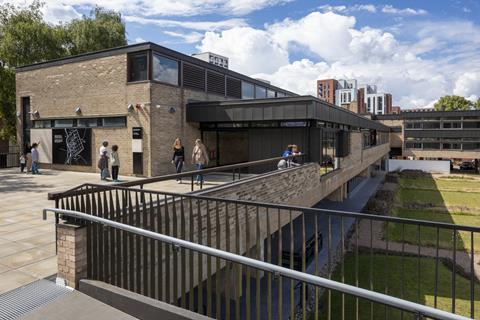
Today, it is flanked by that aggressive 1960s ringroad, and framed by a long, low, L-shaped concrete and brick building.

Trevor Dannatt’s 1959 dual-purpose design
This was designed in 1959 by Trevor Dannatt, with a dual purpose – on the upper floors and the shorter part of the “L” was Vaughan College, a long-standing adult education institution, one of the many workmen’s colleges and mechanics institutes of the Victorian era, and on the bottom floor – beneath the ringroad, but on the same level as the bathhouse foundations – was a Roman museum. This was intended to provide a viewing space for the ruins, alongside a gathering together of the city’s various scattered Roman mosaics, sculptures and wall-paintings.
It was listed, in 1993, long before brutalism came back into fashion. In 2013, the college was absorbed by Leicester University, which soon closed it down (it still exists, just, as a small co-op, offering non-accredited degrees); in 2014, the council bought the site, planning to expand the Roman museum; a decade, and some tortuous experiences with contractors later – the first contractor, NMCN went bust and was replaced by Jeakins Weir – along with budget increases, it finally opened at the end of July 2025 as the Jewry Wall Museum, advertised as a “real Roman experience”.
It is highly unusual, and highly interesting as an example of combining modernism and archaeology, and demonstrating that the two are not necessarily hostile.
Levitate’s sensitive refurbishment
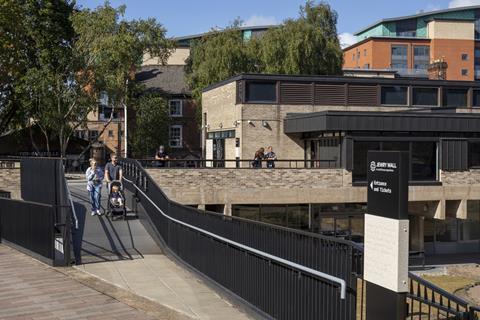
First of all, the refurbishment and replanning of the public spaces, by Levitate Architecture and Design, add only a little new fabric to Dannatt’s building – there is a new pedestrian bridge from the ring road enabling level access, and it is sensitively handled, an unfussy steel walkway that works well with Dannatt’s brusque brutalism. Inside is a large cafe, with a permanent, free public view of the wall and the bathhouse, a gesture that feels all the more important given the museum is ticketed, and not cheap.
This cafe was carved out of the college’s amateur dramatics studio, and opposite, the shop is in the former library, using Dannatt’s original bookshelves and reception desk. It is all very tactful, using Dannatt’s spaces without reducing them to retro kitsch.
When NMCN went bust, the council appointed Maber Architects (already well known for its work on the King Richard III visitor centre and the city’s New Walk Museum) initially to complete the work that Levitate had begun and to solve the many conservation issues that still required listed building approval.
There is absolutely no possibility that this could have happened without the building being listed, an important thing to remember today, given the many recent refusals of 20th-century buildings for listing. In the very mixed company of British brutalism refurbishments, it is much more a sensitive, thoughtful National Theatre or Preston Bus Station than a bungled and botched Park Hill or Balfron Tower.
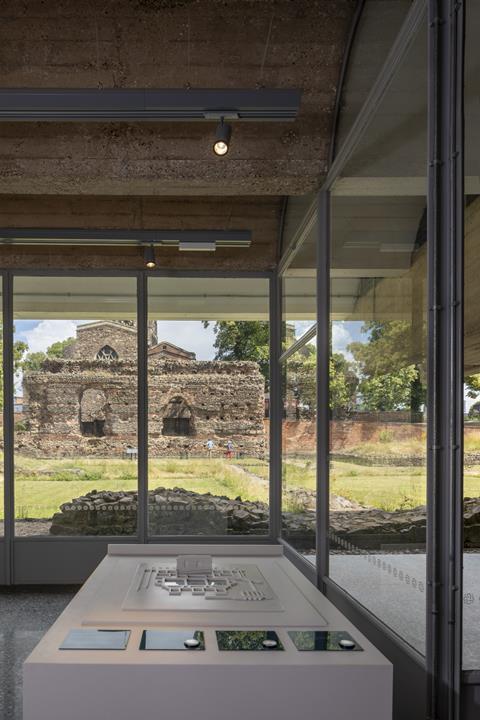
Vaughan College was always very mild brutalism, with much raw concrete but on a self-effacing scale, designed to frame the ruins, not dominate them; it is a continuation of ideas from Dannatt’s slightly earlier College Court at Leicester University (itself renovated successfully a decade ago, as a conference centre), with a miniature archaeological park instead of a quadrangle.
The dual purpose is visible in the elevations, with that bottom level hauled up on thin, protruding concrete piers – with a touch of Louis Kahn and a touch of pre-modernist Japan – so as to not damage the boiler house of the old baths, which lies below. The result much more resembles the modernist Roman museums of, say, Cologne or Thessaloniki, than more kitsch British equivalents such as the Asda-style Verulanium Museum in St Albans.
Ancient and modern are side by side, and why not? The Romans were, after all, lovers of heavy engineering, repetition, scale – and concrete.
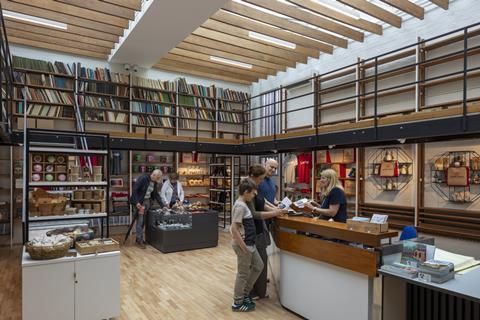
Visitor experience and exhibition spaces
Past the cafe, you are led into a set of large double-doors, and an apparently empty room. This was once the main hall of Vaughan College, and now it is the obligatory immersive experience, the thing you are apparently paying your £12 for.
A film, projected on all four walls, designed by Heritage Interactive, tells a pointedly multicultural story of Roman life in Ratae Corieltauvorum, with scrupulously accurate history and scrupulously anachronistic East Midlands accents. Then, you walk down into Dannatt’s original museum proper.
Sketchy, scribbly animated sequences are projected on to the walls, and distract from the actual exhibits. These are fascinating, but as with most remnants of Roman Britain, deeply amateurish compared with anything you would find in the empire’s real centres, around the Mediterranean, the Adriatic and the Aegean.
Britannia was a backwater, the most minor and remote of the empire’s colonies, and it always shows. Yet the wall itself, and the bathhouse foundations, are always visible as you walk around these gallery spaces.
Dannatt’s concrete vaults, firmly 1960s but subtly evocative of Roman building, have been cleaned, rather than – as they surely would have been if the complex were not listed – painted: the result retains an atmospheric intrigue. Similarly, Dannatt’s small details such as the terrazzo floors, have been newly revealed after years of ad hoc municipal repairs.

Photos of the museum in the 1960s show that Dannatt envisaged a much clearer internal space, without these newly added partitions for projections. It is easy to see why this has been done. Given so little of Roman Britain is spectacular, appreciation of it involves using your imagination, something all the films and animations desperately work against.
Thousands of bored schoolchildren will now at least have some films to watch, but then it is highly puzzling that museums across Britain have decided that the Roman empire is a subject primarily for children. The archaeological finds here are remarkably macabre.
One of the most beautiful objects is a bronze key handle, on which an old, bearded man, lifted into the air by four naked boys, is in the process of having his face eaten off by a lion. Nearby, a near-complete wall painting from a private house – an astonishing find anywhere in Britain – was graffitied at some point in the process of the empire’s collapse, with insults including an accusation that the house’s owner kept a “catamite”. Explain that word to your children, or your pupils.
Although it does not justify it entirely, the greater clutter can also be explained by the collection simply growing larger. Because Leicester is constantly rebuilding itself, there is a continuous stream of new Roman finds – a fragmentary mosaic, a statuette, a wall painting, might be found as space is cleared for the newest mall or the latest egregious block of student flats.

A model of heritage-led regeneration
Leicester is, quietly, one of the most interesting cities in Britain, and for the most part, Jewry Wall Museum does it justice. It has numerous flaws: the treatment of the Vaughan College by the city and the university was shabby, and the forcing out of institutions like it in favour of giant, globalised, megabucks universities is not something to be proud of. The video content is often patronising, and as is so typical in British museums, the need to attract kids and their parents makes it difficult to find the peace and space to really appreciate the ancient and weird real objects that are the ostensible attraction. And a municipal museum should not be charging people, especially not local residents, to see the collection their taxes supposedly pay to maintain.
These – depressingly commonplace – objections aside, this is an excellent project. At a time when “migrant” is effectively used as an insult, Jewry Wall celebrates the movement of peoples, and at the same time, it celebrates the deepest layers of local history, one that long precedes Anglo-Saxon settlement. It is a celebration of a city that is both constantly changing and where the layers of history are constantly visible.
Leicester is a modernist city that has never been a tabula rasa, and a historical city that has never been, and will never be, a museum. This is what real cities, and real history, are about, and this refurbishment, where brutalist concrete and Roman masonry are lined up together with tact and elegance, shows that a complex place need not be an ugly, or a careless one.
I left the museum feeling optimistic about this city, and this country – and in these days of gloom mongering, that goes for a lot.
Project team
Client: Leicester City Council
Architects: Phase I (concept and scheme design): Levitate. Phase II (conservation, detailed design and client design advisors): Maber Architects
Contractor’s architect: pHp
Structural engineer: Entuitive / BWB Consulting engineers / BSP Consulting
M&E consultant: Arcadis / CPW / Teper
Cost consultant: Arcadis / Pulse
Main contractor: NMCN Limited, Jeakins Weir





No comments yet